Construction LD Clauses: What GCs Need to Know (Oct 2026)
This October 2026 guide breaks down construction liquidated damages: LD rate math, enforceability, and the records GCs need to win delay disputes.
A liquidated damages clause looks simple on the surface: a dollar amount per day, a completion date, and a collection method. But the details buried in that language—what counts as substantial completion, whether there's a cap, how excusable delays are handled—can make a real difference to your bottom line when a job runs long. Here's what to look for before you sign.
TLDR:
-
Liquidated damages are a fixed daily rate both parties agree to before signing, capping your delay exposure at a known number instead of leaving it open-ended.
-
Courts apply a two-part test to LD clauses: damages had to be hard to estimate at signing, and the rate must reflect a genuine pre-estimate of loss, not a penalty.
-
Calculate the daily LD rate by adding the owner's lost revenue, extended financing costs, and supervision overhead, then documenting the math so the number survives a challenge.
-
Your strongest defense against an LD charge is a contemporaneous record that timestamps every delay event with its cause, built in real time, not reconstructed after the fact.
-
Constructable's Daily Logs auto-capture weather by zip code and categorize delay causes, so the documentary record courts rely on builds itself as the job runs.
What are liquidated damages in a construction contract?
Liquidated damages, usually shortened to LDs, are a dollar amount both parties agree to upfront as the owner's compensation if the project runs late. The number sits in the contract as a fixed daily rate, and it kicks in the day you blow past the substantial completion date. No fight over what the delay actually cost. The clock just starts, and every calendar day carries the same agreed price.
That word "liquidated" matters. It means the damages are settled and known in advance, which is what separates a valid LD clause from a penalty. A penalty punishes you for being late. An enforceable LD clause estimates a genuine loss the owner expected to face.
Liquidated damages vs. unliquidated damages
The difference comes down to who has to prove the loss. With liquidated damages, the number is already fixed, so the owner never opens the books. With unliquidated damages, no rate exists in the contract, and the owner has to prove the actual loss after the fact in court or arbitration, receipt by receipt.
Say a hotel finishes 30 days late. Under an LD clause set at $2,000 per day, the owner collects $60,000, full stop. Without that clause, the owner has to document real losses, lost room revenue, extended financing costs, staff already hired, and convince a judge the math holds up.
The regime you operate under is set the day you sign, so understanding construction contract types before you sign matters. Check whether your contract names a daily rate; if it does, your exposure is capped and predictable. If it stays silent, your exposure is whatever the owner can later prove, and that number is harder to see coming.
| Liquidated Damages | Unliquidated Damages | |
|---|---|---|
| Rate set in contract? | Yes: fixed daily rate agreed before signing | No: no pre-set rate in the contract |
| Who proves the loss? | Nobody; the agreed rate applies automatically | The owner must document and prove actual losses in court or arbitration |
| Contractor's exposure | Capped and predictable (daily rate × delay days) | Open-ended; whatever the owner can prove after the fact |
| Example (30-day delay) | $2,000/day × 30 days = $60,000, full stop | Lost room revenue + financing + idle staff, proven receipt by receipt |
| Owner's burden | None at collection; the clause does the work | Must reconstruct and document every cost element post-completion |
| Cap on total exposure | Negotiable (e.g., 10% of Contract Sum) | None; capped only by what the owner can prove |
Why liquidated damages clauses exist: the financial stakes of delay
Owners write these clauses because delay is the norm, not the exception. Research across North American projects found that 98% of construction projects face some delay, with durations running an average of 37% longer than first projected. Owners and subcontractors alike absorb that risk when no LD clause defines the exposure. An owner planning around a completion date knows the odds are stacked against hitting it.
That late finish carries real costs. Construction loans keep accruing interest past the date the owner expected to stop paying. A retail tenant who planned to open in March sits dark, collecting no rent. A hospital wing that isn't ready pushes back staffing, equipment, and every downstream schedule tied to it.
The LD rate is the owner's attempt to put a number on that exposure before anyone signs. Instead of gambling on proving those losses later, the owner fixes a daily figure that reflects what each day of delay is expected to cost.
How to calculate liquidated damages in construction
No universal formula sets the LD rate. The number has to trace back to the owner's real anticipated losses, and the method comes down to a few steps you can work through before signing.
-
Add up the owner's expected daily costs of a late finish: lost rental or operating revenue, extended financing and loan interest, and the cost of keeping supervision and overhead running past the deadline.
-
Aggregate those into a single per-day figure.
-
Where losses tie to the full contract term, divide the total anticipated loss by the contract duration to allocate a proportional daily amount.
Take a $10 million office building. Lost rental income while tenants can't move in runs roughly $6,000 a day, and extended financing adds another $2,000 to $3,000 in daily interest. Add supervision and carrying costs, and a rate of $8,000 to $10,000 per day becomes defensible.
The math is straightforward; what matters is the paper behind it. A rate you can document survives a legal challenge, while a round number pulled from nowhere invites the argument that the clause is a penalty. The same principle applies to what a change order is: undocumented scope changes can blur who caused the delay.
What makes a liquidated damages clause enforceable
When you challenge an LD clause, courts almost always run the same two-part enforceability test. First, the actual damages had to be genuinely hard to estimate at the time the contract was signed. Second, the rate has to be a reasonable pre-estimate of the loss the owner probably faced, not a number designed to punish.
Fail either half, and the clause is vulnerable. If the daily rate turns out grossly disproportionate to any real damage, a court can strike it as an unenforceable penalty and send the owner back to proving actual losses.
This is why you see the phrase "as liquidated damages and not as a penalty" written into the clause itself. That line is deliberate legal strategy, a signal that both parties intended a genuine estimate. It is not filler.
The catch is that state rules vary, sometimes sharply. Have a construction attorney review any clause before you sign.
Sample liquidated damages clause in a construction contract
Contract language for LDs tends to follow a predictable shape. Here is a representative clause:
The Contractor shall pay the Owner five thousand dollars ($5,000) for each calendar day that substantial completion extends beyond the Contract Time, as liquidated damages and not as a penalty. Such amounts may be deducted from progress payments otherwise due. Total liquidated damages shall not exceed ten percent (10%) of the Contract Sum. Delays caused by events beyond the Contractor's control shall entitle the Contractor to a time extension.
An AIA change directive is one common mechanism owners use to direct work while scope is still being resolved.
Each piece does specific work:
-
Trigger: substantial completion past the Contract Time.
-
Daily rate: a fixed per-day figure backed by your calculation.
-
Penalty disclaimer: "not as a penalty" language that signals a genuine pre-estimate.
-
Cap: 10 percent of the Contract Sum, if you negotiate one.
-
Excusable delay: language that preserves your right to a time extension.
-
Collection: usually deduction from progress payments.
AIA contract documents cover liquidated damages provisions, and any clause you actually sign should be reviewed by legal counsel.
The trickle-down effect: liquidated damages in subcontracts
When you sign a prime contract carrying an LD clause, you inherit the owner's exposure. If a framing sub or mechanical sub blows the schedule, the owner still collects from you, not from them. Flow-down language in your subcontracts moves that liability to the trade that caused it. Properly managing change orders is one way to keep that liability trail clean.
A subcontract LD clause does two separate jobs:
-
It passes through the portion of prime-contract liquidated damages attributable to that sub's delay.
-
It recovers your own extended general conditions, the supervision, trailer, and overhead you keep running because that sub ran late.
The hard part is apportionment. When three trades each contribute to a single late finish, deciding who owes what gets messy fast. Courts in many states will void an LD clause outright where delay is concurrent and the subcontract offers no way to divide responsibility, and RFI management is one of the most common sources of that concurrent-delay problem. Write apportionment language in, or risk absorbing the whole loss yourself.
FAR liquidated damages in construction (federal contracts)
Federal work runs on its own rulebook. When you bid a government project, the relevant clause is FAR 52.211-12, and its use is governed by FAR 11.501, which limits LD provisions to jobs where timely performance matters and the government's delay costs would be genuinely hard to prove.
A few features set the federal framework apart:
-
The contracting officer has to document the daily rate, built from the government's inspection and superintendence costs plus other delay-related costs, per FAR 52.211-12.
-
The charge is compensatory, meant to cover actual government loss, not to punish.
-
If you get terminated for default, LDs keep accruing against you until a replacement contractor reaches completion.
Highway and infrastructure contracts often layer in incentive and disincentive provisions that reward early completion alongside the LD exposure.
How GCs can defend against and limit liquidated damages exposure
Your negotiating position is strongest before anyone signs. That is where you negotiate the daily rate down, push for a cap on total exposure, and settle a few defensive terms that keep the clock accurate once work starts.
-
Pin down what "substantial completion" actually means in writing, so there is no argument over the day the rate begins accruing.
-
Build realistic float into the schedule instead of a completion date you cannot defend.
-
Issue written notice the moment an excusable delay hits—weather, owner-directed changes, permitting holdups, or unanswered RFIs—and log the cause in real time. Proper RFI tracking for accountability is what turns that notice into a defensible record.
-
Request formal time extensions before the completion date lapses, not after.
The strongest defense is a contemporaneous daily record that timestamps every delay event with its cause, and following daily log best practices is what makes that record defensible. When a dispute lands in arbitration, the decision turns on the documentary record, not on anyone's memory.
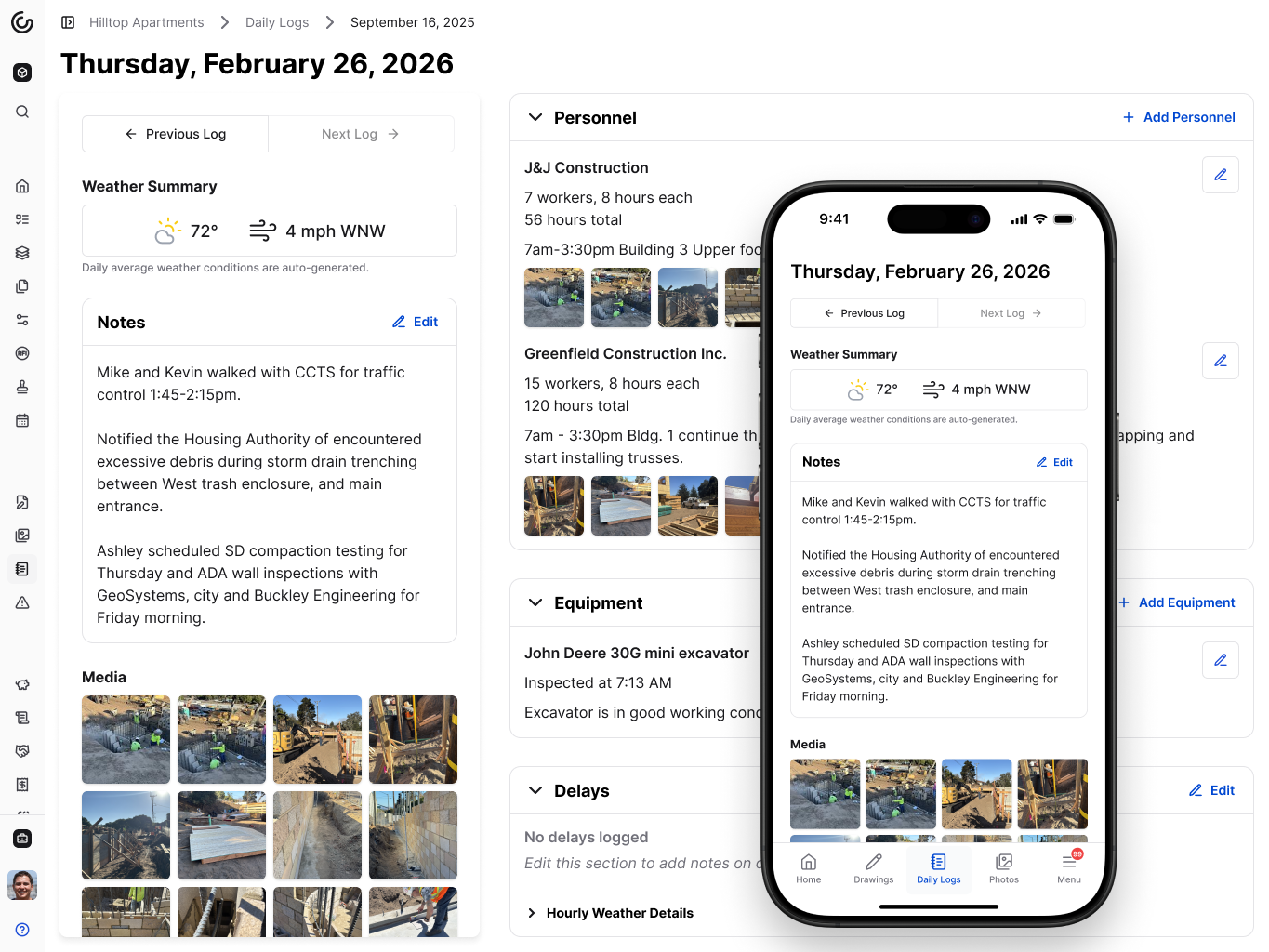
The Daily Log feature in Constructable helps you keep accurate documentation on every project. Its highly customizable fields let you focus on what's most important for your record-keeping.
How Constructable supports the documentation trail that liquidated damages disputes hinge on
Everything in the prior section comes down to paper, and the paper is either there when the dispute lands or it isn't. This is where your daily log and field reporting software decides the outcome.
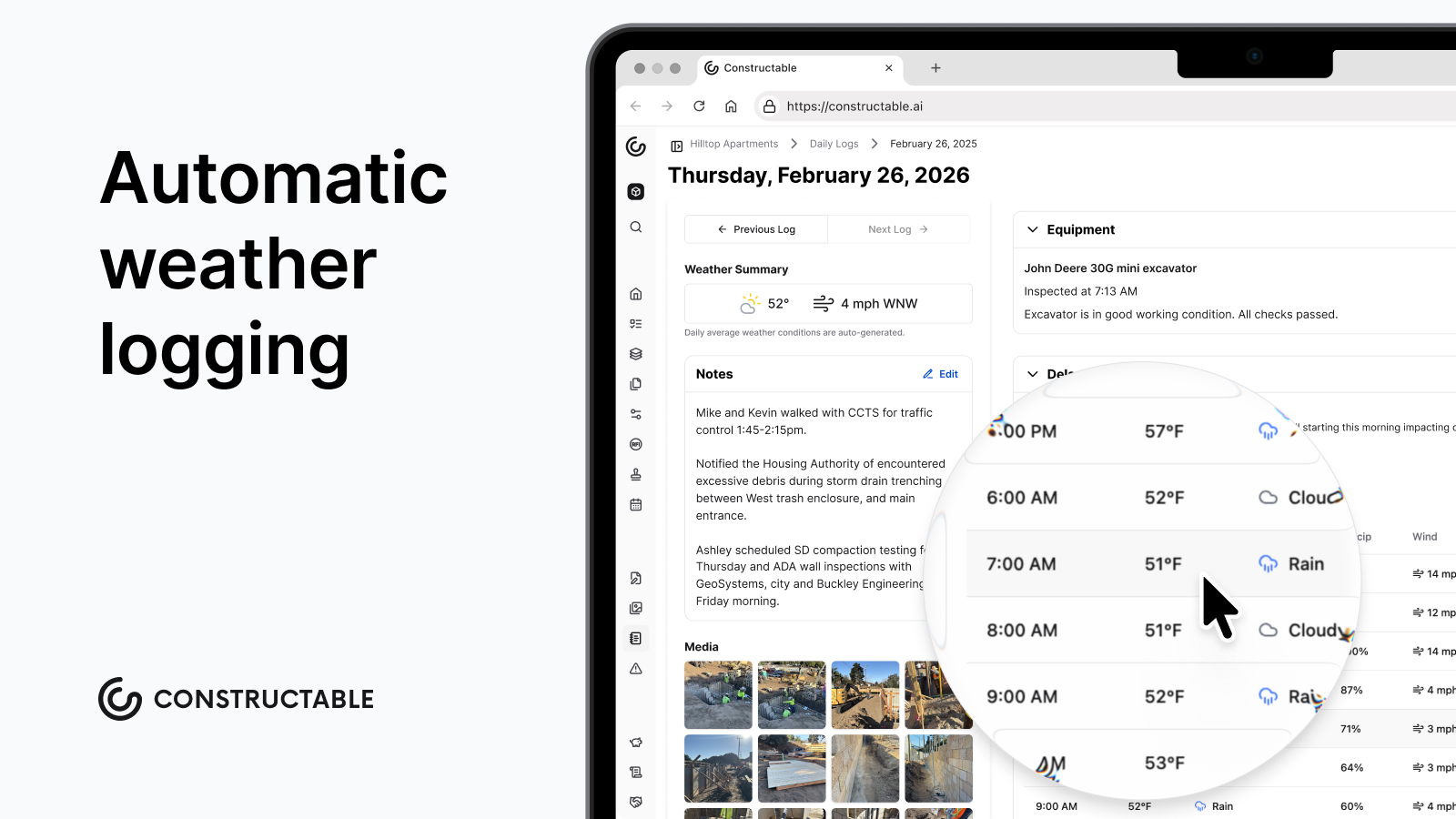
Constructable's Daily Logs automatically pull hourly weather from the project zip code, so a weather delay day is timestamped the moment it happens, without anyone having to remember to log it. Delay entries are categorized by cause, be it Weather, Owner Directive, Waiting on RFI/Submittal, Material Acquisition, or Other. Those categories map straight onto the excusable-versus-inexcusable line courts draw when you contest an LD charge.
RFIs get pinned to the exact drawing location, carry response due dates, and keep full distribution history. Understanding RFI management in construction and what works is what turns that history into an LD defense. If an unanswered RFI dragged your schedule, that record is already dated and sitting in the file.
And when disputes arise, the AI Answer Engine queries drawings, daily logs, RFIs, and change events and returns cited primary sources, so you're armed with the facts immediately when you need them. All you need to do is ask. For a GC running $20M to $150M a year, where one LD dispute can eat a real slice of project profit, that record is the defense.
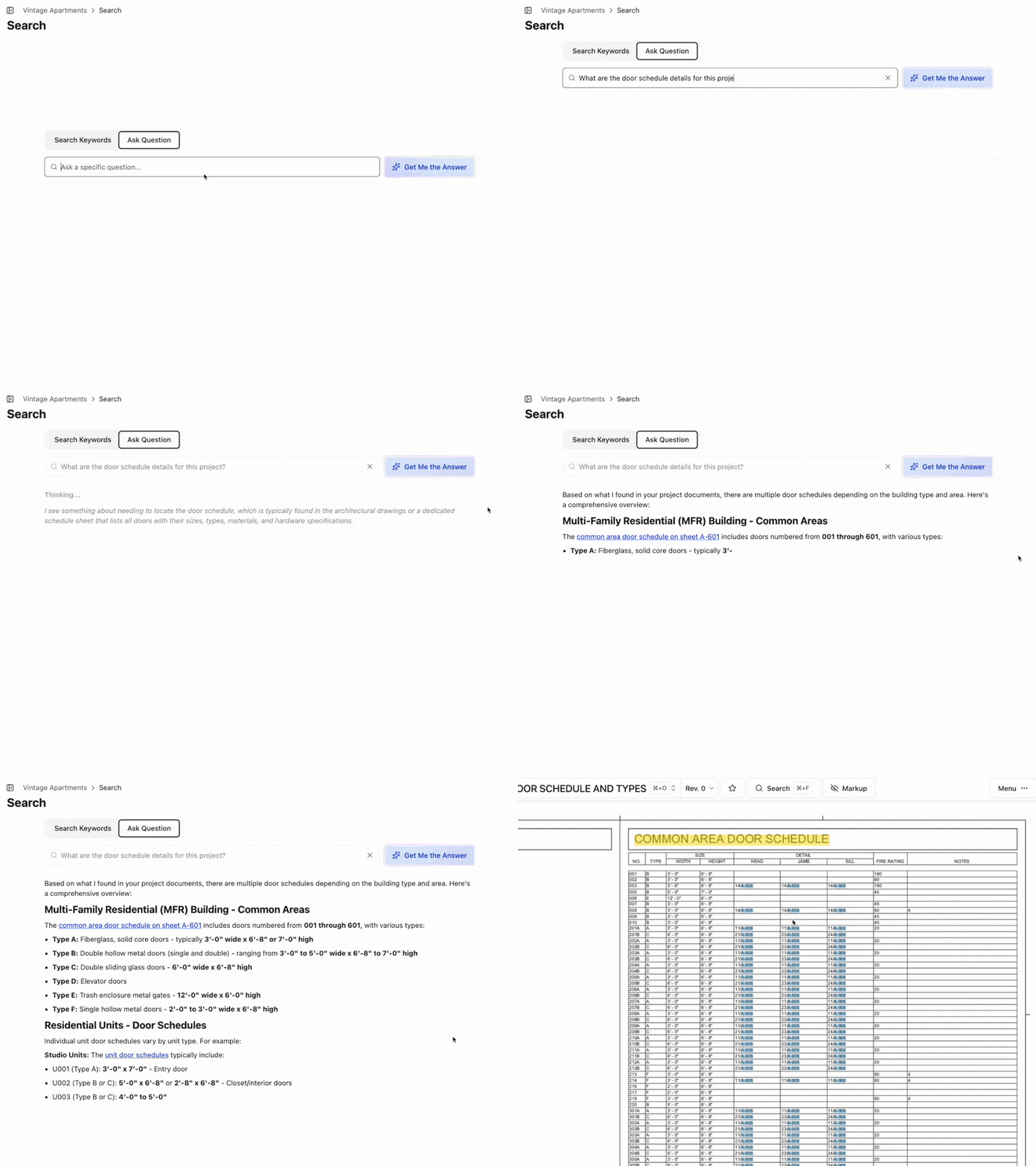
You can ask Constructable any question about your project, and it immediately outputs the answer.
Final thoughts on liquidated damages in construction contracts
No LD clause is truly scary if your documentation is solid. The contractors who walk into arbitration with timestamped delay logs, dated RFI records, and a clean schedule history are the ones who come out ahead. Build that habit on every job, and reach out to the Constructable team if you want to see how the tools support it.
FAQs
What is the difference between liquidated damages and unliquidated damages in a construction contract?
Liquidated damages fix a daily rate in the contract before work begins, so the owner collects a set dollar amount per day of delay without proving actual losses. Unliquidated damages have no pre-set rate, meaning the owner must document real costs (lost revenue, extended financing, idle staff) and prove them in court or arbitration after the fact. Which regime applies is decided the day you sign, so checking whether your contract names a daily rate is the first thing to do before execution.
How do you calculate liquidated damages per day on a construction project?
Start by adding up the owner's expected daily costs of a late finish: lost rental or operating income, extended loan interest, and ongoing supervision or carrying costs. Aggregate those into a single per-day figure. On a $10 million office building, for example, lost rent plus financing can produce a defensible rate of $8,000 to $10,000 per day. The math is straightforward; what matters is the documentation behind the number, because a rate you can trace to real anticipated losses survives a legal challenge where a round number picked arbitrarily does not.
What makes a liquidated damages clause enforceable vs. an unenforceable penalty?
Courts apply a two-part test: the actual damages had to be genuinely hard to estimate when the contract was signed, and the daily rate must be a reasonable pre-estimate of real owner loss, not a number designed to punish. A rate that turns out grossly disproportionate to any actual damage can be struck as an unenforceable penalty, sending the owner back to proving losses the hard way. The phrase "as liquidated damages and not as a penalty" in the clause itself signals that both parties intended a genuine estimate, which is why that language appears in nearly every well-drafted construction contract LD provision.
What documentation do GCs need to defend against a liquidated damages claim for construction delay?
The strongest defense is a contemporaneous record that timestamps every delay event (weather, owner directives, unanswered RFIs, permitting holdups) with its cause logged at the time it happened, not reconstructed months later. Written notice issued the moment an excusable delay begins, formal time extension requests made before the completion date lapses, and a daily log that categorizes each delay by type all map directly onto the excusable-versus-inexcusable line courts draw when contesting an LD charge. Constructable automates part of this: hourly weather data pulls automatically from the project zip code, delay entries are categorized by cause, and RFIs carry response due dates with full distribution history, so the record exists before anyone knows a dispute is coming.
Should GCs flow down liquidated damages exposure to subcontractors in their subcontracts?
Yes, when a sub's delay can cause the GC to miss the prime contract completion date, flow-down language in the subcontract shifts LD liability from the GC to the trade that caused it. A subcontract LD clause should do two jobs: pass through the portion of prime-contract liquidated damages attributable to that sub's work, and recover the GC's own extended general conditions (trailer, supervision, overhead) for each day the sub runs long. The critical piece to include is apportionment language; without it, courts in many states will void the clause entirely when multiple trades contribute to a concurrent delay, leaving the GC to absorb the full loss.