Construction Daily Log Best Practices | July 2026
Daily log best practices for foremen: capture weather, delays, and site activity automatically in the field (July 2026).
Construction daily logs have a reputation for being a box to check at quitting time, and that reputation is exactly why they fail when it matters most. A log built from end-of-day memory looks fine until a dispute surfaces and opposing counsel starts asking why the Tuesday entry is blank on the exact day production stalled. There's a better way to build the record, and it starts with how information reaches the foreman in real time.
TLDR:
-
A daily log built the day work happens carries near-evidentiary weight; one reconstructed later invites doubt in every entry.
-
Effective delay entries name four things: cause, duration, who was responsible, and the hit to the critical path.
-
Adverse weather affects roughly 45% of construction projects worldwide, making specific weather data a claim-ready record, not a courtesy note.
-
Blank log entries on the exact days problems hit read as concealment, giving opposing counsel an open door into your timeline.
-
Constructable pulls hourly weather automatically, tags delays by cause at entry, and syncs logs offline so foremen capture conditions in the moment.
What construction daily logs document
A daily log is a contemporaneous record of what happened on site, who was there, and what conditions the crew worked under. Treat it as evidence, gathered the day the work occurred, and it carries real weight. Treat it as a box to check at quitting time, and it turns into a thin summary nobody can rely on later.
The scope is broader than a progress note. A useful log captures crew and headcount, equipment on site, deliveries, inspections, the weather crews actually faced, and any delay that stalled production. What separates a log that survives scrutiny from one that gets picked apart is timing and detail. The record has to be built as the day unfolds, not reconstructed from memory a week later.
The foreman as the jobsite documentation hub
The foreman keeps information moving. All day, you sit between crews running the actual work, subs showing up with their own schedules, the office asking for status, and design teams answering questions that arrived late. Nothing on site coordinates itself, so when a change hits, you make sure everyone adjusts.
That position is what makes the daily log more than paperwork. By the time you sit down to record the day, you already hold the fullest picture of what happened and why.
When a log comes up short, the cause usually traces back to a gap in how information reached you, not carelessness at the keyboard. A delivery nobody flagged, an RFI answer lost in someone's inbox, a sub who changed headcount without telling anyone. Fix the flow into the foreman, and the documentation coming out of it gets sharper on its own.
What to include in every construction daily log
A complete log leaves no room for later guessing. Each field below should carry enough specificity that someone reading it a year from now can reconstruct the day without calling you.
| Field | What to capture |
|---|---|
| Project identification | Job name, number, date, and the log author |
| Personnel and crew | Headcount broken out by trade and by subcontractor |
| Equipment | What was on site, what ran, and what sat idle |
| Deliveries | Materials received, quantities, and who dropped them |
| Work activities | The actual scope completed, by location, not "framing continued" |
| Inspections | What was inspected, by whom, and the result |
| Weather | Conditions crews worked in and any hour-by-hour changes |
| Delays | The cause and how long production stalled |
| Safety events | Incidents, near misses, and toolbox talks |
What separates a defensible log from a weak one is detail in the work activities. "Poured slab on grade, grid A-C, 40 yards placed by noon" holds up. "Concrete work" does not.
Why daily logs carry legal weight in claims and disputes
A record made the day work happened is treated as more credible than a timeline pieced together months later. Arbitrators and courts weigh contemporaneous documentation heavily, because it was created before anyone had reason to shade the story. An account reconstructed after a dispute starts invites doubt about every entry.
That credibility gap has money behind it. The average construction dispute value reached $60.1 million in 2025, and delay claims remain the most common type. When you file or defend one, the daily log becomes the primary evidence for what happened, when, and why production stalled.
Best practices for documenting weather on the jobsite
A note reading "rainy day" tells an arbitrator nothing. What holds up is the record that logs the temperature, the inches of precipitation, wind speed, and the ground conditions crews actually faced. Weather is evidence, and its specificity decides whether an entry backs a claim or falls apart under questioning.
Adverse weather affects roughly 45% of construction projects worldwide, the most common external cause of schedule disruption. So the detail matters. Capture at minimum:
-
Temperature and how it changed through the day
-
Precipitation type and amount, with the hours it fell
-
Wind speed when it stalled a crane pick or exterior work
-
Ground conditions, such as standing water or mud that stopped grading
Documentation alone rarely wins a delay claim. Most contracts require formal notice within a set window, and your log entries substantiate that notice later. Record the weather the day it hits, then tie it to the delay filing while the timeline stays clean.
How to record and categorize construction delays
A delay entry that reads "work was delayed today" cannot support a claim or rebut one. What holds up names four things: the cause, how long production stopped, who was responsible, and the hit to the critical path. Record all four the day it happens, while you can still see the idle crew.
Categorization matters because recovery analysis depends on it. Tag each delay by cause so review can sort excusable, compensable, and owner-side quickly:
-
Weather that stopped or slowed production
-
Owner directives that changed scope or paused work
-
Material holds and late deliveries
-
RFI or submittal responses crews stalled on
Duration carries as much weight as cause. "Framing crew idle four hours waiting on the structural RFI response" ties the stall to a number an analyst can trace downstream.
Real-time entry vs. end-of-day documentation
The gap between a log finished at 3pm and one rebuilt Friday from memory is the gap between a record that holds and one that gets torn apart. Same-day entries carry near-evidentiary weight because they were made while details were fresh, before anyone had a stake in the outcome. Wait a week, and headcounts blur.
Real-time capture rarely means sitting at a laptop. It means small habits that offload memory as the day runs:
-
Snap a photo the moment a delivery lands or a delay starts
-
Jot headcounts at the morning huddle
-
Log the pour or inspection result before the next task
Each note trims what you reconstruct later.
Using photos and visual documentation in daily logs
A written entry describes what happened. A photo proves it. Pair them and each one covers for the other, so a timestamped image of standing water sitting next to a rain delay entry holds up in ways neither does alone. Photo and video documentation keeps the office in sync with what crews actually faced.
The record only helps if you can find it later. That means labeling and connecting each photo to the entry it supports:
-
Capture site conditions, work in place, deliveries, and safety setups the day they exist
-
Document any pre-existing damage before your crew touches the area
-
Note the date, location, and what the frame shows
-
Tie the photo to the specific log entry it backs
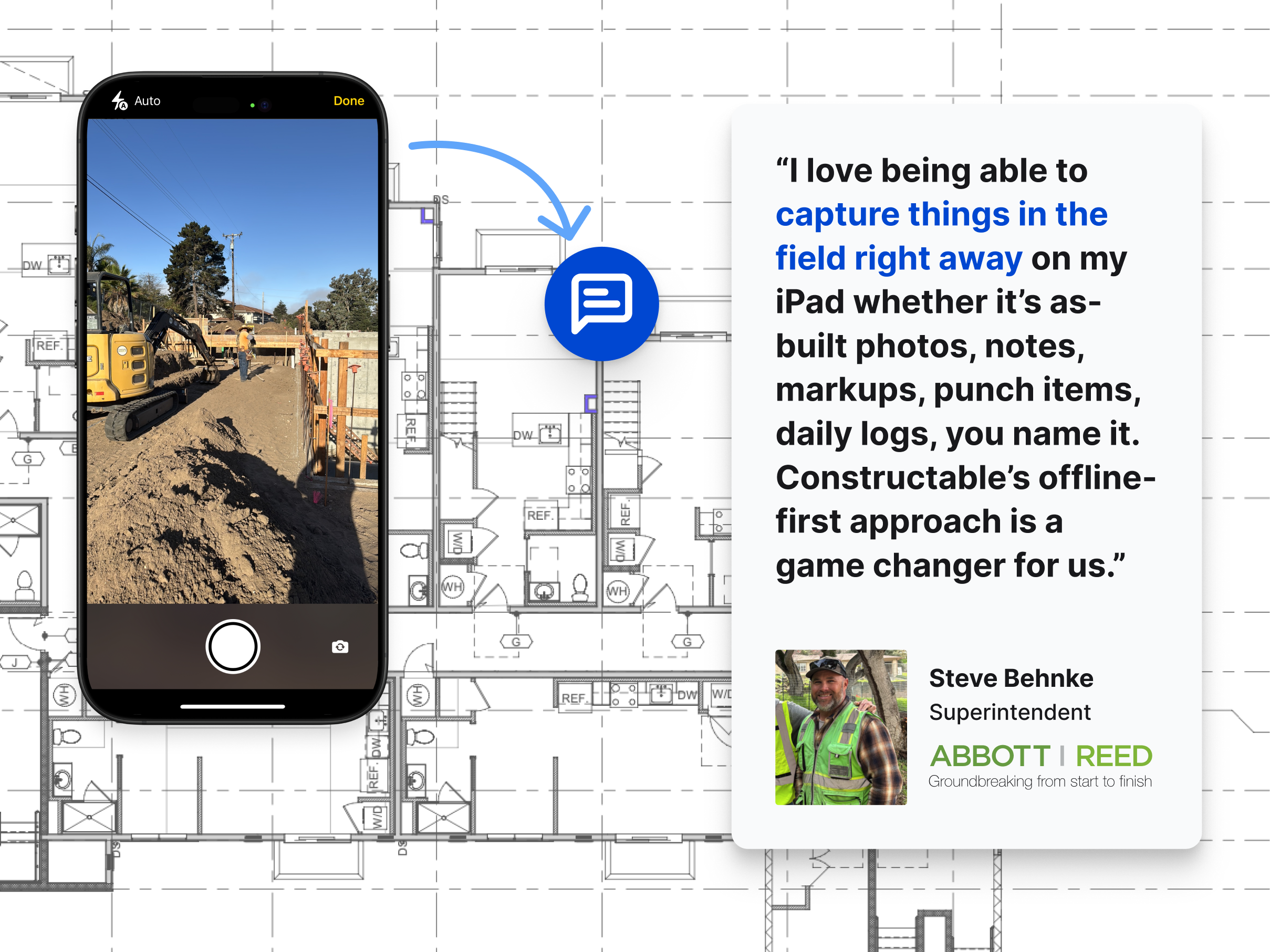
Constructable makes it very easy to add photos, notes, markups, and punch items right to your drawings
Common daily log mistakes that weaken your records
A gap in a log timeline is an open door. Opposing counsel looks for the days that go quiet, the entries that say nothing, the weeks where completion slipped. Each one lets the other side argue your record cannot be trusted.
The ones that surface again and again:
-
Vague language like "work continued as planned," which describes nothing an analyst can check
-
Inconsistent completion, where some days are logged in full and others skipped
-
Entries written days late, easy to attack as reconstruction
-
Delays noted without cause, duration, or responsibility
-
Silence on the exact days problems hit, reading as either concealment or absence
The last one does the most damage. When a delay landed on a Tuesday and the Tuesday log is blank, that blank becomes the argument.
How digital tools change the daily log workflow
Manual logging breaks down for a structural reason. Every step between the moment something happens and the moment it gets recorded pushes the entry later, which is when detail degrades. Construction daily log and field reporting software earns its place by cutting those steps, so capturing conditions as they occur beats reconstructing them at week's end.
Four categories of friction come up again and again:
-
Offline entry, so a log filled out inside a concrete structure or a dead zone syncs once signal returns
-
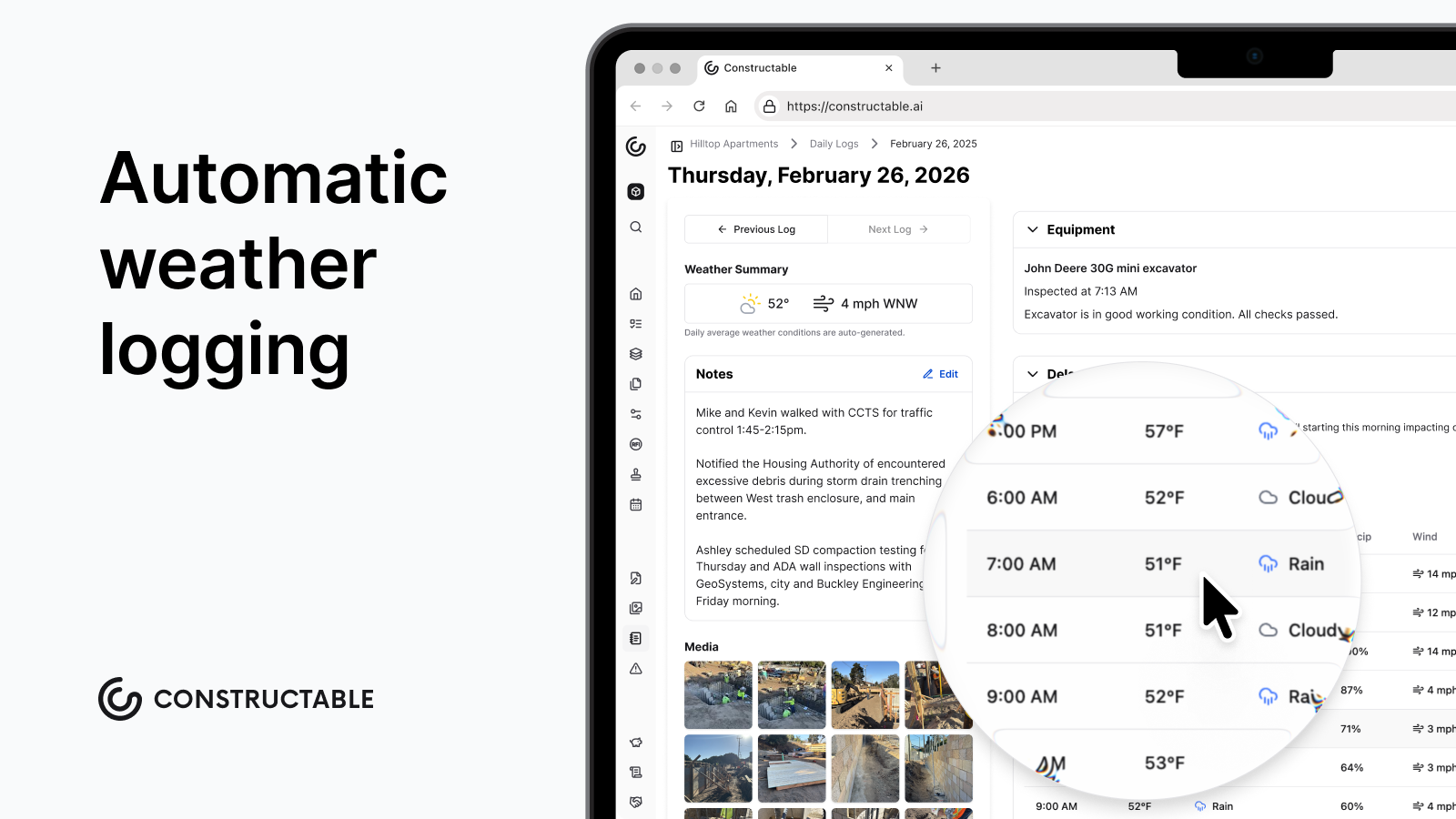
Automatic weather pulled from the project location, which kills the daily lookup and timestamps conditions on its own
-
Photos that file themselves against the log they belong to instead of scattering across a camera roll
-
Cloud sync that puts the same record in front of the office the moment the field saves it, one of several advantages offered by strong construction communication and collaboration tools
None of these add a task. Each removes one.
How Constructable handles daily logs in the field
Everything above shapes how we built the Daily Logs tool under Field Tools. Logs are organized by week, Sunday through Saturday, so a defensible timeline sits ready instead of scattered across single entries.
The automations remove the steps that push entries late:
-
Hourly weather pulled from the project zip code, dropping the 20 to 30 minutes of manual lookup field teams usually absorb
-
Delays tagged by cause at entry (Weather, Permitting, Owner Directive, Material Acquisition, Waiting on RFI/Submittal, or Other), so claim-ready records stay structured from the start: the kind of documentation construction project managers rely on when disputes surface
-
Offline entry with automatic sync, so a foreman inside a concrete structure logs conditions in the moment
-
Photos filed into a dedicated Daily Log Photos album on their own
Labor hours entered in a log can flow to project costs once hourly rates are set, giving you documentation and cost allocation in one entry, part of the broader general contracting workflow a GC manages daily. It handles that without acting as a clock-in system.
Final thoughts on construction daily log best practices
Your daily log is the closest thing to a paper trail that actually defends your work. Keep it specific, keep it timely, and tie every photo to the entry it supports. When you're ready to see how Constructable handles this in practice, we're easy to reach.
FAQ
What should a construction daily log include to hold up in a delay claim?
A defensible daily log names the cause of the delay, how long production stopped, who was responsible, and the impact on the critical path, all recorded the day it happens. Vague entries like "work delayed" or "weather issues" give arbitrators nothing to work with; specific entries like "framing crew idle four hours waiting on structural RFI response" give them a number they can trace. Pair written entries with timestamped photos and you have a record that can support or rebut a claim without reconstruction.
How do I document weather conditions on a jobsite so they actually support a claim?
Log temperature, precipitation type and amount with the hours it fell, wind speed when it affected crane picks or exterior work, and ground conditions like standing water or mud. A note reading "rainy day" carries no weight; the same entry with inches of precipitation, a two-hour window, and standing water that stopped grading gives an arbitrator something concrete. Most contracts also require formal notice within a set window, so log the weather the day it hits and tie it to that filing while the timeline is clean.
Real-time daily log entry vs. end-of-day documentation: does timing actually matter?
Yes, and the difference is real. Same-day entries carry near-evidentiary weight because they were made before anyone had a stake in the outcome; entries rebuilt from memory days later invite doubt about every detail. Real-time capture doesn't require a laptop: snapping a photo when a delay starts, jotting headcounts at the morning huddle, and noting an RFI number the moment a crew stalls each trim what you reconstruct later.
Can Constructable replace manual weather tracking in a daily log?
Yes. Constructable pulls hourly weather data automatically from the project zip code, dropping the 20 to 30 minutes of manual lookup field teams typically absorb each day. Temperature, conditions, precipitation, and wind are timestamped without any entry on your part, so the weather record exists whether or not anyone remembered to log it.
What daily log mistakes most often weaken construction claims and disputes?
The most damaging are blank entries on the exact days problems hit, vague language like "work continued as planned," and delays recorded without cause, duration, or responsibility assigned. Opposing counsel looks for the quiet days first: a blank Tuesday log on the day a delay landed reads as either concealment or absence, and either reading damages credibility. Inconsistent completion, where some days are fully documented and others skipped entirely, compounds the problem by making the whole record easier to attack.