Types of Construction Contracts: A Plain-English Guide for General Contractors (July 2026)
Learn the main types of construction contracts for GCs in July 2026: lump sum, cost-plus, GMP, T&M, and unit price. Match the right structure to your project scope.
The contract you sign decides who pays when the job moves, and jobs always move. Owner revisions hit three weeks into framing, material costs jump between bid and pour, and scope grows after the foundation sets. Every one of those shifts has a financial owner, and the contract type names them before the work starts. Lump sum locks the price and puts overrun risk squarely on you, while cost-plus opens the books and lets actual costs flow through. A guaranteed maximum price caps total exposure and splits any savings, and time and materials simply bill the hours and materials used. Unit price locks the rate per unit and lets quantities float. Whichever structure holds up is the one that matches how much scope you can actually see on the day you sign.
TLDR:
-
The contract type names who absorbs the cost when scope drifts or drawings change mid-job.
-
Lump sum locks price and risk on you; GMP caps it with savings splits; cost-plus stays open.
-
Match the structure to scope clarity at signing, not the last job you ran.
-
Constructable handles change events and orders across all contract types with one workflow.
What Is a Construction Contract (and Why It Matters More Than You Think)
A construction contract sets the terms of the deal, but its real job is deciding who absorbs the hit when something goes sideways. Costs run over. A drawing gets revised three weeks into framing. The owner adds scope after the foundation is poured. Every one of those moments has a financial owner, and the contract type names them.
The contract type decides how changes get priced, who carries overrun risk, and what control you have when scope moves. Research compiled by Ironclad found organizations lose 11% of contract value after signing. On a $5M job, that's $550,000 leaking out after everyone shook hands.
Lump Sum Contracts: Fixed Price, Fixed Expectations
A lump sum contract sets one fixed price for the entire job, and that price holds whether the work costs more or less than you figured. Owners like the certainty, which is why this structure dominates residential and small commercial work where scope is drawn tight.
The catch sits on your side. Once you sign, you absorb the overruns out of your margin. Fixed price is the most common contract type in construction, according to Fennemore's construction law practice, which means change orders are the primary lever you have to protect your margin once work starts. Documenting every scope change keeps a clean close from turning into a fight over the final invoice.
Cost-Plus Contracts: Transparency With Open-Ended Risk
A cost-plus contract reimburses your actual expenses (labor, materials, equipment) and adds an agreed fee. It fits jobs where scope stays fuzzy at signing, like a renovation behind walls nobody has opened or a design that keeps changing as the owner makes calls. The owner carries the overrun risk here, since they pay whatever the work actually costs.
That fee usually lands between 10% and 20% of total costs, depending on complexity and market conditions. Three variations show up most:
-
Cost-plus fixed fee: a set dollar amount regardless of final cost
-
Cost-plus percentage: the fee scales with total spend
-
Cost-plus with incentive: a bonus for beating a target
The trade-off is paperwork. Every receipt, timesheet, and invoice has to be tracked and documented.
Guaranteed Maximum Price (GMP): The Middle Ground Between Certainty and Flexibility
A GMP works like a cost-plus deal with a hard ceiling. You bill actual costs and your fee up to an agreed maximum, and anything above that number comes out of your pocket. Come in under it, and the savings are often split with the owner on a preset percentage. That blend gives owners open-book transparency without the open-ended exposure, which is why it shows up so often on commercial work.
The hard part is timing. Set the GMP too early, while the design is still loose, and you are guaranteeing a price against drawings that do not exist yet. As the AIA's guidance on GMP compensation notes, the maximum holds the contractor to a ceiling, so locking it before the design firms up means carrying the risk of every unknown that surfaces later.
Time and Materials Contracts: When Scope Cannot Be Defined Upfront
A time and materials contract bills for the hours your crew works and the materials they use, with a markup on each. No fixed total at signing makes T&M the least certain arrangement on cost, and that is the point. It fits emergency work, repairs where you cannot see the damage until you open the wall, and any scope you cannot honestly estimate beforehand.
Most owners watch that open meter and want a not-to-exceed cap. Run T&M up to a guaranteed maximum, and they get daily billing transparency while keeping a hard ceiling on total exposure.
Unit Price Contracts: When Quantities Are Unknown but Rates Are Clear
A unit price contract fixes the rate per measurable unit and lets the final count float. You agree on a price per cubic yard of excavation or linear foot of pipe, and the total settles once the crew measures what was installed.
That fits work where you can define the task but not the volume. Roadwork, utilities, and earthmoving all qualify, since nobody knows how much rock sits below grade until digging starts.
The split from lump sum comes down to where the unknown lives. Lump sum locks one number against a defined scope; unit price locks the rate and absorbs quantity swings. Both sides watch the estimated quantities in the bid, because lowball figures distort comparison and surprise everyone at the final measurement.
Design-Build Contracts: One Contract, One Accountability Point
Design-build combines design and construction under a single entity, so the owner signs a single contract rather than hiring a designer and a builder separately. Traditional design-bid-build splits those roles, leaving the owner refereeing between architect and contractor when drawings and field reality collide.
Folding both under one roof speeds delivery and kills most coordination fights. One party owns the outcome, which means one party to call when something is wrong.
The trade-off is control. The designer now reports to the contractor, not to you, so design decisions tilt toward buildability and budget over your preferences. Pick a design-builder you trust, because once the contract is signed, their judgment steers the design.
Integrated Project Delivery (IPD): Shared Risk, Shared Reward
A multi-party agreement binds the owner, designer, and contractor (and sometimes key trades) into a single contract with shared risk and reward. Profits go into a shared pool. Beat the targets together, everyone wins; miss them, everyone takes the hit.
That shared fate is the whole design. It rewards early coordination and new thinking, which is why IPD shows up on complex institutional and commercial work. It also remains the rarest structure, since it only works when trust, governance, and culture align.
How to Choose the Right Contract Type for Your Project
The contract that fits comes down to one question: how clearly is the scope defined right now? Match the structure to that reality, not to the last job you ran.
| Project condition | Best fit |
|---|---|
| Scope locked at 95% or more | Lump sum |
| Design still evolving, owner wants transparency | Cost-plus or GMP |
| Variable quantities, known rates (roads, utilities) | Unit price |
| Scope genuinely cannot be estimated | T&M with a cap |
| Speed or early collaboration drives everything | Design-build or IPD |
Every structure trades one thing for another. Lump sum buys cost certainty but sacrifices flexibility. Cost-plus and T&M flip that. GMP splits the difference and adds open-book reporting. The pick that holds up is the one honest about how much you actually know on the day you sign.
Payment Terms That Show Up in Every Construction Contract
Whatever contract type you sign, the money moves the same way. Progress payments are billed against completed work, usually monthly, through a payment application supported by an updated schedule of values and supporting documentation. Owners review, then release.
Most contracts hold back 5 to 10% of each progress claim, released in stages, often half at practical completion and the rest after the defect liability period closes. That withheld money guarantees you finish and fix what you missed.
The cash flow burden cascades down the payment chain. The owner holds your retainage while you hold your subs', which means everyone is financing completed work out of pocket until the tier above them pays. Change orders make it worse, since anything unapproved or slow to price sits outside the billing cycle entirely, further delaying payment.
How Constructable handles contracts, change orders, and payment flows across all contract types
Whatever structure you signed, the headache is the same: tracking the change and getting paid for it. Constructable is built to cut that friction with AI construction management software designed around how jobs actually run.
The change workflow runs on a two-stage model. The moment something changes on the job, you create a change event, then build change orders underneath it. If the same issue hits your electrical sub and your prime contract, both orders live under one event, with line items auto-filling from the parent, so you don't have to retype descriptions and cost codes across documents.
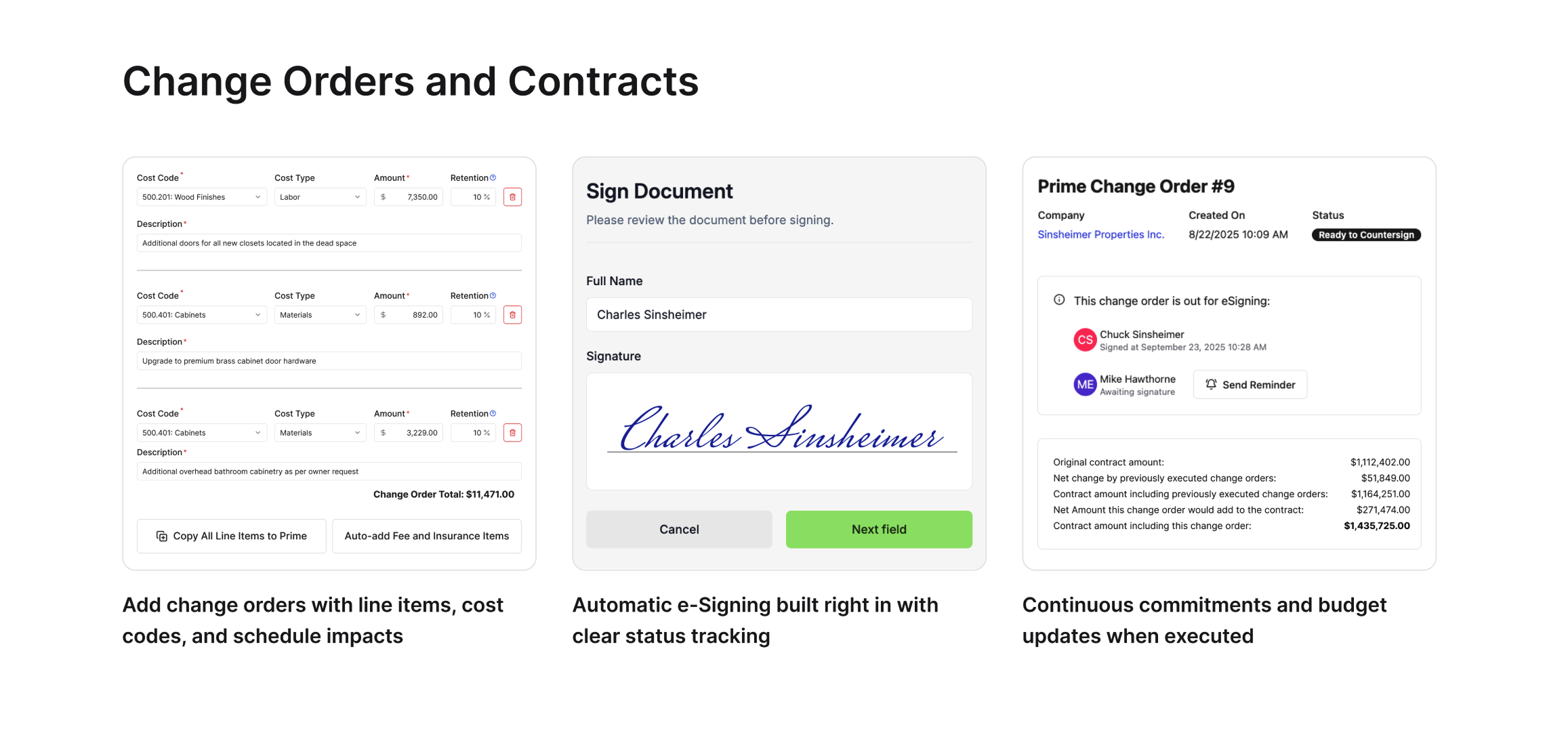
The financial tools flex to the contract you are running. Budgets, schedules of values, and invoicing work the same whether the job is lump sum, cost-plus, GMP, or unit price. Built-in e-signing covers change orders and commitments, so there is no separate signing tool to manage.
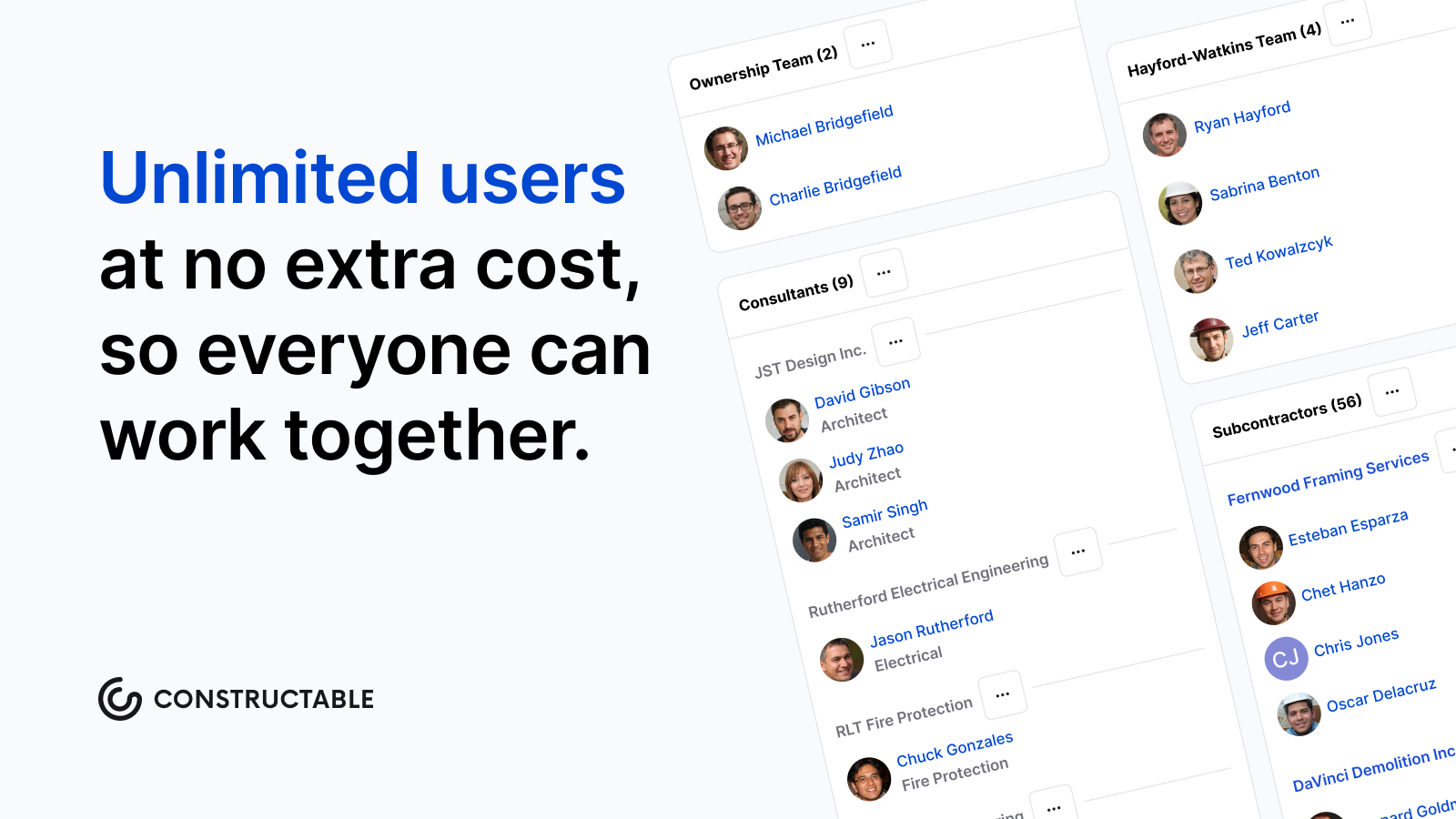
Plus, Unlimited users sit on every plan. Subs, consultants, and owners all collaborate on contract documentation without per-seat costs climbing every time you add someone. The point is to reduce the paperwork and make it less busywork, no matter which contract type the project lives under.
Final Thoughts on Selecting the Right Contract Structure
The contract type that fits depends on one thing: how clearly the scope is defined when you sign, not which structure feels familiar. Lump sum works when the drawings are locked, cost-plus works when they are still moving, and GMP works when you can set a ceiling that reflects real design completion. Constructable handles change tracking and payment flows the same way across all contract types; schedule a walkthrough if you want to see how it maps to how you actually run jobs. Choose the structure that is honest about what you know today, because the contract only holds if the pricing assumptions do.
FAQ
What are the 4 types of construction contracts most commonly used?
The four main types are lump sum (fixed price for the entire job), cost-plus (reimbursement for actual costs plus a fee), guaranteed maximum price or GMP (cost-plus with a hard ceiling), and time and materials (billing for actual hours and materials used). Each fits different levels of scope certainty: lump sum when scope is locked, cost-plus when design is still evolving, GMP for transparency with a cap, and T&M when you genuinely can't estimate upfront.
Lump sum vs cost-plus contract: which protects the contractor better?
Cost-plus protects the contractor from overrun risk because the owner pays actual costs, while lump sum puts all overrun risk on the contractor's margin. Lump sum only works when scope is tight and you can price accurately; once signed, every dollar over your estimate comes out of your pocket. Cost-plus requires detailed documentation of every receipt and timesheet, but the owner absorbs cost swings instead of you.
Can I track change orders without separate cost-plus and lump sum workflows?
Yes. Constructable handles change events and change orders across all contract types: lump sum, cost-plus, GMP, unit price, or T&M, all in one workflow. Create a change event the moment something changes, then build change orders beneath it with line items that auto-fill from the parent event, whether the job is fixed-price or cost reimbursable. Built-in e-signing covers all change order types without separate tools.
How do I choose between GMP and cost-plus for a commercial project?
Choose GMP when the owner wants open-book transparency but needs a hard ceiling on total exposure, common on commercial work where design is still firming up, but budget certainty matters. Pure cost-plus leaves the owner exposed to unlimited overruns, while GMP caps that risk and often splits savings below the maximum. The risk for you: setting the GMP too early, before design is complete, locks you into guaranteeing a price against drawings that don't exist yet.
What's the difference between unit price and lump sum contracts?
Lump sum locks one total price against a defined scope; unit price locks the rate per measurable unit (cubic yard, linear foot) and lets the final quantity float. Unit price fits work where you can define the task but not the volume: roadwork, utilities, earthmoving. Nobody knows how much rock sits below grade until digging starts. Both sides watch the estimated quantities in the bid, because lowball figures distort comparison and surprise everyone at the final measurement.