Warranty Coverage Rules Every GC Should Know (2026)
Learn how GCs handle warranty coverage, flow-down exposure, and closeout documentation. October 2026 guide.
You finish the job, you close out, and you move on to the next one. Then a call comes in eighteen months later about a defect, and suddenly everyone has a different memory of what your warranty covered. Getting your warranty terms documented clearly upfront is the difference between a quick repair and a drawn-out fight over scope you never defined.
TLDR:
-
Your written one-year warranty governs obvious defects, but latent defects can still trigger claims years later under statutes of limitations.
-
GCs warrant the entire project to the owner; flow-down clauses pass that exposure to subs, even obligations buried in the prime contract.
-
California's SB 800 runs separate clocks by defect category: one year for workmanship, four years for water intrusion, ten years for structural failures.
-
Most warranty defense failures come down to missing documentation, not bad work; approved submittals and daily log photos are your defense, and neither is recoverable after the fact.
-
Constructable's Closeout feature compiles submittals, inspection records, photos, and RFIs into a structured archive that mid-size GCs can actually search when a dispute surfaces.
What a Construction Warranty Is (and What It Is Not)
A construction warranty is a written assurance by a contractor to repair or replace defective work after a project concludes, limited to a defined duration and subject to stated exclusions. Most warranty disputes don't hinge on whether a warranty existed; they hinge on what it actually covered and whether anyone wrote it down clearly.
The terms "warranty" and "guarantee" get used interchangeably on jobsites, but they carry different legal weight. A warranty defines scope, duration, and exceptions; a guarantee implies an absolute promise. Courts treat them differently, which puts a GC handing a client a "lifetime guarantee" on workmanship without written terms in a far less predictable position than one issuing a defined one-year warranty with clear exclusions.
A warranty also isn't a service contract. It covers defects in the work as delivered, not routine maintenance, owner misuse, or normal wear.
Types of Construction Warranties
Two categories govern nearly every construction project, and you're bound by both whether your contract mentions them or not.
Express warranties are deliberate. Written warranty letters, one-year workmanship clauses in your subcontracts, manufacturer warranties passed through at closeout: these are express. You defined the terms, the duration, and the scope.
Implied warranties arise by law, independent of what your contract says. The most common are the implied warranty of workmanship and, on residential projects, the implied warranty of habitability. A contract that says nothing about warranties still carries these obligations, and one that tries to disclaim them may not succeed in court depending on the state.
Both can coexist on the same job. Your written one-year warranty might cover trade finishes while an implied warranty of habitability runs separately under statute for a longer period.
Standard Construction Warranty Periods
One year is the most common construction warranty period, but treating it as the universal default creates real exposure.
The widely used 1-2-10 model in residential new construction breaks coverage into three tiers: one year for workmanship and materials, two years for mechanical systems including plumbing, electrical, and HVAC, and ten years for major structural defects. As American eBuilder describes it, the ten-year structural warranty provides a multi-year framework of responsibility for qualifying load-bearing defects in newly constructed homes.
The one-year period is a common contractual default, not a legal floor. Porter Hedges notes that under standard AIA and EJCDC warranty language, owners retain the ability to bring warranty claims for latent defects out to the limits set by statutes of limitations and repose, well after the stated one-year period expires. The one year governs obvious defects. Latent defects that surface years later can still trigger claims under the same contract.
Who Is Responsible for Construction Warranties
GCs warrant the entire project to the owner, a natural extension of what a GC actually does on a project. Every trade, every material, every system lands on the GC's desk regardless of who actually installed it.
Flow-down clauses are how GCs pass that exposure downstream. The language typically reads that the subcontractor assumes toward the contractor all obligations the contractor assumes toward the owner. As Pelles AI explains, the sub is now promising the GC whatever the GC promised the owner, even if the sub never reviewed the prime contract.
That gap matters because prime contracts frequently require warranty periods longer than one year. A mechanical subcontractor who signs a subcontract with boilerplate one-year terms may inherit a two-year or five-year obligation buried in the prime contract's flow-down clause. Subs should request and read the prime contract before assuming their exposure is limited to their own subcontract.
Manufacturer warranties on materials pass through to the owner during project closeout, but the contractor's workmanship warranty runs separately. If a roof leaks because of faulty installation and not a defective product, the manufacturer warranty won't respond. That falls on the GC.
What a Construction Warranty Should Include
Gaps in any one of these fields are where disputes take hold. Every construction warranty document should include:
-
Contractor name, company name, and license number
-
Project location and a brief description of the work covered
-
Date of substantial completion
-
Warranty start and end dates, explicitly stated and not left implied from completion
-
Scope of covered work, described with enough detail to exclude what you didn't do
-
Clear exclusions: ordinary wear and tear, owner neglect, third-party modifications, acts of God
-
The claims process: how the owner notifies you, in what form, and within what timeframe
-
Your response timeframe after receiving a claim
-
Contractor signature and date
The two fields most commonly omitted are the claims process and the response timeframe. Without them, a disagreement about whether you responded "reasonably" becomes a he-said-she-said. Undefined coverage scope causes the other common disputes. A warranty that covers "all work" without specifying what work was performed leaves the door open to interpretation, so reference your contract's scope directly or reproduce it. On complex projects, none of this replaces legal review, but a warranty missing these elements isn't protecting anyone.
Construction Warranty Templates and Letters: What to Use
Three document types serve different functions at closeout, and mixing them up creates real problems.
A subcontractor warranty form is submitted to the GC, confirming that the sub's scope meets contract requirements and will be repaired or replaced if defects appear within the warranty period. A GC warranty letter runs from the GC to the owner, covering the project as a whole. A workmanship warranty template typically covers labor and installation only, separate from manufacturer warranties being passed through.
The core language in each includes party names, project location, covered scope, warranty period, exclusions, and the claim notification process. Generic templates often omit claim response timeframes and state-specific disclosures, which creates gaps in California, where SB 800 requires category-specific limitation periods in writing. A template pulled from a Texas GC doesn't translate cleanly to a California residential project without modification.
For free starting points, fill in project-specific scope language instead of vague phrases like "all work performed," and reflect any statutory warranty requirements directly in the document's terms.
California Construction Warranty Requirements
California operates under one of the most layered warranty frameworks in the country. For residential new construction, the Right to Repair Act (SB 800, Civil Code §§ 895 to 945.5) sets category-specific limitation periods: one year for workmanship, two years for plumbing and electrical systems, four years for water intrusion defects, and ten years for structural failures. Each category runs its own clock, so a project doesn't age out of warranty exposure uniformly.
| Defect Category | SB 800 Limitation Period | Examples |
|---|---|---|
| Workmanship | 1 year | Surface finishes, trim, paint, tile |
| Plumbing & Electrical Systems | 2 years | Pipe leaks, wiring defects, panel issues |
| Water Intrusion | 4 years | Roofing, windows, waterproofing membranes |
| Structural Defects | 10 years | Foundation, load-bearing walls, framing |
SB 800 applies to new residential construction only. Commercial projects fall under general statutes of limitations on construction defects instead of the tiered SB 800 framework, and claim deadlines there can depend on several overlapping statutes, so it helps to review them together.
The CSLB adds a separate layer: licensed contractors face a four-year administrative complaint window from the date of the alleged violation, running independent of any contractual warranty period. A contractor whose written warranty has expired can still face a CSLB complaint. California also requires warranty terms to be documented in writing, and home improvement contracts over $500 require written agreements under Business and Professions Code §7159.
When the Warranty Period Starts
Substantial completion triggers the warranty clock in most contracts, but that date is rarely as clean as it sounds.
Under AIA standard forms, substantial completion is the date when the work is sufficiently complete for the owner to occupy or use it for its intended purpose. A Certificate of Substantial Completion documents that date and sets the warranty period start for all covered work. Final completion, when the last punch list item closes, is a later event and does not restart the clock.
Disputes arise when no certificate was issued, when the owner took partial occupancy early, or when the parties never recorded an agreed date. If the warranty letter references "date of completion" without specifying which milestone, each party tends to define it in their favor.
Phased projects add complexity. Each phase may reach substantial completion on a different date, meaning separate warranty periods run simultaneously across different scopes. A GC who issues one warranty letter covering the full project without phase-specific dates may find early-phase warranty coverage expiring before the final phase even finishes.
The warranty period start date is also separate from the statute of limitations for filing a legal claim. A two-year warranty may expire with no claims filed, but a latent defect that surfaces after that window could still trigger litigation under the applicable statute of limitations, which runs from the point of discovery instead of from completion. The warranty defines your contractual obligation window; the statute of limitations governs when a court will still hear the case.
Common Warranty Exclusions
Vague exclusions are where warranty disputes actually live. A warranty that excludes "damage caused by the owner" without defining what that means hands an attorney an argument.
Standard exclusions across most construction warranties include:
-
Ordinary wear and tear
-
Owner-caused damage or neglect
-
Modifications made by parties other than the original contractor after completion, distinct from documented change orders made during the project
-
Extreme weather, floods, earthquake damage, or other natural disasters
-
Building code changes enacted after substantial completion
-
Deferred maintenance the owner was responsible for performing
Each of these is defensible in court when written with precision. Generic language like "damage not caused by contractor" routinely gets interpreted against the drafter, since courts apply the principle that ambiguity in a contract favors the party who didn't write it.
GCs most often leave out two exclusions: code changes and deferred maintenance. A project built to code at completion doesn't become your liability when a jurisdiction updates its standards two years later, the same way scope changes tracked through a change directive shouldn't retroactively expand warranty obligations. Write that explicitly. A roof leak caused by gutters the owner never cleaned can look like a workmanship defect without a maintenance exclusion making the distinction clear.
Breaching a Construction Warranty: Consequences and Risks
Failing to honor a valid warranty claim exposes a GC to costs that routinely exceed the original repair itself. Courts typically award the lesser of repair cost or diminution in value, but in jurisdictions that permit consequential damages, a breach can trigger liability for owner costs downstream: temporary accommodations during remediation, damaged contents, lost rental income, or business interruption.
Insurance coverage depends on the nature of the claim. General liability policies respond to property damage caused by completed operations, but they typically exclude the cost of repairing the defective work itself. That gap usually falls to errors and omissions coverage or to the contractor directly. Misreading which policy applies is one of the most consistent ways warranty disputes become out-of-pocket losses.
The Magnuson-Moss Warranty Act governs consumer product warranties and applies to appliances, fixtures, and other manufactured goods installed during construction. GCs who issue written warranties covering "all work and materials" without carving out manufacturer-warranted products can inadvertently inherit obligations those manufacturers were supposed to hold.
Reputational exposure compounds the financial risk. A warranty dispute that escalates to arbitration or litigation becomes part of a GC's claim history, affecting bonding capacity and insurance renewal terms. The risk isn't a single breach but the pattern it signals to surety underwriters reviewing litigation history at renewal.
How to File and Respond to a Warranty Claim
For owners, the process starts with written notice. Most warranty agreements require claims to be submitted in writing to a specific contact, within a defined timeframe after discovery. Verbal complaints don't typically trigger the contractor's obligations or stop limitation clocks from running. Document the defect with photos, describe when it appeared, and send notice to the contractor's contact information of record via a method that creates a delivery record.
GCs receiving a claim should respond in writing, confirm receipt, promptly schedule a site inspection, and rely on organized jobsite photo documentation to support the inspection. Most contracts specify a response window of a few weeks. Ignoring a claim removes your right to control the remedy. The contractor's right to cure lets you repair it yourself instead of having the owner hire someone else and bill you for it, but that right evaporates if you don't respond within the warranty timeframe.
During the site inspection, document everything: photos, notes, scope of the alleged defect, and any conditions suggesting the cause falls outside covered work. If the defect looks like owner neglect or a post-completion modification, note it contemporaneously. That documentation becomes your defense if the claim escalates.
When parties disagree on whether the warranty applies, most construction contracts route disputes (much like construction delay claims) through mediation first, then arbitration or litigation. SB 800 projects in California require a mandatory pre-litigation process that includes notice and an opportunity to repair before the owner can file suit.
Warranty Documentation at Closeout
Most warranty defense failures aren't legal problems. They're documentation problems.
A claim lands two years after closeout, and the GC can't produce the submittal showing the approved waterproofing system, the inspection sign-off confirming it was installed correctly, or the daily log photos showing conditions on the day of pour. The work may have been done right. Without documentation, that's an argument, not a fact.
The standard closeout package items with direct warranty relevance include:
-
Subcontractor warranty letters, signed and dated, with scope and period clearly stated
-
Manufacturer warranty certificates for equipment, roofing, glazing, and other warranted assemblies
-
Operations and maintenance manuals for all mechanical, electrical, and plumbing systems
-
Final inspection sign-offs and punch list completion records
-
Approved submittals and product data sheets for installed materials
-
As-built drawings reflecting actual field conditions
-
Daily log photos documenting installation sequences and conditions
The last two items are what most teams underweight at closeout. Approved construction submittals prove the specified product was installed. Photos taken during installation prove it was installed correctly. Neither is recoverable after the fact.
The quality of warranty documentation is fixed at the time the work happens, not when the claim arrives.
How Constructable Keeps Warranty-Relevant Records Organized
When a warranty claim arrives two years post-closeout, the records Constructable organized during construction are what you hand the other side.
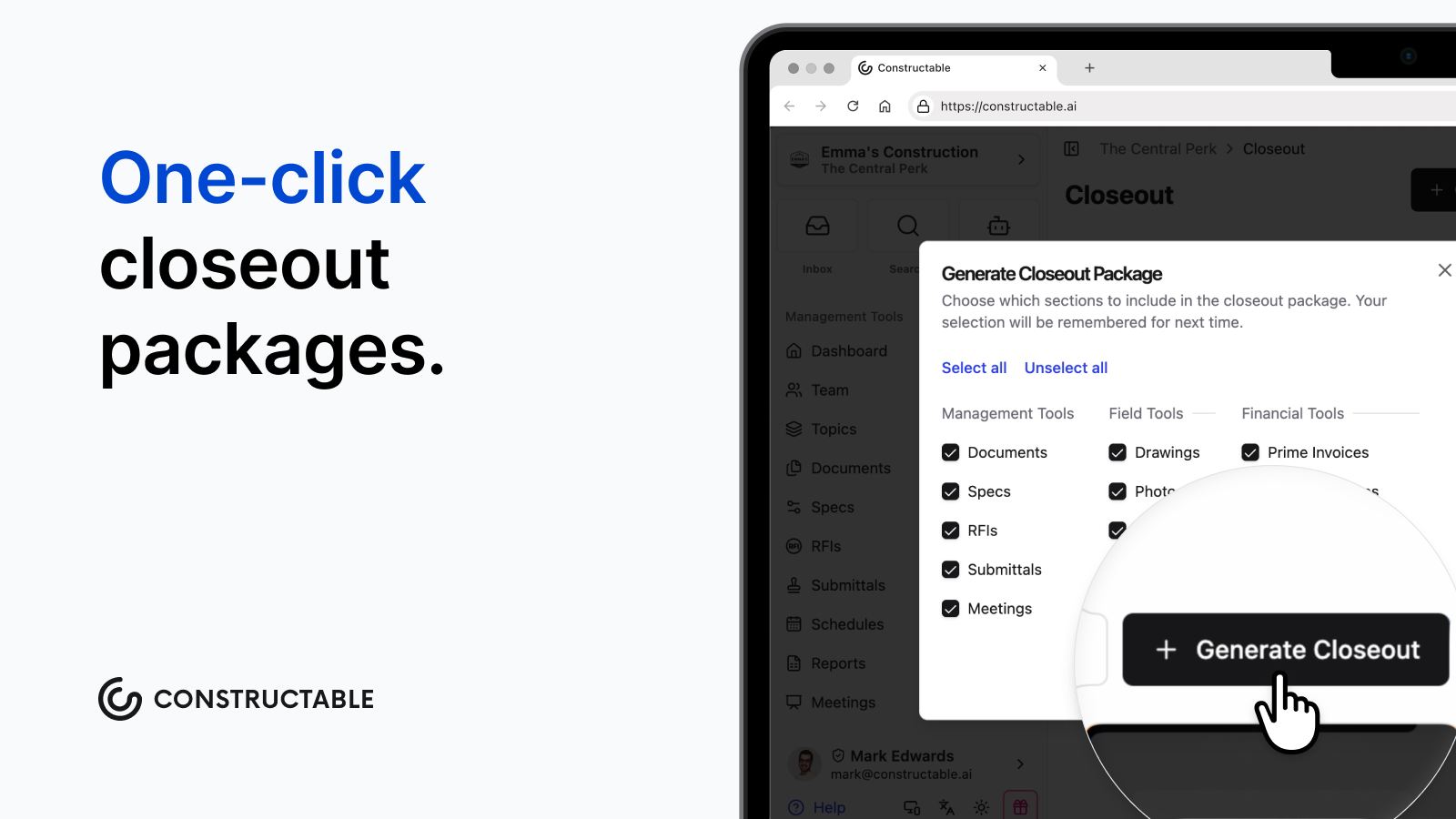
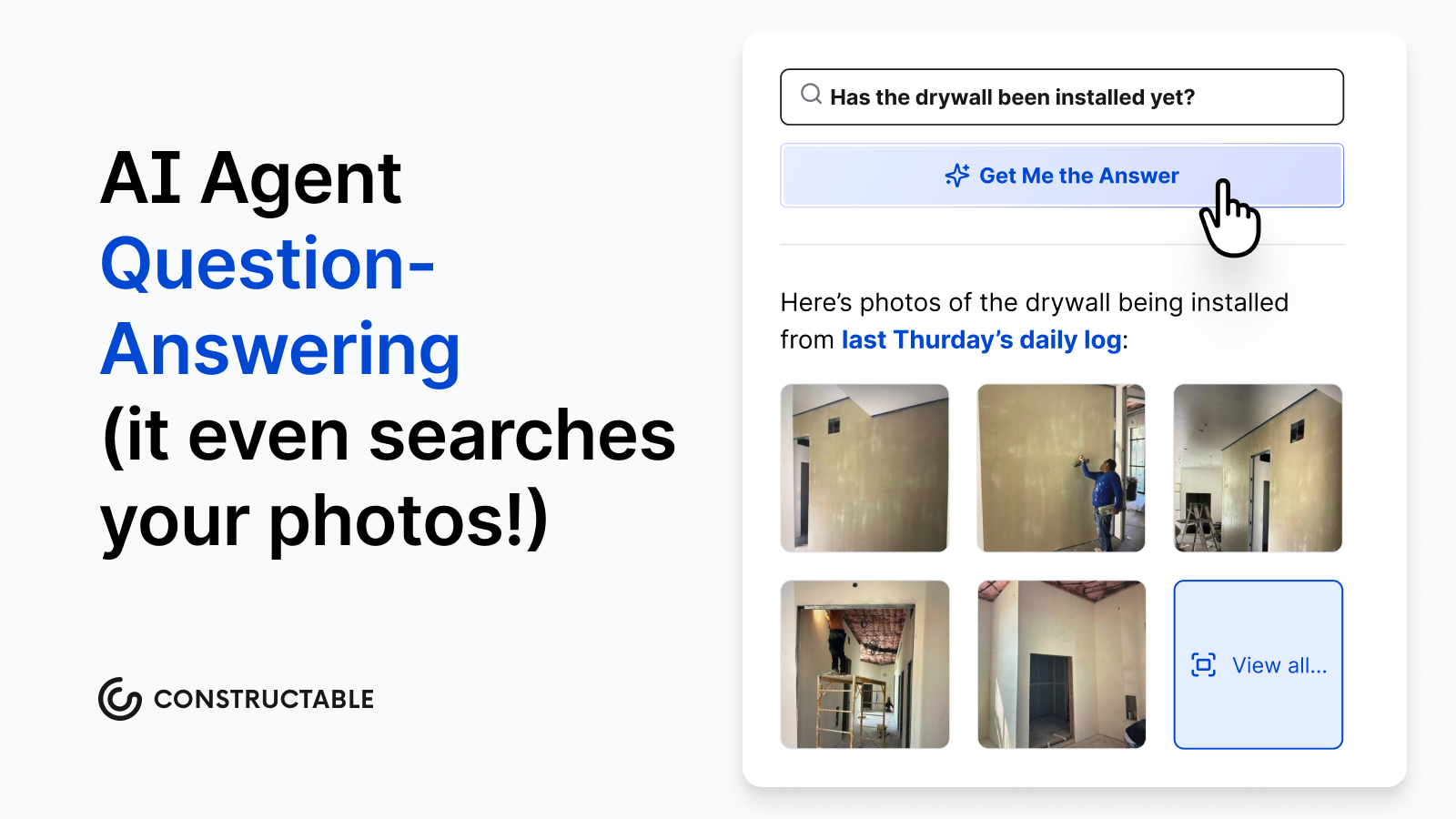
The Closeout feature generates a downloadable package compiling submittals, specs, inspection records, photos, daily logs, and RFIs into a structured archive. The AI Answer Engine adds the retrieval layer: ask a plain-language question about what waterproofing product was approved, or which inspector signed off a specific scope, and it surfaces the primary source document instead of returning a folder list to sort through manually—the kind of RFI tracking visibility teams otherwise lose to email.
Constructable doesn't include a dedicated warranty-management module (yet). What it provides is a defensible project record that mid-size GCs can actually search through when a dispute surfaces. Organized submittals prove the specified product was installed. Inspection records confirm the work passed review. Daily log photos document conditions during installation. Document storage is project-scoped, so every answer the AI returns links back to the actual submittal or log entry, not a decontextualized file.
Final Thoughts on Construction Warranties
Construction warranties reward contractors who get the details right up front. Clear scope, specific exclusions, defined start dates, and a documented claims process do more to protect you than any legal argument after the fact. And when a claim does arrive, the records you kept during the job are what you hand the other side. Talk to the Constructable team to see how organized project documentation holds up under that kind of pressure.
FAQ
How long is a standard construction warranty period, and does the one-year default actually limit your exposure?
One year is the most common contractual default for workmanship, but it does not cap your legal exposure. Under standard AIA language, owners can still bring claims for latent defects well past the one-year mark under applicable statutes of limitations and repose; the written warranty period governs obvious defects, not the full window a court will hear. Residential new construction in California runs on a tiered clock under SB 800: one year for workmanship, two for mechanical systems, four for water intrusion, and ten for structural defects.
What should a construction warranty letter include to actually hold up when a claim arrives?
A defensible warranty letter names the contractor, project location, covered scope, substantial completion date, explicit start and end dates, and a clear claims process: including how the owner notifies you, in what form, and your response timeframe. The two fields most commonly omitted are the claims process and the response window; without them, what counts as a reasonable response becomes an argument instead of a contract term. Generic scope language like "all work performed" is also a recurring source of disputes; reference your contract's scope directly or reproduce it.
What are California's specific construction warranty requirements for residential new construction under SB 800?
California's Right to Repair Act (SB 800, Civil Code §§ 895 to 945.5) sets separate limitation periods by defect category, not a single expiration date: one year for workmanship, two years for plumbing and electrical, four years for water intrusion, and ten years for structural failures. Each category runs its own clock independently, so a project does not age out of warranty exposure uniformly at any single date. The CSLB adds a parallel four-year administrative complaint window from the date of the alleged violation, which runs independently of any contractual warranty period, meaning a contractor whose written warranty has expired can still face a CSLB complaint.
What's the best way to protect a GC against warranty claims two years after closeout?
The strongest warranty defense is a complete project record assembled during construction, not after a claim arrives. Approved submittals prove the specified product was installed; daily log photos prove it was installed correctly; inspection sign-offs confirm the work passed review, and none of those are recoverable after the fact. A well-organized closeout package covering subcontractor warranty letters, manufacturer certificates, O&M manuals, as-built drawings, and punch list completion records gives you a defensible record to hand the other side, not an argument about what happened.
What's the difference between a subcontractor warranty form and a GC warranty letter, and do you need both?
Yes, both serve distinct functions at closeout. A subcontractor warranty form runs from the sub to the GC, confirming their scope meets contract requirements and that they will repair or replace defective work within the warranty period; it documents that downstream obligations are in place. A GC warranty letter runs from the GC to the owner, covering the project as a whole. The GC warrants the entire project to the owner regardless of which trade performed the work, so the subcontractor form is what backs that commitment up when a specific defect surfaces.