Construction Project Closeout: Step-by-Step Process (September 2026)
Speed up construction project closeout in September 2026 by tying document submissions to milestones and collecting lien waivers with every pay application.
The punch list is done, the certificate of occupancy is in hand, and somehow you're still not getting paid. That's what construction project closeout looks like when it's treated as an afterthought. The good news is the fix isn't complicated; it's mostly about when you start collecting things, not how hard you chase them at the end.
TLDR:
-
Closeout is a financial mechanism: retainage (typically 5-10%) stays locked until every document is accepted.
-
One missing warranty or unsigned lien waiver from a single sub holds the entire final payment hostage.
-
Start the closeout checklist at kickoff and tie document submission to milestones, so the final weeks handle verification instead of collection.
-
Closeout delays can stretch well past a year from substantial completion to final payment when managed reactively.
-
Constructable connects punch lists, lien waivers, inspections, and closeout documentation inside one system built for mid-size commercial GCs.
What is construction project closeout?
Project closeout is the final phase of a project, running from substantial completion through final payment and the release of retained funds. It covers the handoff of a finished building to the owner along with everything that proves the work was done right: warranties, as-built drawings, operation and maintenance manuals, permits, lien waivers, and final inspections.
Closeout is a contractual and financial mechanism, not an administrative footnote. Until the documentation is complete and accepted, the project is not formally finished, and the retention held back across the entire job remains locked.
That is why closeout carries real weight. The paperwork you assemble here determines when you get paid, when the warranty clock starts, and whether the owner signs off without a fight. A project can be physically built and still sit open for months because a single closeout item is missing.
Substantial completion vs. final completion
Substantial completion and final completion sound similar, but they sit at opposite ends of the closeout phase and trigger different obligations.
Substantial completion is the point where the owner can occupy and use the space for its intended purpose. It starts the warranty clock and usually triggers a reduction in retainage, even though minor work remains. Final completion comes later, once every punch list item is resolved, all closeout documents are accepted, and the final payment application goes in.
| Substantial completion | Final completion | |
|---|---|---|
| What it means | Owner can occupy and use the space | All work and paperwork finished |
| Warranty clock | Starts here | Already running |
| Retainage | Partial reduction | Final release |
| Payment | Continues | Final application submitted |
Conflating the two is where disputes start, especially over when warranty periods actually began and how much retainage should still be held.
Who is involved in construction project closeout?
Closeout pulls in nearly everyone who touched the project, and each party owns a piece the others cannot finish for them.
-
General contractor: coordinates the whole effort and assembles the final closeout package for handoff.
-
Subcontractors and trades: deliver their portion of the documentation, from warranties to as-built markups on their scope.
-
Owner: formally accepts the project and releases retention once the package holds up.
-
Design team: the architect and engineers verify substantial completion and review as-built drawings against the design intent.
-
Suppliers and equipment vendors: provide warranties and operation and maintenance manuals for the systems they furnished.
When closeout stalls, the cause is rarely one party dropping the ball. It is coordination breaking down across the group, with one missing warranty or unsigned waiver holding the entire package hostage.
Key construction closeout documents
A complete closeout package pulls together the records that prove the work meets the contract and code requirements. Assemble these:
-
Certificate of substantial completion (AIA G704), which fixes the date the owner takes over and the warranty clock starts.
-
As-built drawings, also called record drawings, marked up to show what was actually installed.
-
Operation and maintenance manuals for every system and piece of equipment.
-
Equipment warranties and guarantees from manufacturers and installing trades.
-
Lien waivers and releases from every tier of the contracting chain, subs and suppliers included.
-
Certificate of occupancy from the local authority.
-
Commissioning and testing reports for mechanical, electrical, and life-safety systems.
-
Training records confirming the owner's staff learned to run the building.
-
The project closeout report, covered later in this guide.
One missing item stalls the whole package. If a single sub never submits a warranty or an unsigned waiver, final payment for the entire project is delayed. Retainage, typically 5% to 10% of each progress payment, stays locked until the owner accepts everything.
The construction project closeout process, step by step
Closeout runs smoother when you treat it as a sequence, not a scramble at the end. Here is how experienced teams work through it.
-
Start closeout planning before substantial completion. Build the document checklist, assign owners, and put subs on notice while paperwork is still easy to chase.
-
Issue the punch list and run the final walkthrough. Log every deficiency, assign it to a trade, and set completion dates.
-
Collect and track documents from every sub and vendor: warranties, as-builts, O&M manuals, and signed lien waivers.
-
Resolve open change orders and match the financials against what was actually billed.
-
Pass final inspections and secure the certificate of occupancy.
-
Assemble the handover package and deliver it for formal acceptance.
-
Release retainage and submit the final payment application.
Steps three and four often run in parallel, since financial reconciliation stalls the same way document collection does when one party goes quiet.
Construction project closeout checklist
Run this as a live tracker from the framing stage, not a sprint at the end. Teams that keep it open throughout construction close out faster.
-
Punch list: walkthrough complete, deficiencies assigned, all items verified closed.
-
Construction inspections and certificates: final inspections passed, certificate of occupancy issued, commissioning reports signed off.
-
Documents: as-builts submitted, O&M manuals compiled, warranties collected from every trade.
-
Lien waivers: conditional and unconditional releases gathered from each tier, subs, and suppliers.
-
Financials: change orders resolved, final pay application submitted, retainage released.
-
Handover: owner training delivered, systems walked through, records archived for warranty reference.
Common construction project closeout challenges
Closeout drags for structural reasons, not because a team got lazy. The same problems show up job after job.
Document collection bottlenecks. Subs whose scope wrapped months ago have moved on, and chasing down their warranties and lien waivers becomes a slow hunt. Unresolved change orders that resurface as claims once final numbers get settled. The reverse bell curve, where administrative momentum drops off as crews shift to the next project and closeout paperwork loses its owner. Weak field-to-office communication, so turnover conditions never get captured while they are fresh. Separately, poor RFI management compounds closeout delays when outstanding questions go unresolved. Punch list scope creep, where owners tack on items beyond contract deficiencies.
These are financially material. Closeout periods routinely stretch well past a year from substantial completion to final payment when managed reactively, compounding costs that hit retainage, cash flow, and the next job's mobilization at once. AIA's closeout best practices point to continuous communication and financial transparency as the two levers that most shorten the window.
Starting closeout before substantial completion
The teams that close out fast never let closeout become a separate phase. They fold it into the work they already do every month, so the final weeks focus on verification rather than collection.
A few practices make the difference:
-
Tie document submission to milestones. When a trade finishes its scope, its O&M manuals and warranties are due while the crew is still on site and reachable.
-
Collect lien waivers with every pay application. Each payment cycle is a natural checkpoint, so conditional and unconditional releases arrive alongside the money instead of six months after the sub demobilizes.
-
Open the closeout checklist at the kickoff meeting. Put subs on notice about what they owe and when, then keep it current as a standing agenda item.
Handled this way, closeout runs quietly in parallel, and substantial completion arrives with most of the package already in hand.
The project closeout report
The closeout report is the narrative record of how the project actually ran, assembled once the work is done. It pulls the entire job into a single document that outlives the crew and the contract.
A complete report covers:
-
Project summary and scope overview.
-
Final budget reconciliation with cost variance analysis.
-
Schedule performance against the original timeline.
-
RFI and submittal log outcomes.
-
Change order log and total contract value adjustments.
-
Lessons learned worth carrying into the next bid.
-
Unresolved items handed off as warranty obligations.
It answers to two audiences at once. The owner gets a defensible, auditable record of what was built and what it cost. Your own team gets institutional knowledge, so the next estimate and schedule start with real numbers instead of guesses.
How Constructable supports construction project closeout
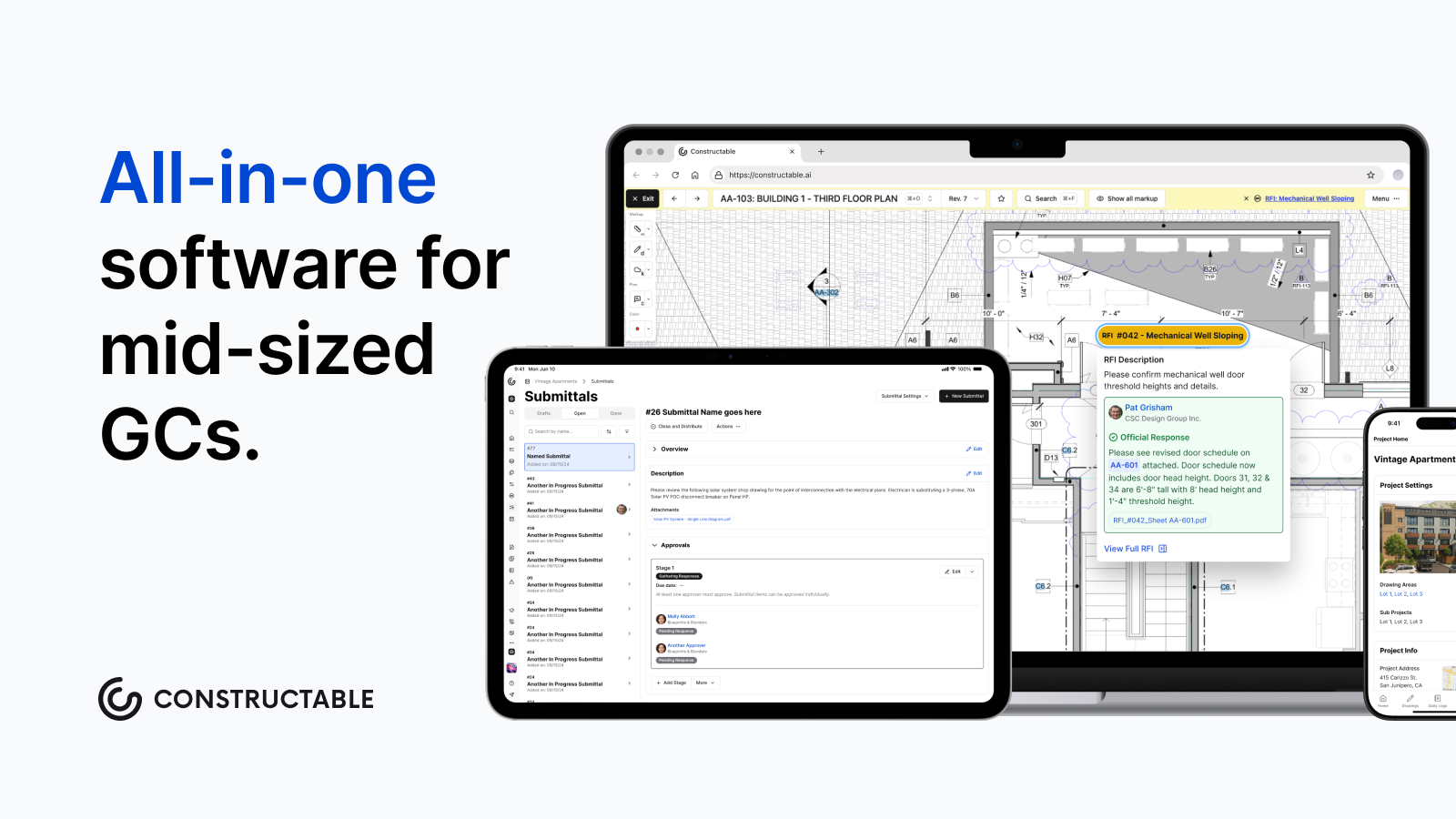
Everything covered so far assumes you can actually find the documents, chase the waivers, and close the punch list without the whole thing turning into a multi-month scramble. That is where a connected system earns its keep. Constructable folds each closeout stage into the work your team already does, so the package is ready when substantial completion arrives.
Punch lists live in Quality Lists, with items pinned to exact drawing locations, assigned to the responsible trade, and moved through Open, In Review, and Completed. The workflow is built around the same needs covered in the best punch list software for GCs, and each item includes its own photo documentation.
Pre-completion walkthroughs run through Inspections, with structured pass/fail results and a PDF export ready for the owner package. Items that require follow-up feed directly into plan-linked punch lists and issue management, so nothing falls through the cracks.
Lien waiver collection is built into the invoicing and pay app process. Conditional waivers are tied directly to payment events, and waiver status remains visible alongside the financials, so there is no need to hunt for a separate document when closeout arrives.
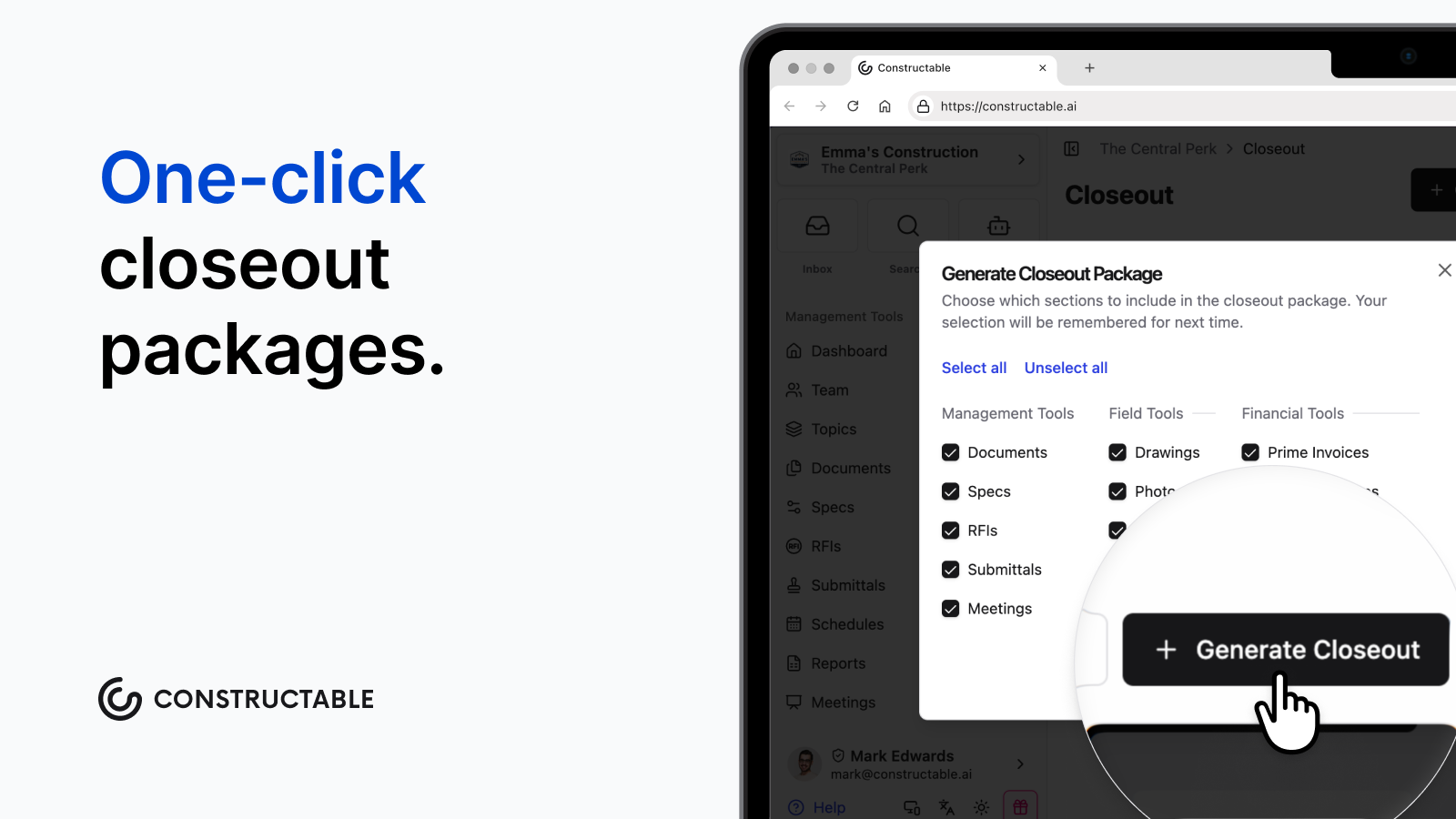
The Closeout feature generates a downloadable .zip file of structured closeout documentation, letting you choose which data types to include rather than assembling files by hand.
The AI Answer Engine retrieves any document, RFI response, daily log entry, or warranty record from a plain-language question, tackling what makes document search so difficult, and every answer links back to its primary source for verification.
Because document storage is project-scoped, everything stays organized within the job it belongs to. Constructable is built for mid-size commercial GCs running $20M to $150M in annual volume, the teams that need closeout to be a clean final step.
Final thoughts on managing construction project closeout
The paperwork at the end of a job is only painful when it gets treated as an afterthought. Tie submissions to milestones, collect waivers with every pay app, and closeout stops being a separate phase. Talk to the Constructable team to see how it fits into the work your crew already does.
FAQs
What documents are typically required for a construction project closeout package?
A complete construction project closeout package includes the certificate of substantial completion (AIA G704), as-built drawings, operation and maintenance manuals, equipment warranties, lien waivers and releases from every tier of the contracting chain, a certificate of occupancy, commissioning and testing reports, training records, and a project closeout report. Missing even one item (a single unsigned lien waiver or a warranty a sub never turned in) holds the entire package and keeps retainage locked. Building this closeout documents checklist early and assigning ownership by trade is the fastest way to avoid that bottleneck at the end.
What's the difference between substantial completion and final completion in construction?
Substantial completion is when the owner can occupy and use the space. It starts the warranty clock and typically triggers a partial retainage reduction, even though punch list items remain open. Final completion comes after all deficiencies are resolved, all closeout documents are accepted, and the final payment application is submitted. Conflating the two is a common source of disputes, especially over when warranty periods began and how much retainage should still be held.
How do I avoid a 500-day closeout on my next commercial project?
Start the construction project closeout process before substantial completion, not after. Tie document submission to trade milestones: when a sub finishes their scope, their warranties and O&M manuals are due while the crew is still on site and reachable. Collect lien waivers with every pay application so conditional and unconditional releases arrive alongside the money, not months after the sub demobilized. Keeping a live closeout checklist as a standing meeting agenda item means the final weeks handle verification, not collection.
Constructable vs. a manual closeout process for mid-size GCs: what actually changes?
With a manual process, document collection stalls because lien waivers, warranties, and as-builts live in email threads, shared drives, and text messages that no one can easily find at closeout. Constructable keeps lien waiver collection built into the pay app workflow, punch list items pinned to drawing locations and tracked through a status workflow, and a Closeout feature that exports a structured .zip package without manual file assembly. The AI Answer Engine can pull any warranty, RFI response, or daily log entry from a plain-language question, with a direct link back to the source, so nothing gets lost in a folder hunt when the owner asks for documentation.
What should a construction project closeout report include?
A construction project closeout report should cover a project summary and scope overview, final budget reconciliation with cost variance analysis, schedule performance against the original timeline, RFI and submittal log outcomes, the change order log with total contract value adjustments, lessons learned for future estimates and schedules, and any unresolved items carried forward as warranty obligations. It serves two purposes: the owner gets an auditable record of what was built and what it cost, and your own team gets real project data to inform the next bid and schedule instead of starting from assumptions.