Filing and Defending Construction Delay Claims September 2026
Build a defensible construction delay claim with the right records and notice habits. A contractor's guide for September 2026.
Getting hit with a project delay is one thing. Turning it into a recoverable claim is something else entirely. Whether you're the one filing or the one defending, the outcome usually comes down to your records, your notice timing, and whether the schedule impact traces back to a defined cause. Here's how to make sure your documentation holds up.
TLDR:
-
A valid delay claim requires a defined cause tied to a responsible party and a quantified impact; being behind schedule alone is not enough.
-
Only critical-path delays support entitlement; compensable delays earn time and money, while excusable non-compensable ones earn time only.
-
Miss your contract's notice window (often 7 to 14 days) and a valid claim can fail on procedure alone.
-
Contemporaneous daily logs, timestamped RFIs, geotagged photos, and schedule updates are what separate recoverable claims from ones that collapse under scrutiny.
-
Constructable logs delays by cause at the moment they occur, tracks RFI ball-in-court with drawing-level timestamps, and keeps all notice communications in one auditable record.
What a construction delay claim actually covers
A construction delay claim is a formal assertion that one party's actions or inactions pushed the schedule out and caused measurable harm. It asks for something concrete: added time, added money, or both. Being behind schedule alone doesn't make a claim. What matters is proving who caused the slip, how the timeline moved, and what that movement cost.
Two things separate a claim from a gripe:
-
A defined cause tied to a responsible party
-
Quantified impact, whether extra days, prolongation costs, or lost productivity
Everything that follows builds on that structure.
Types of construction delays
Every delay analysis starts with one question: did it hit the critical path? A non-critical delay eats float without moving the completion date, so it rarely supports relief. A critical delay pushes the finish, and that's where entitlement lives.
Once a delay is critical, two distinctions decide what you can recover.
An excusable delay comes from something outside the contractor's control, like unusual weather or an owner-directed change directive. A non-excusable delay traces back to the contractor or its subs, and earns no relief. Excusable delays split again: a compensable delay entitles you to time and money, usually owner-caused, while a non-compensable one like force majeure typically earns added time but no added cost.
| Delay type | Time extension | Added cost |
|---|---|---|
| Non-excusable | No | No |
| Excusable, non-compensable | Yes | No |
| Excusable, compensable | Yes | Yes |
Concurrent delays complicate this. When an owner-caused delay and a contractor-caused delay overlap on the critical path during the same period, courts often grant a time extension but deny prolongation costs.
Common causes of construction delay claims
The same triggers show up on job after job:
-
Owner-directed changes that reshape scope mid-build
-
Design errors and omissions buried in the drawings
-
Change order disputes that add cost without clear authorization
-
Unanticipated subsurface conditions once the ground opens up
-
Permitting delays outside anyone's schedule
-
Weather events that shut down the site
-
RFI management and submittal response lag that leaves crews waiting
-
Subcontractor failures that stall the trades downstream
None of this is rare. 77% of project managers experience delays, and those projects run an average of 70 days behind. On a mid-size job, 70 days of extended general conditions can run well into five or six figures before counting acceleration or liquidated damages. That's the exposure a well-built claim protects.
Contract clauses that shape your claim
Your entitlement is written into the contract long before anyone falls behind. Read these clauses before a delay event, not after.
-
Notice provisions set how and when you must flag an event; miss the window and a valid claim can die on procedure. Most construction contracts include provisions detailing how and when you must give notice.
-
No-damages-for-delay clauses bar money recovery even for owner-caused delay, though many states limit their reach.
-
Force majeure clauses define which uncontrollable events earn time.
-
Time-is-of-the-essence language makes every date enforceable.
-
Liquidated damages set a daily rate the owner charges when you finish late.
How courts read these varies by state, so Texas, California, and Florida enforce the same wording differently. Your contract is the first place to look.
How to give proper notice of a delay
Notice is the first thing an owner's attorney checks, and a late or informal one can sink a claim that was otherwise sound. Send written notice the moment you recognize a delay event, not once the impact is clear.
Good notice does a few things at once: it identifies the event and the date you first recognized it, ties it to the responsible party and the affected work, states that time or cost impact is likely even if you can't yet quantify it, and goes to the exact person and location the contract names.
Most contracts give a tight window, often 7 to 14 days from first recognition. Miss it, and the argument moves from what happened to whether you followed procedure. Put it in writing, date it, and keep proof of delivery.
Building the documentation record
A defensible delay claim gets built day by day, not reconstructed after the dispute starts. The file an owner's expert respects usually includes daily logs with categorized delay notations; timestamped RFIs and submittals with full response tracking; photos with date, time, and location metadata; weather records tied to the specific site; baseline schedules alongside every subsequent update; and OAC meeting minutes with dated correspondence.
Quantifying damages is a comparative exercise, and documentation is critical to a contractor's claim. Records on bid pricing, price changes, supply chain disruptions, and the communications behind them can make or break recovery. Treat the record as a daily discipline.
Delay analysis methods
No single method fits every dispute. The method you choose can affect entitlement, causation, concurrency arguments, and whether the claim holds up once records come under scrutiny.
-
As-planned vs. as-built: a simple observational comparison of the baseline against what actually happened. Best for completed, straightforward projects.
-
Impacted as-planned: inserts a fragnet into the baseline to model an event's theoretical effect.
-
Time impact analysis (TIA): tests a single event against the current schedule update, run prospectively or retrospectively.
-
Windows analysis: divides the as-built into periods, well suited to complex, concurrent delay disputes.
-
Collapsed as-built: removes delay events from the as-built to show what the finish date would have been without them.
The right pick depends on record quality, project complexity, and how the schedule was maintained.
Quantifying delay damages and prolongation costs
Once a delay qualifies as excusable and compensable, recovery falls into recognized categories. Extended general conditions cover site supervision, trailers, and temporary utilities held longer than planned. Equipment standing time accrues while crews wait, and labor costs escalate across the extended period. Material storage and price escalation add further exposure, and finance costs build on capital tied up longer than the original schedule allowed.
Owners pursue their own damages: lost revenue, increased financing costs, and liquidated damages offsets against your account.
An extension of time (EOT) claim is a separate remedy. It moves the completion date and shields you from liquidated damages, but time alone carries no money unless the delay is compensable.
The governing regime depends on the contract. A liquidated damages clause sets a daily rate agreed in advance; without it, you must prove actual damages line by line—the wording tells you which applies.
Defenses to construction delay claims
Whether you're pursuing a claim or fielding one, the same defenses come up. Know them cold either way.
-
Concurrent delay: the contractor caused critical-path delay in the same window, so the owner argues neither party owes the other, capping recovery at time only.
-
Failure to mitigate: the claimant let float burn or ignored reasonable steps to limit the impact.
-
No-damages-for-delay enforcement: the clause bars money recovery outright, subject to state-law exceptions for bad faith or active interference.
-
Inadequate or late notice: the event was flagged outside the contractual window, so the claim fails on procedure.
-
No critical-path impact: the delay hit float, not the completion date, so no entitlement follows.
The strongest rebuttal is the contemporaneous record. A defense built on missing notice or unproven causation collapses when the daily logs, schedule updates, and dated correspondence tell a clean story. Understanding why RFI management breaks down is part of building that defense.
Resolving delay claims without litigation
Most delay claims settle long before a courtroom, and the path there follows a predictable escalation. Direct negotiation comes first, then mediation with a neutral third party, then a dispute review board where projects use one, then arbitration, and litigation last. Each step up costs more time, more money, and more goodwill with a party you may work with again.
Early informal resolution protects margins and relationships that formal proceedings tend to burn. Documentation drives your position at every rung; a clean, contemporaneous record settles a claim in negotiation that a thin one drags into arbitration.
How Constructable supports delay claim documentation
Delay claims fail at the documentation layer. When records live in email threads, spreadsheets, and disconnected tools, no one can reconstruct a coherent timeline once the claim comes under scrutiny.
Constructable keeps the record in one place as work happens:
-
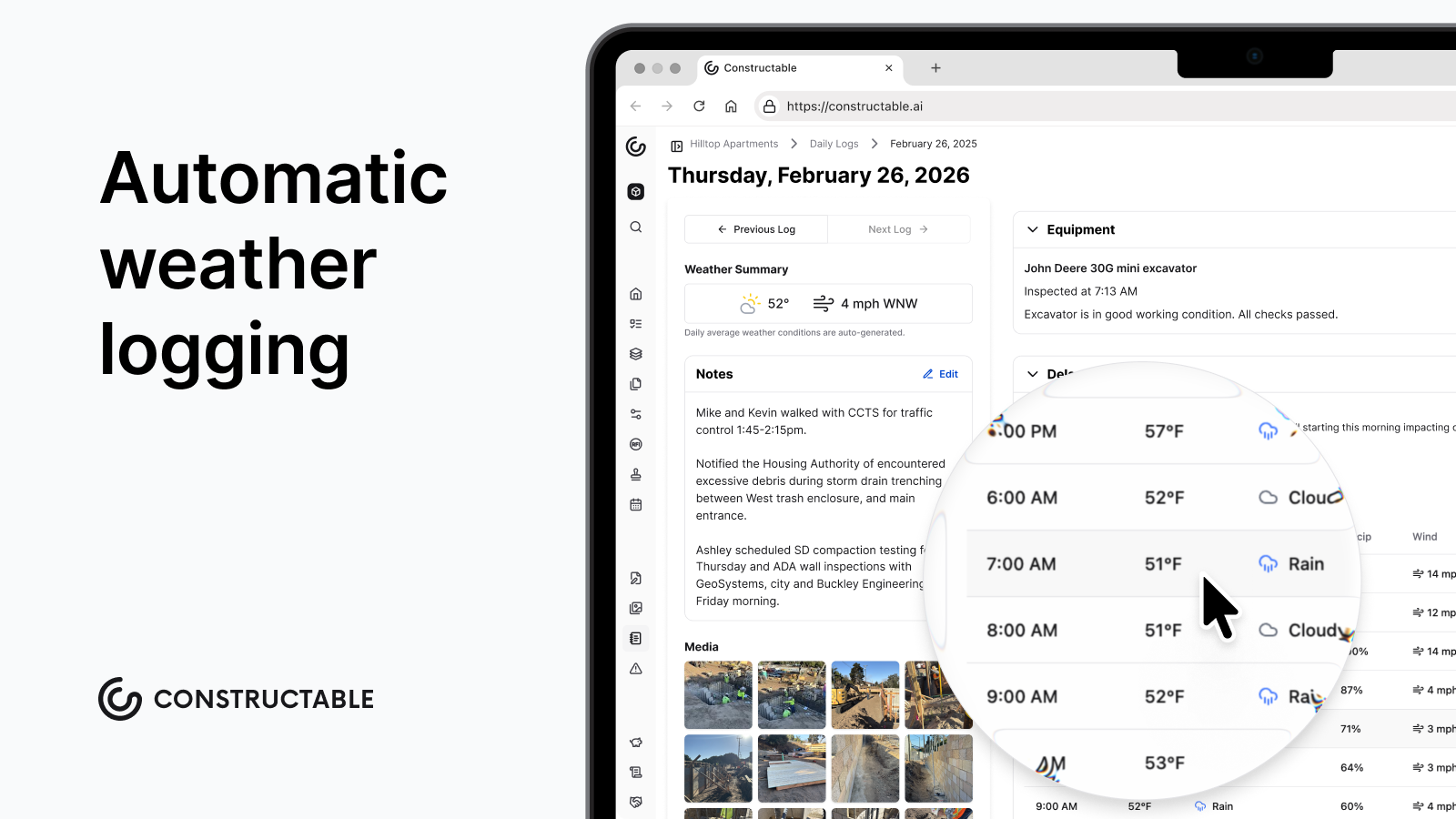
Daily log and field reporting software categorizes delays by cause (weather, permitting, owner directive, waiting on RFI or submittal) at the moment they occur, with hourly weather pulled automatically by project zip code.
-
RFI ball-in-court tracking pins timestamps to exact drawing locations, so every unanswered coordination question has a spatial and chronological trail.
-
Jobsite photo documentation captures geotag coordinates and timestamps through the watermark overlay, producing defensible visual evidence without external tools.
And because Constructable is flat-fee with unlimited users, subcontractors and owners sit in the same project record. Notice communications and response tracking live in one auditable location, not scattered email chains.

Final thoughts on construction delay claims and how to protect your recovery
Delay claims reward preparation and punish reconstruction. The contractors who recover time and money are the ones who treat notice and documentation as daily habits, not crisis responses. Your record is your argument, so the best time to build it is before anyone disputes anything. Talk to the Constructable team to see how it fits into the way your crews already work.
FAQs
What's the difference between a compensable delay and a non-compensable delay in construction?
A compensable delay entitles the contractor to both a time extension and added cost recovery. The owner typically causes it, such as a directed scope change or a failure to respond to RFIs. A non-compensable excusable delay, like a force majeure event, earns added time but no additional money. The distinction lies in who caused the delay, not just whether it was within anyone's control.
What documentation do I actually need to support a construction delay claim?
Build the file as work happens, not after the dispute starts: contemporaneous daily logs with delay causes categorized by type, timestamped RFIs and submittals with full response tracking, photos with date and location metadata, weather records tied to the project site, and baseline schedules alongside every subsequent update. Quantifying prolongation costs (extended general conditions, equipment standby, labor escalation) is a comparative exercise, and that comparison only holds up when records show what was planned versus what actually happened, day by day.
What are the main defenses to construction delay claims, and how does the contractor's own record affect them?
See the defenses section above for the full breakdown of concurrent delay, notice failures, no-damages-for-delay clause enforcement, failure to mitigate, and no-critical-path-impact arguments. In each case, a clean contemporaneous record is the contractor's strongest rebuttal.
What delay analysis methods are used in construction delay claims?
The five methods in regular use are as-planned vs. as-built, impacted as-planned, time impact analysis (TIA), windows analysis, and collapsed as-built. The body section above covers all five methods and when to use each.
Can Constructable help build the documentation record needed for a construction delay claim?
Yes. Constructable captures the record in real time, so you don't have to reconstruct anything after a dispute starts. Daily logs categorize delays by cause as they occur, with weather pulled automatically by project zip code. RFIs carry timestamps and ball-in-court tracking pinned to exact drawing locations. Photos carry geotag coordinates and timestamps through the watermark overlay. The AI Answer Engine queries across all of those records at once and links back to the source document, so assembling a claim package means retrieving an existing record, not rebuilding one from email threads and disconnected files.