What Are Construction Submittals? Definition, Types & Best Practices (May 2026)
Learn what construction submittals are, the main types, and how to manage them without delays. Complete guide with best practices for May 2026.
Most teams treat submittals like a formality—something to check off and move on from. The teams that stay on schedule see them differently. Submittals are an early warning system. When they move fast and come back clean, everything downstream stays on track. When they pile up, get rejected, or sit in someone's inbox waiting for a review, the schedule quietly starts to slip. The definition is simple enough. Managing them without constant friction is where the work actually lives.
TLDR:
- Submittals are formal documents proving materials match project specs before installation begins.
- Rejection rates are high across the industry, and most stem from incomplete packages, wrong products, or skipping the GC preliminary review.
- Mapping every required submittal to lead times before mobilization prevents late-breaking schedule problems.
- Constructable keeps submittals, RFIs, and drawings in one place, with an AI Answer Engine that pulls answers from across your project with direct links to the source.
- Most rejections stem from incomplete packages, wrong products, or skipping the GC preliminary review.
- Mapping every required submittal to lead times before mobilization prevents late-breaking schedule problems.
- Constructable connects submittals directly to drawings and uses AI to flag missing information before routing.
What Are Construction Submittals?
Before a single piece of material gets installed on a job site, someone has to prove it belongs there. That's the job of a submittal.
A submittal is a formal document, sample, product data sheet, or drawing that a contractor sends to the architect or engineer for review and approval before work begins. Think of it as a checkpoint: the design team confirms that what you're planning to use actually matches what the project specifications require.
Submittals don't protect just the owner. They protect you. If a material gets rejected after installation because it wasn't approved, that's your problem to fix, on your dime. Getting sign-off upfront keeps the work moving and keeps disputes off the table.
Every project has them. The question is whether you manage them well or let them manage you.
Submittal vs Submission: Understanding the Difference
"Submittal" and "submission" sound interchangeable, and in everyday English, they basically are. But in U.S. construction, they carry distinct meanings, and mixing them up signals you might be new to the room.
A submission is the act of sending something. You make a submission when you file a form, turn in a bid, or email a document. It describes the action itself.
A submittal is the thing you send. It's the package: shop drawings, product data sheets, samples, or calculations prepared for the design team's review. In contracts, specifications, and project logs, "submittal" is the standard term. It's what the specs reference, what gets logged and tracked, and what comes back stamped approved or rejected.
So if someone asks for "the submittal," they want the document. If they ask about "the submission," they're probably asking whether you sent it yet.
Common Types of Construction Submittals
Not all submittals are created equal, and knowing which type you're dealing with changes how you handle it.
Product Data
Product data submittals are manufacturer spec sheets, cut sheets, and technical literature that confirm a product meets the spec requirements. These are the most common type on a typical commercial project. If you're going to get your process dialed in anywhere, start here.
Shop Drawings
Shop drawings are detailed fabrication or installation drawings prepared by a subcontractor, supplier, or manufacturer. Structural steel connections, custom millwork, precast panels, anything built to specific dimensions gets a shop drawing. The design team reviews them to confirm fit and intent before fabrication starts.
Samples
Physical samples, such as a flooring sample, a paint chip, or a brick section, are submitted so the architect can approve the color, texture, or finish. Simple in concept, but slow in practice. Plan for lead time.
Other Types
Beyond the big three, you'll also run into:
- Test reports and certifications, such as concrete mix designs and compressive strength results
- Operation and maintenance manuals, which are typically required at closeout
- Warranties and guarantees from manufacturers or subcontractors
- Engineering calculations for structural or MEP systems
| Submittal Type | Primary Purpose | Typical Contents | Review Focus |
|---|---|---|---|
| Product Data | Confirm manufactured products meet specification requirements before ordering | Manufacturer spec sheets, cut sheets, technical literature, performance data, installation instructions | Compliance with spec section requirements, product features, warranties, certifications |
| Shop Drawings | Verify custom fabrication details and dimensions before manufacturing begins | Detailed fabrication drawings, connection details, material specifications, dimensional layouts | Fit with structural systems, dimensional accuracy, compliance with design intent |
| Samples | Approve aesthetic qualities like color, texture, and finish before bulk ordering | Physical material samples, finish mockups, color chips, texture boards | Visual appearance, color match, texture consistency, finish quality |
| Test Reports | Document material performance and quality control results | Concrete mix designs, compressive strength tests, soil reports, material certifications | Compliance with performance specifications, testing methodology, lab certifications |
| O&M Manuals | Provide operating guidance and maintenance requirements for building systems | Equipment operation procedures, maintenance schedules, parts lists, warranty information | Completeness, accuracy of equipment coverage, maintenance detail, warranty terms |
The Construction Submittal Process Explained
The process looks simple on paper. In practice, it's where projects either stay on schedule or quietly start to fall apart.
Here's how it typically flows:
- The subcontractor or supplier prepares the submittal based on the project specs
- The GC reviews it first, checking that it's complete, correctly formatted, and actually relevant before forwarding
- The architect or engineer reviews for technical compliance and stamps it: approved, approved as noted, revise and resubmit, or rejected
- The approved submittal goes back down the chain before work or ordering begins
That last stamp matters more than people realize. Rejection rates across the industry are high, and every rejected submittal costs you time, rework, and schedule buffer you probably didn't have to spare.
Most rejections stem from the same problems: submittals sent before they're ready, missing information, or the wrong product entirely. The GC's preliminary review is the catch point, and it only works if someone is actually paying attention.
Why Submittals Matter for Project Success
Fixing a mistake on paper costs you an hour. Fixing it after installation costs you a week and a painful conversation with your owner.
That's the core logic behind submittals. They exist to catch misalignments early, before materials are ordered, fabricated, or bolted into place. A rejected shop drawing is frustrating; a rejected structural connection after the steel is up is a disaster.
Specification Compliance
Every approved submittal is proof that what's going into the building meets the contract requirements. That paper trail matters at closeout, during inspections, and any time a dispute surfaces. If an owner claims a material wasn't to spec, your approved submittals are what you point to.
Coordination Before Installation
Submittals force coordination issues into the open early. When the mechanical contractor submits equipment data that doesn't fit the structural opening, the conflict surfaces in a review comment, not during rough-in. That's a phone call, not a change order.
Quality Control Throughout the Job
Submittals create a running record of what was approved and when, across every trade and every phase. That record is what makes project audits manageable and owner disputes short.
The projects that struggle with submittals aren't short on paperwork. They're short on process.
Best Practices for Managing Construction Submittals
Most submittal problems are planning issues that surface late, usually at the worst possible time.
A few habits separate teams that stay ahead from teams scrambling on Friday afternoon:
- Build your submittal schedule before mobilization, not during. Map every required submittal to its specification section, responsible sub, and lead time. Long-lead items like custom steel, mechanical equipment, and specialty glazing need to move first. A detailed submittal log keeps everyone aligned on deadlines and dependencies.
- Standardize your format. A consistent cover sheet with the project name, spec section, sub, date, and revision number cuts review time on both ends.
- Set a review window and stick to it. Seven to fourteen days is the industry standard for most submittals. Document it in your subcontracts. If the design team needs more time, get that in writing early.
- Review internally before forwarding anything. If a submittal leaves your desk incomplete, the rejection comes back to you, not the sub.
Your submittal log is an early warning system. When it starts slipping, the schedule follows. Digital submittal workflows help construction businesses save 6-9% on costs, primarily by reducing errors and optimizing resource allocation.
How Constructable Simplifies Submittal Management
Most submittal headaches aren't about the work itself. They're about the paper getting lost, misrouted, or reviewed in a vacuum while the drawings live somewhere else entirely.
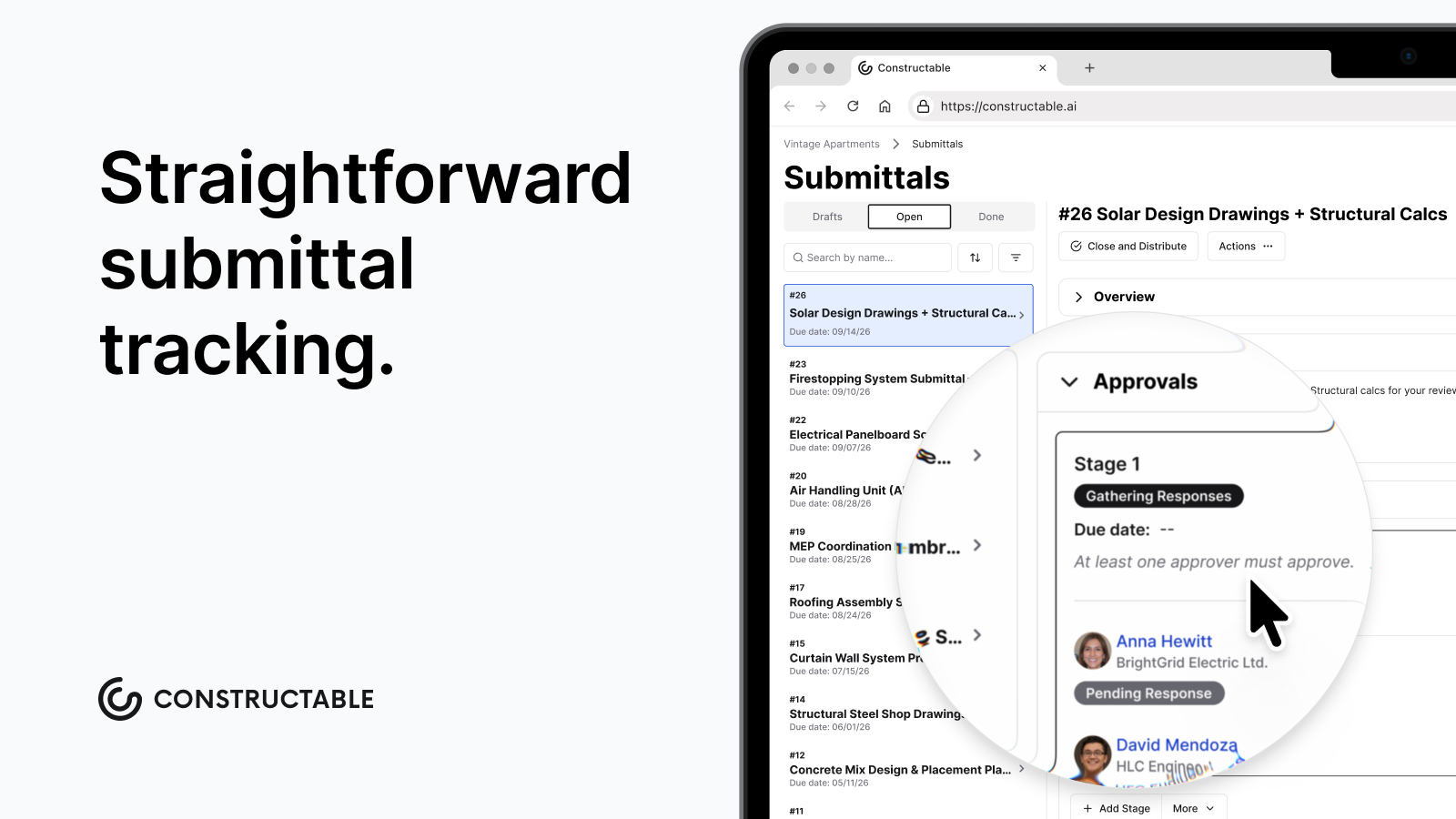
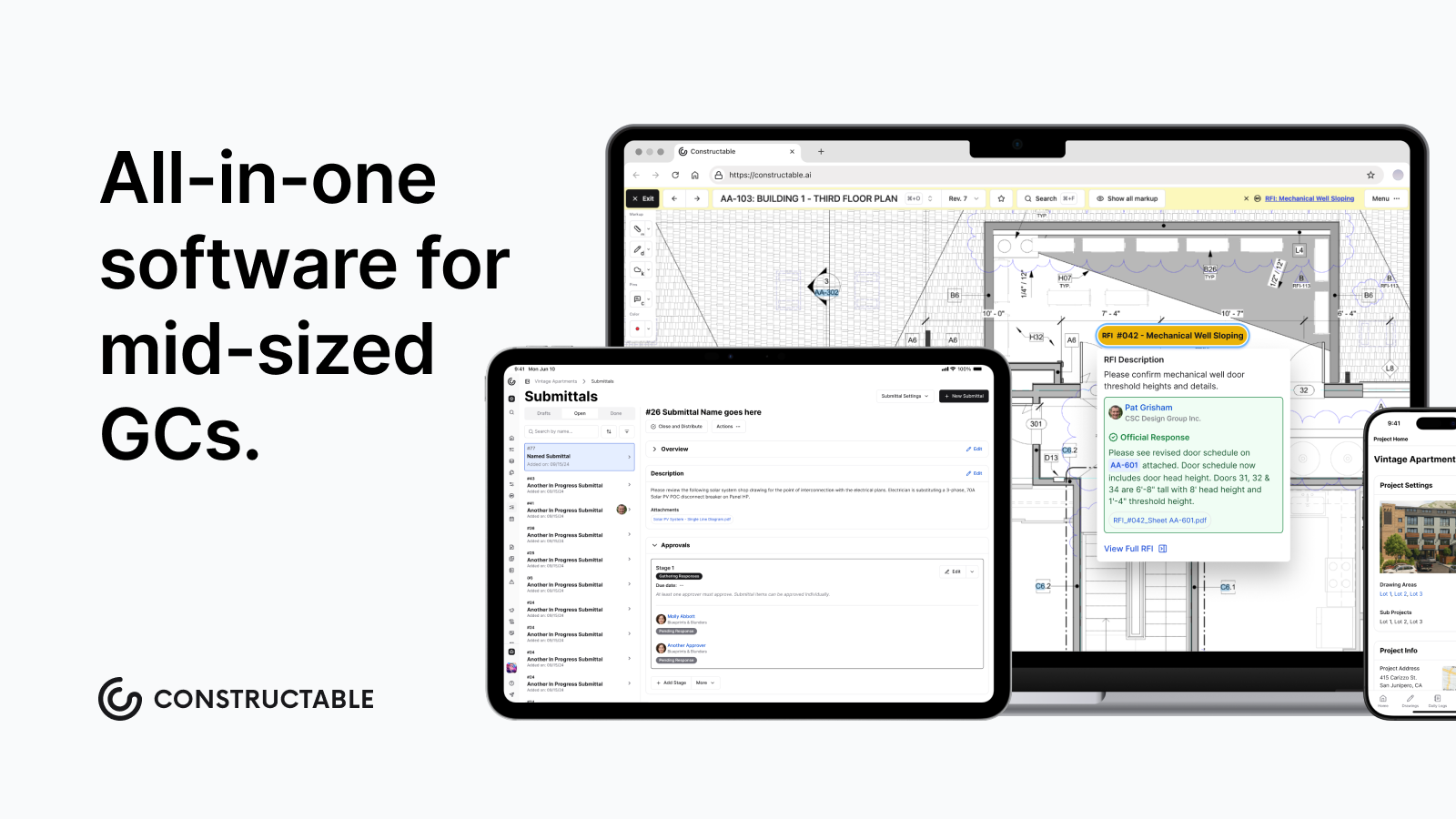
Constructable keeps Submittals, their corresponding Specs, RFIs, and drawings all in one place. When it's time to get a Submittal approved, all the relevant documents are available and reviewers can quickly jump between submittal documents, the project's Specs, and the drawings, not a separate email thread nobody can find two weeks later. Reviews happen where the context already lives.
When a question comes up, reviewers can use the AI Answer Engine to pull the answer from your plans, photos, documents, and logs, with direct links to the source, so nothing gets lost in translation.
Your log stays current. Your team stays informed. And nothing slips because someone forgot to cc the right person.
Final Thoughts on the Construction Submittal Process
The submittal process won't make or break your project on its own, but it quietly determines whether you're ahead of problems or constantly reacting to them. W of rework that eats up both time and budget. Talk to us if you want your submittal workflow to stop being a bottleneck. You've got better things to do than chase down approvals and track down missing documents.
FAQ
What's the main difference between submittals and submissions in construction?
A submittal is the document package itself: shop drawings, product data, and samples. Submission is the act of sending it. In contracts and specs, "submittal" is the standard term for the material you're getting approved, not the process of turning it in.
How long should I plan for submittal review?
Seven to fourteen days is standard for most submittals, but long-lead items like custom steel or mechanical equipment can take longer. Document the review window in your subcontracts upfront and build that time into your schedule before mobilization.
Submittal vs submission examples in actual project use?
The spec requires three submittals for the curtain wall system (that's the documents). Your submission of those submittals happened last Tuesday (that's when you sent them). If the architect asks, "Where's the submittal?" they want the package, not a status update.
When should I start my submittal schedule?
Before mobilization. Map every required submittal to its spec section, responsible sub, and material lead time as soon as the contract is signed. Waiting until you're on site means long-lead items can delay your critical path before you even realize it.