Job Hazard Analysis (JHA): Construction Template (November 2026)
A job hazard analysis breaks a task into steps, hazards, and controls. Get a construction JHA template, a worked example, and when to update it.
Your MEP sub is about to core 14 holes and saw-cut a duct chase through a post-tensioned slab, with the drywall crew working on the floor below. The foreman hands you their job hazard analysis. It lists "be careful," "wear PPE," and "keep area clean," and it could belong to any task on any job. It doesn't say who scanned for tendons, what keeps the core from dropping onto the drywall crew, or how the dust is controlled. If something goes wrong tomorrow, that page is what the owner, your insurer, and an OSHA compliance officer will read first.
TLDR:
- A job hazard analysis (JHA) breaks one task into steps, lists the hazards in each step, and names the controls that will be in place before anyone starts.
- A JHA and a job safety analysis (JSA) are the same document under two names. A USACE Activity Hazard Analysis (AHA) covers a whole definable feature of work, and a pre-task plan (PTP) is the crew's daily version that points back to the JHA.
- Federal OSHA's construction rules don't use the term "job hazard analysis," but they require accident prevention programs and hazard training, and many contracts and owners require a written JHA before the work starts.
- The template and the worked example below rate each step's risk before and after controls, and label every control by its level in the hierarchy of controls.
- A JHA is never finished. Update it when the scope, crew, equipment, or conditions change, and after every near miss or incident on that task.
- Constructable runs a JHA as a work plan with sign-offs and a hold point, checks the controls with inspections, and keeps near misses and their investigations in Incidents.
What is a job hazard analysis (JHA)?
A job hazard analysis is a written review of one task, done before the task starts. OSHA's guide to the method, Job Hazard Analysis (OSHA 3071), describes it as a technique that "focuses on job tasks as a way to identify hazards before they occur," looking at the relationship between the worker, the task, the tools, and the work environment.
On a construction job, a JHA answers four questions for each step of the task:
- What does the crew do in this step?
- What can hurt someone while they do it?
- What will be in place to stop that from happening?
- Who makes sure it's in place?
Who writes it. The foreman or the competent person for the trade doing the work writes the JHA with the crew that will do it. The crew knows where the job bites. The GC's superintendent or safety manager reviews it before the work starts, and the crew signs it to show they've been through it.
When it's done. Before the task starts, and again whenever the task changes. A JHA written after the work starts, or after an incident, is paperwork, not planning.
What it's for. A good JHA does three jobs. It makes the foreman think through the task step by step before the crew is standing on the slab. It trains the crew on the plan. And it gives the GC a record that the hazards were identified and controlled, which matters when an inspector, an owner, or a lawyer asks.
JHA vs JSA vs AHA vs pre-task plan
GCs, subs, owners, and federal agencies use different names for overlapping documents. Here's how they compare.
| Document | Scope | Who writes it | When | Where it lives |
|---|---|---|---|---|
| Job hazard analysis (JHA) | One task, broken into steps, such as coring an elevated slab | The trade's foreman or competent person, with the crew; reviewed by the GC's super or safety manager | Before the task starts; updated when it changes | Project safety files, and on site while the task runs |
| Job safety analysis (JSA) | Same as a JHA | Same as a JHA | Same as a JHA | Same as a JHA |
| Activity Hazard Analysis (AHA) | One definable feature of work on a USACE or other federal project, such as all concrete coring and cutting | The contractor doing the work; the government accepts it | Before that feature of work starts | Project safety files, and on site while the work runs |
| Pre-task plan (PTP) | One crew's work for one shift | The crew's foreman, with every worker signing | At the start of each shift, and again when conditions change | With the day's records, such as the daily log |
| Toolbox talk | A safety topic, such as silica or ladder use | The foreman or safety manager | Weekly or daily, by company policy | Sign-in sheet in the safety files |
JHA vs JSA. There's no difference in practice. OSHA's own publication uses both terms. Some companies say JSA, especially in industrial and oil and gas work, and many construction companies say JHA. Use whatever your safety program calls it and make sure the content is the same.
AHA. The Activity Hazard Analysis is the US Army Corps of Engineers term. Its safety manual, EM 385-1-1 (the current edition is dated 15 March 2024), requires an AHA for each definable feature of work on Corps projects, and other federal agencies adopt the manual by contract. The contractor doing the work prepares it, and the work doesn't start until the government has accepted it. An AHA covers more ground than one JHA: a definable feature of work, such as "cast-in-place concrete" or "roofing," usually holds several tasks. If you work on Corps jobs, write to the manual's AHA format, because the government reviewer will.
Pre-task plan. A PTP is the crew's daily check. It names today's work, today's crew, and today's conditions, and points back to the JHA for the full analysis. When the PTP turns up something the JHA didn't cover, such as a new crew member, rain, or a different area, the JHA gets updated.
Toolbox talk. A toolbox talk is training. It teaches a topic, and it doesn't analyze a specific task. A talk on silica before the coring starts is a good idea, but it doesn't replace the JHA.
When do you need a job hazard analysis?
What OSHA says
Federal OSHA's construction standards, 29 CFR Part 1926, don't use the term "job hazard analysis." Two general requirements are what JHAs are usually built to meet:
- 29 CFR 1926.20(b) requires employers to start and maintain accident prevention programs, and those programs must provide for "frequent and regular inspections of the job sites, materials, and equipment to be made by competent persons designated by the employers."
- 29 CFR 1926.21(b)(2) requires the employer to "instruct each employee in the recognition and avoidance of unsafe conditions" and the regulations that apply to their work.
Some specific standards require written plans that overlap with a JHA. The construction silica standard, 29 CFR 1926.1153, requires a written exposure control plan for work that creates silica dust and a competent person to carry it out. A JHA for coring or saw-cutting concrete should point to that plan, not replace it.
State plans can go further. California, for example, requires every employer to have an Injury and Illness Prevention Program under 8 CCR 3203 that includes identifying and evaluating workplace hazards. Check your state plan's rules if you work outside federal OSHA jurisdiction.
What contracts and owners say
On most commercial jobs, the contract is what makes a JHA mandatory. Many GCs require a written JHA from every subcontractor before it mobilizes or starts each new task, and many owners write the same requirement into the GC's contract. On USACE projects, EM 385-1-1 requires the AHA. Read your subcontract and the owner's safety requirements to see exactly what's due, when, and in what format.
Which tasks need one first
You can write a JHA for almost any task. OSHA 3071 says to give priority to:
- Jobs with the highest injury or illness rates. On a jobsite, that's work at height, overhead work, and anything near energized equipment.
- Jobs with the potential for severe or disabling injury, even if nobody has been hurt doing them yet, such as steel erection, trenching, and crane picks.
- Jobs where one simple error could cause a severe injury, such as cutting into a PT slab or opening a floor.
- Jobs that are new to your operation or have changed, such as a new means and methods, new equipment, or a new sub.
- Jobs complex enough to need written instructions, such as a critical lift or a confined space entry.
How to do a job hazard analysis in 6 steps
OSHA 3071 lays out the method. Here it is in jobsite terms.
1. Pick the task. Use the priority list above, and look at your three-week look-ahead for what's coming. A JHA that arrives the morning the work starts is too late to change the plan. Tying JHA due dates to the look-ahead schedule gives the sub and the super a week or more to work it out.
2. Break it into steps. OSHA 3071 says to watch the work being done and list each step as the worker takes it. If the task hasn't started yet, walk it with the foreman. Five to ten steps is usually right. Fewer and you're skipping things. More and you're writing the operator's manual. Describe what the crew does ("set up and anchor the core rig"), not the hazard ("electrical safety").
3. Identify the hazards in each step. For each step, OSHA 3071 asks:
- What can go wrong?
- What are the consequences?
- How could it arise?
- What are other contributing factors?
- How likely is it that the hazard will occur?
Check every step against OSHA's construction Focus Four: falls, struck-by, caught-in or between, and electrocution. Then add health hazards, such as silica, noise, and heat, and site conditions, such as other trades working below or beside you. Review the project's near misses and incidents too. OSHA 3071 treats near misses as a sign that the existing controls may not be enough.
4. Rate the risk. Score each hazard by how likely it is and how bad it would be, before any controls. The rating tells you which steps need the most attention. See the risk matrix below.
5. Pick controls from the top of the hierarchy down. Start by asking whether you can remove the hazard. Then whether you can do the work a safer way. Then engineering controls, administrative controls, and last, PPE. Write each control so someone could check it on site: "GFCI on every cord" can be checked, and "use caution with electricity" can't. Then rate the risk again with the controls in place.
6. Review it with the crew and have them sign. Go through the JHA with every worker who'll do the task, before they start. Change it when they point out something you missed, which they will. Then everyone signs. The GC's super or safety manager signs that it was reviewed.
A simple risk matrix
OSHA doesn't prescribe a scoring method for a JHA. Rating risk with a likelihood and severity matrix is common practice, and it makes the JHA easier to review because the high-risk steps stand out. Here's a simple one on a 1 to 5 scale.
| Score | Likelihood | Severity |
|---|---|---|
| 1 | Rare: hasn't happened on jobs like this | First aid only |
| 2 | Unlikely: could happen, but not expected | Medical treatment, no lost time |
| 3 | Possible: has happened on jobs like this | Lost-time injury or illness |
| 4 | Likely: will probably happen at some point on this task | Permanent injury or serious illness |
| 5 | Almost certain: expect it without controls | Fatality or multiple serious injuries |
Multiply likelihood by severity for a score from 1 to 25, and set a rule for each band:
| Risk score | Rating | What happens |
|---|---|---|
| 1 to 4 | Low | Proceed with the controls listed. |
| 5 to 9 | Medium | Proceed once the super has reviewed the controls. |
| 10 to 16 | High | Add controls from higher in the hierarchy before work starts. |
| 20 to 25 | Critical | Don't start. Redesign the task. |
Severity rarely changes much with controls, because a fall through a floor opening is still a fall if it happens. Good controls bring the likelihood down. If a step still rates High after controls, the work doesn't start until the safety manager and the super agree on more.
Job hazard analysis template
Copy this template for any construction task. The header records the task and the conditions. The table is the analysis. The sign-on block shows who reviewed it.
Header
| Field | Fill in |
|---|---|
| Project | |
| Job or task | |
| Location (building, level, area) | |
| Date and planned start | |
| Company | |
| Prepared by (foreman or competent person) | |
| Reviewed by (GC superintendent or safety manager) | |
| Crew size | |
| Equipment and tools | |
| Required PPE | |
| Permits and plans required (hot work, energized work, silica exposure control plan, lift plan) | |
| Related JHAs, pre-task plans, or inspections |
Analysis
| Step | Hazards | Risk before (L × S) | Controls (hierarchy level) | Risk after (L × S) | Responsible |
|---|---|---|---|---|---|
| 1. | |||||
| 2. | |||||
| 3. | |||||
| 4. | |||||
| 5. |
Label each control with its level: Elimination, Substitution, Engineering, Administrative, or PPE. A reviewer can then see at a glance whether the JHA leans on PPE.
Crew sign-on
| Name | Company | Signature | Date |
|---|---|---|---|
By signing, each worker confirms they reviewed this JHA, understand the hazards and controls, and will stop work and tell the foreman if conditions change.
Before work starts
The foreman checks these on the morning the task starts, with the crew:
Job hazard analysis example: core drilling an elevated slab
Here's a filled-in JHA for a common task on a commercial building: core drilling and saw cutting an elevated post-tensioned slab for MEP penetrations.
Task: Core 14 four-inch holes for plumbing and sprinkler risers and saw-cut one 24 by 36 inch opening for a duct chase through the Level 3 slab. The slab is post-tensioned. The drywall crew is working on Level 2 below. The cores are cut with a rig-mounted core drill with water feed, and the opening with a walk-behind saw with water feed.
Required PPE: Hard hat, safety glasses, gloves, hearing protection, and, for the saw cutting, a respirator with an assigned protection factor (APF) of at least 10.
Permits and plans: Coring permit signed by the GC superintendent after the scan. The sub's written silica exposure control plan.
| Step | Hazards | Risk before | Controls (hierarchy level) | Risk after | Responsible |
|---|---|---|---|---|---|
| 1. Lay out penetrations and scan the slab | Cutting a PT tendon (sudden release, structural damage); cutting energized conduit (shock) | 3 × 5 = 15 High | Move any hole that lands on a tendon or conduit (Elimination). Ground-penetrating radar (GPR) scan by a qualified scanning tech, with tendons, rebar, and conduit marked on the slab (Administrative). Engineer of record approves locations near tendons. Super signs the coring permit before any drilling (Administrative). | 1 × 5 = 5 Medium | Scanning tech, MEP foreman, GC super |
| 2. Set up controlled access below | Core or slab piece falling on workers on Level 2; slurry dripping on workers or equipment | 3 × 4 = 12 High | Barricade and sign each area below the cuts, and keep it closed until the openings are covered (Administrative). Plastic sheeting and containment under each cut (Engineering). Radio contact between the operator and a worker below (Administrative). | 1 × 4 = 4 Low | MEP foreman, GC super coordinates with drywall foreman |
| 3. Set up and anchor the core rig; run water and power | Rig spins or tips if the anchor fails (struck-by); shock from corded tools on a wet slab; trips on hoses and cords | 3 × 4 = 12 High | Anchor or vacuum base per the manufacturer (Engineering). GFCI on every 120-volt temporary receptacle, per 29 CFR 1926.404(b)(1) (Engineering). Cords inspected before use and connections kept off the wet slab (Administrative). | 1 × 4 = 4 Low | Core drill operator |
| 4. Wet-cut the cores | Respirable crystalline silica; noise; hands caught if the bit binds | 4 × 4 = 16 High | Rig-mounted core drill with integrated water delivery to the cutting surface, per Table 1 of 29 CFR 1926.1153 (Engineering). Hands stay clear of the bit while it turns (Administrative). Hearing protection, safety glasses, gloves (PPE). | 2 × 3 = 6 Medium | Core drill operator |
| 5. Saw-cut the duct opening | Silica; kickback; slab piece dropping when cut free; noise | 4 × 4 = 16 High | Walk-behind saw with integrated water delivery to the blade, and exhaust ventilation indoors (Engineering). Slab piece shored from below before the last cut (Engineering). APF 10 respirator, which Table 1 requires for this saw indoors (PPE). Hearing and eye protection (PPE). | 2 × 3 = 6 Medium | Saw operator, MEP foreman |
| 6. Remove the core or slab piece and cover the opening | Fall through or trip into the new opening; tools or debris dropped through it | 3 × 5 = 15 High | Cover each opening right away. Covers are secured, marked "HOLE" or "COVER," and support at least twice the weight of workers, equipment, and materials on them, per 29 CFR 1926.502(i) (Engineering). Super checks covers each shift (Administrative). | 1 × 5 = 5 Medium | MEP foreman, GC super |
| 7. Clean up slurry and debris | Silica from dried slurry; slips on wet slurry | 3 × 3 = 9 Medium | Wet vacuum or HEPA-filtered vacuum. No dry sweeping or compressed air, per 29 CFR 1926.1153(f) (Engineering, Administrative). Clean up before slurry dries (Administrative). | 1 × 3 = 3 Low | Core drill operator |
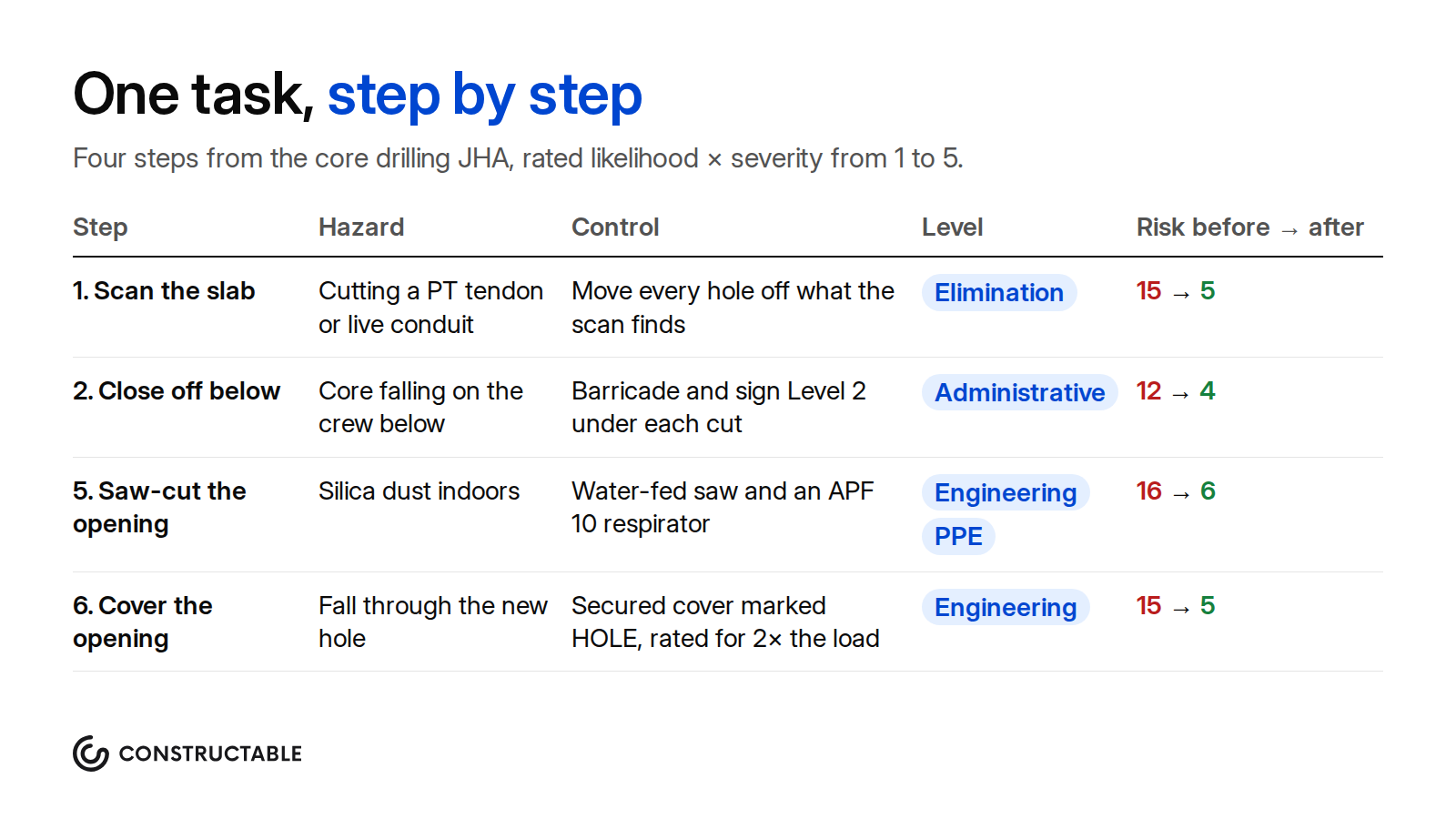
Why these controls
Step 1, scanning. Cutting a tendon can release it with enough force to injure anyone nearby and damage the structure, so the safest control is to keep the cut away from it. The scan tells you where the tendons are, and moving the hole removes the hazard. The permit makes sure nobody drills before the scan is done.
Step 2, controlled access below. The hazard is to people who aren't on the coring crew. A barricade and a radio are cheap, and they're the only thing between a falling core and the drywall crew.
Step 3, setup. Water and corded tools together are an electrocution hazard. OSHA requires GFCIs on 120-volt, single-phase, 15- and 20-amp temporary receptacles on construction sites, or an assured equipment grounding conductor program. GFCIs are simpler to check on site.
Step 4, coring. Table 1 of the silica standard lists rig-mounted core saws and drills. With a tool that has integrated water delivery to the cutting surface, operated and maintained to minimize dust, Table 1 requires no respirator, at any duration.
Step 5, saw cutting. Table 1 treats walk-behind saws differently. Even with integrated water delivery, a walk-behind saw used indoors or in an enclosed area needs a respirator with an APF of at least 10, at any duration. Outdoors, it needs none. Table 1 also requires exhaust ventilation indoors as needed to keep visible dust from building up. Shoring the piece before the last cut keeps it from dropping onto Level 2.
Step 6, covering the opening. OSHA's fall protection standard requires that covers be secured against displacement, marked "HOLE" or "COVER," and able to support at least twice the weight of employees, equipment, and materials on them. Covering each core hole as it's finished keeps the slab from filling with open holes.
Step 7, cleanup. Wet slurry isn't a dust hazard, but dry slurry is. The silica standard bars dry sweeping and compressed air where they could contribute to exposure, unless the alternatives aren't feasible.
The hierarchy of controls on a jobsite
NIOSH's hierarchy of controls ranks controls from most to least effective: elimination, substitution, engineering controls, administrative controls, and PPE. Controls at the top change the work so the hazard isn't there. Controls at the bottom depend on people doing the right thing every time.
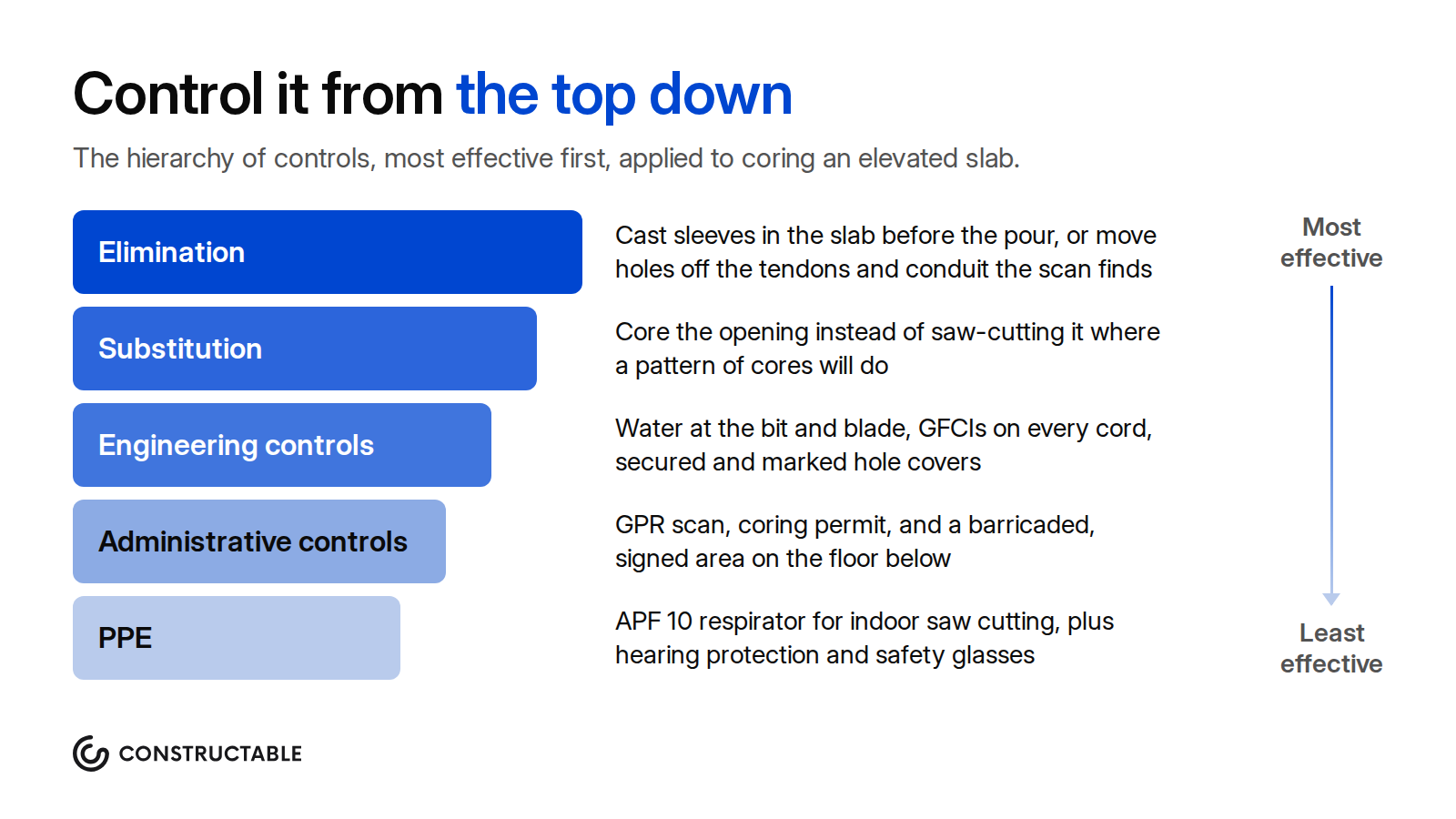
Elimination. Remove the hazard. The best way to avoid coring a PT slab is to cast sleeves in the slab before the pour, so there's nothing to cut. On this job it's too late for Level 3, but the MEP coordination for Levels 4 and 5 can put the sleeves in the pour. Moving a hole off a tendon is elimination too.
Substitution. Do the work a less hazardous way. Where a core will do, a rig-mounted core drill with water feed needs no respirator under Table 1, while a walk-behind saw indoors needs an APF 10 respirator. A duct chase that can be built from a pattern of cores instead of a saw-cut rectangle trades a respirator task for one that doesn't need one.
Engineering controls. Change the equipment or the workplace so the hazard can't reach the worker: water delivery at the bit and blade, exhaust ventilation, GFCIs on the cords, shoring under the slab piece, and secured hole covers.
Administrative controls. Change how people work: the GPR scan and coring permit, controlled access below, radio contact, a hole-cover check each shift, and cleaning up slurry before it dries. Administrative controls work only if someone follows them every time, which is why a JHA names who's responsible.
PPE. The last line of defense. An APF 10 respirator for indoor saw cutting, as Table 1 requires, plus hearing protection, safety glasses, and gloves. PPE belongs on every JHA, but a JHA where PPE is the only control for a serious hazard isn't finished.
How a GC reviews subcontractor JHAs
Most JHAs on a commercial job come from subcontractors. The GC's job is to make sure each one is specific, arrives before the work, and is followed in the field.
What to send back
Return a JHA for revision when it has any of these:
- A generic copy. The same JHA for every job, with no project name, location, or site conditions. If it could apply to any building, it doesn't apply to yours.
- "Be careful" or "use caution" as a control. These can't be checked. Ask what the crew will physically do.
- PPE as the only control for a serious hazard such as a fall, a struck-by, or silica.
- No steps, just a list of hazards for the trade.
- Missing hazards that are obvious on your site, such as other trades below, an occupied building, or energized systems nearby.
- No signatures, or signatures from a crew that isn't the one doing the work.
- Controls that conflict with your site rules, such as a 6-foot trigger for fall protection when your site requires tie-off at a lower height.
Tie JHAs to the look-ahead
Ask for each JHA a set number of working days before the task shows up on the three-week look-ahead. That gives the super time to review it and the sub time to fix it before the crew mobilizes. The same rule works for the trade's quality plan. Our guide to building and running a QC plan and our post on inspection and test plans use the same idea for hold points on quality work, and our guide to passing construction inspections without delays covers scheduling the inspections that follow.
Keep a JHA library by trade
Keep every accepted JHA, organized by trade and task. The next time a sub cores a slab, start the review from the last accepted version on a similar job, with its lessons learned. The library also shows you which subs send good JHAs and which send the same page every time.
When to update a JHA
A JHA describes the task the crew planned to do. When the task changes, the JHA has to change too. Update it when:
- The scope changes, such as more holes, a larger opening, or a different area.
- The crew changes, such as a new foreman, new workers, or a different sub.
- The equipment or method changes, such as a handheld saw instead of a walk-behind saw, or a rented rig of a different model.
- Conditions change, such as rain on an open deck, an area that becomes occupied, or a nearby trade starting overhead work.
- A near miss or incident happens on the task. OSHA 3071 says it's especially important to review the JHA after an injury or illness, and to discuss a close call with everyone who does the job.
Close the loop from near misses
When a near miss happens, the investigation should end with a question: does the JHA need to change? If a core dropped into the barricaded area below, the investigation might find that the barricade was moved for a delivery. The corrective action changes the JHA (a worker posted below whenever the barricade is open) and the crew is retrained on it before the next core. OSHA 3071 says to train every affected worker any time you revise a JHA.
The daily log is where most near misses first get written down. Make sure the ones that matter make it to an investigation and back to the JHA.
Common JHA mistakes
- Writing it after the work starts. It's then a record of what happened, not a plan.
- Writing it in the office. A JHA written without the crew misses what the crew knows.
- Hazards without steps. A list of the trade's hazards isn't an analysis of this task.
- Controls nobody can check. "Be careful" and "be aware" aren't controls.
- Leaning on PPE. If every control is PPE, nobody worked down from the top of the hierarchy.
- Ignoring other trades. A core dropped through a slab hits whoever is working below, not the coring crew.
- Never updating it. The JHA from mobilization rarely matches the task six weeks later.
- Filing it and forgetting it. A JHA in a binder in the trailer doesn't help the crew on Level 3. The foreman's shift-start and handoff communication is where it reaches the people doing the work.
How Constructable keeps JHAs, sign-offs, and safety records together
GCs run JHAs in Constructable with the field tools they already use for quality and safety, so the analysis, the sign-offs, the field checks, and the near misses sit on the same project.
Build the JHA as a work plan. Work Plans turn a task into a numbered outline of sections and items. Each step of the JHA is an item. Its Acceptance criteria hold the hazards and the controls that must be in place, and its sign-offs name who confirms them. A sign-off can name a person, or a subcontractor's company, so any of that company's people on the project can sign.
Stop the work until the super signs. Set Blocks on an item, such as the slab scan, to The rest of the plan, and later items can't be signed off until the named person signs it. Pick "Hold Point" as that sign-off's Verification method so the label shows on the plan and the PDF. Every signature is a typed name with a confirmation, saved with the time.
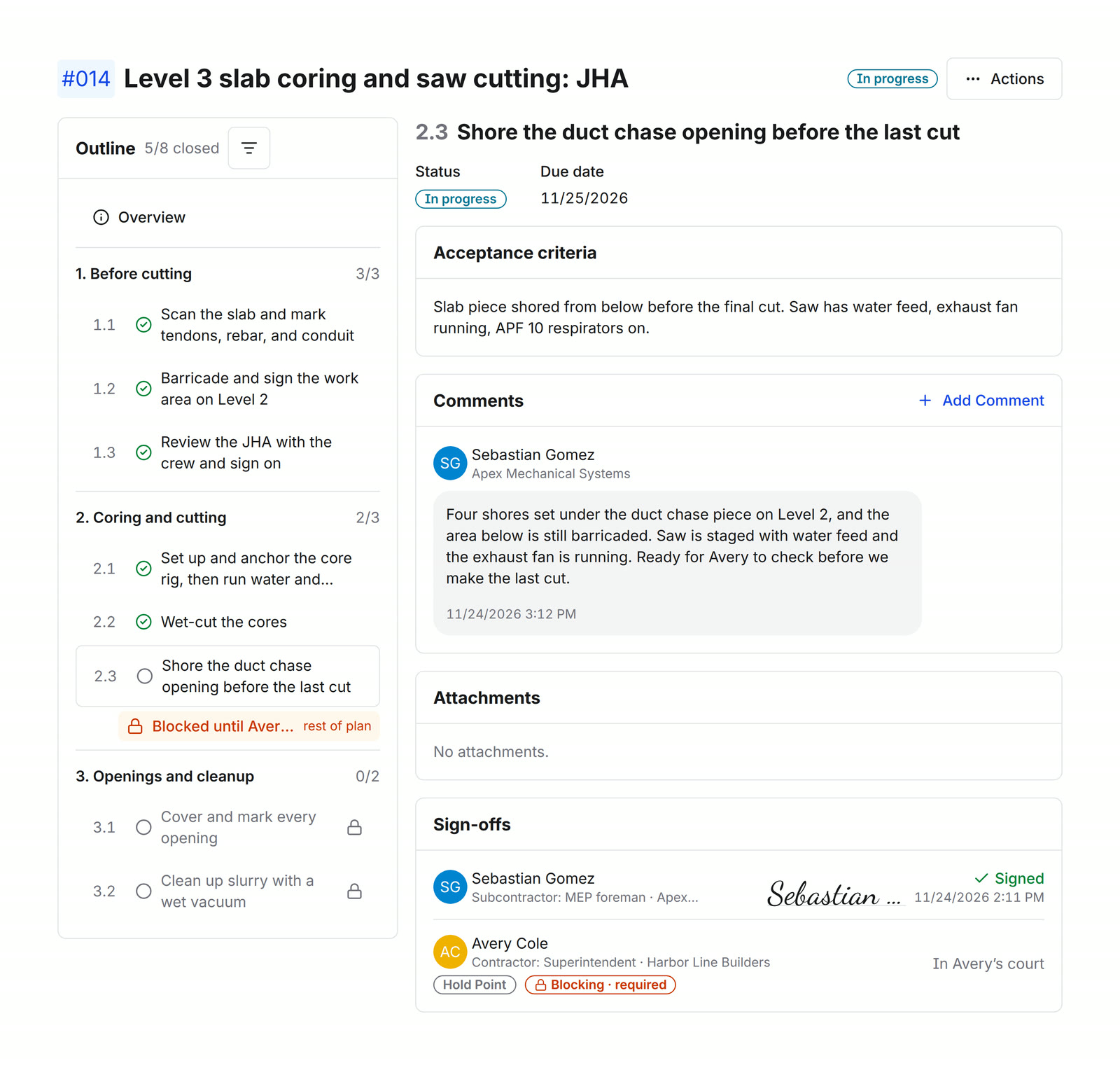
Start every JHA from a template. Organizations add their own Work Plan Types, with custom fields such as required PPE and permits, and build company and project Work Plan Templates. A JHA for coring, hot work, or a critical lift starts from the last good version instead of a blank page.
Ask for the proof. Requested records on an item ask for photos, documents, or a linked inspection, such as a photo of the scan marks or the sub's own JHA form. Each item has a comment thread with photos and files. Ball-in-court shows whose signature is missing, and the work plan PDF prints every item, comment, signature, and the activity log.
Let subs sign their own items. Subcontractor roles see published plans their company is named on and can work and sign their company's items, so the sub's foreman signs from the field instead of on a paper form you scan later.
Check the controls in the field. Inspections run from organization templates with sections, items, and response sets, so a safety walk can ask "Hole covers secured and marked?" with Yes and No answers. Inspection items can also record a date, a number, text, or a signature. A failed item becomes a punch list item.
Log the day's safety record. The Safety section of the daily log holds the day's toolbox talk and near-miss notes. Attach the signed JHA or the crew's sign-in sheet there, and it exports as "Safety Photos" and "Safety PDF Files." Projects can add their own custom fields to the Safety section.
Investigate near misses. In Incidents, report what happened from the field, add a Near Miss record, and fill in the built-in investigation (hazard, contributing conditions and behaviors, root cause) and the corrective actions. That's where the decision to update a JHA gets made and written down.
Link it together. Related items link work plan items, inspections, and daily logs to each other, and the links show on their PDFs.
Final thoughts on job hazard analysis
A job hazard analysis is the foreman and the crew thinking through a task before they start it, written down so the GC can check it and the crew can follow it. Break the task into steps, name what can go wrong in each, control it from the top of the hierarchy down, and change the JHA when the work changes or something goes wrong. To see how work plans, inspections, daily logs, and incidents keep your JHAs and safety records on one project, book a demo of Constructable.
FAQ
What is a JHA in construction?
A JHA, or job hazard analysis, is a written review of one construction task that breaks it into steps, lists the hazards in each step, and names the controls that will be in place before work starts. The trade's foreman or competent person usually writes it with the crew, and the GC's superintendent or safety manager reviews it. The crew signs it to show they've been through it.
What is the difference between a JHA and a JSA?
There is no practical difference. A job hazard analysis (JHA) and a job safety analysis (JSA) are the same document under two names, and OSHA's own guide uses both terms. Use the name your safety program uses, and make sure the content covers steps, hazards, controls, and sign-offs.
Is a job hazard analysis required by OSHA?
Federal OSHA's construction standards don't use the term "job hazard analysis." They require accident prevention programs with frequent and regular inspections by competent persons (29 CFR 1926.20(b)) and training workers to recognize and avoid unsafe conditions (29 CFR 1926.21(b)(2)), and a JHA is a common way to meet them. Many GCs, owners, and federal agencies, including the US Army Corps of Engineers, require a written hazard analysis by contract, and some state plans have their own requirements.
What are the steps of a job hazard analysis?
Pick the task, break it into steps, identify the hazards in each step, rate the risk, choose controls from the top of the hierarchy of controls down, and review the JHA with the crew and have them sign. OSHA's guide adds involving workers, reviewing the job's accident and near-miss history, and watching the job being done to list its steps.
Who is responsible for completing a JHA?
The employer doing the work is responsible, which usually means the subcontractor's foreman or competent person writes it with the crew. The GC's superintendent or safety manager reviews and accepts it before the work starts. Each worker on the crew signs to confirm they reviewed it.
How often should a JHA be reviewed or updated?
Review a JHA before the task starts and whenever the scope, crew, equipment, method, or site conditions change. OSHA's guide says to review it after any injury or illness on the job, to discuss any close call with everyone who does the job, and to retrain affected workers whenever the JHA changes. Many GCs also have the crew check it each shift through a pre-task plan.
What is an Activity Hazard Analysis (AHA)?
An Activity Hazard Analysis is the US Army Corps of Engineers' version of a JHA, required by its safety manual, EM 385-1-1, for each definable feature of work on Corps projects. It covers a whole feature of work, such as cast-in-place concrete, rather than one task. The contractor doing the work prepares it, and the government accepts it before that work starts.
What's the difference between a JHA and a pre-task plan?
A JHA analyzes one task in depth and stays in force while the task runs, updated when the task changes. A pre-task plan (PTP) is a short daily check the crew fills out at the start of each shift, covering today's work, crew, and conditions, and it points back to the JHA. When a PTP turns up something new, the JHA gets updated.