QC Plans for Construction: How to Build and Run One November 2026
Updated for November 2026: how to structure a construction quality control plan, from DFOW lists to nonconformance tracking.
Rework eats a large share of total project cost, and most of it traces back to problems that weren't caught early enough. That's a systems problem, not a crew problem. The difference between projects that keep rework under control and those that don't usually comes down to whether inspection expectations were defined upfront, not sorted out after something fails. Here's what a construction quality control plan actually needs to include, and how to run one once you have it.
TLDR:
-
Rework consumes 5-10% of project costs; firms with consistent QA/QC processes keep rework below 5% more often than those without
-
Your QC plan must be project-specific with named personnel, referenced spec sections, and hold points tied to actual scope
-
The USACE three-phase model (preparatory, initial, follow-up) works because it treats readiness as a gate, not a formality
-
Most QC plans fail in execution: DFOW lists copied from prior jobs, titles without names, and documentation written after the fact
-
Constructable's Inspections and Quality Lists workflows pin findings to drawing sheet locations, keeping your ITP record connected to the actual work
Why quality control plans prevent the rework your budget can't absorb
Rework is where project budgets quietly bleed out. Across decades of industry research, it consumes roughly 5 to 10% of total project cost, and design-related issues drive more than 70% of it. Those aren't numbers about careless crews. They're numbers about systems that didn't catch problems early enough.
The data is consistent on what separates firms that contain rework from those that don't. According to PlanRadar's Construction QA/QC Impact Report 2025, which surveyed 811 construction professionals across 13 countries, 56% of firms with consistent QA/QC processes keep rework below 5% of project budget, compared with 37% of those without. That gap closes when inspection expectations, approval points, and accountability are defined before work starts, not sorted out after something fails.
A quality control plan is the structural answer to a structural problem. It sets the standard upfront, assigns ownership, and gives the field a clear path for catching deviations before they become expensive corrections.
QA vs. QC: the distinction that shapes your whole plan
Quality assurance and quality control solve different problems, and mixing them up produces a plan that does neither job well.
QA is focused on process: it defines how work will be performed before a crew touches anything, covering approved methods, material submittals, trade qualifications, and training requirements. It's preventive by design. QC is focused on the finished product, inspecting what was actually built against what the specs required. Detection, not prevention.
In practice, QA lives in your plan documents and submittal approvals. QC lives in your inspection checklists and test results. Keep them in separate sections so responsibilities don't blur during execution.
What a construction quality control plan actually is
A construction quality control plan is a project-specific document, not a company policy, not a generic checklist borrowed from another job. It names who owns quality on this project, what standards apply to each definable feature of work, when inspections happen, and how nonconformances get resolved and recorded.
That specificity separates it from a general quality policy, which describes an organization's overall commitment to quality in broad terms. A QC plan puts that commitment into action for a single project with named personnel, referenced specifications, and scheduled hold points tied to the actual scope of work.
On federal projects, the distinction matters contractually. USACE and Federal Highway Administration contracts typically require a formal QC plan as a deliverable before construction begins, with a designated CQC manager, defined inspection roles, and documented three-phase control for each definable feature of work. Submitting a boilerplate policy instead of a project-specific plan is a compliance failure, not a paperwork technicality.
For private commercial work, the QC plan may not be explicitly required by contract, but it still functions as the working backbone for managing inspections, subcontractor accountability, and closeout documentation.
The core sections every QC plan must include
A complete QC plan has eight core components that answer three questions: who is responsible, what gets inspected, and what happens when something fails.
-
Project overview and quality objectives: defines the scope, applicable codes and specifications, and the measurable standards the work must meet.
-
Roles, responsibilities, and QC organization chart: names the CQC manager, inspection personnel, and each subcontractor's quality representative with clear lines of authority.
-
Definable features of work (DFOW) list: breaks the project into discrete work activities that each require their own inspection and approval sequence.
-
Inspection and test plans (ITPs): identifies hold points, witness points, and required tests for each DFOW, with the responsible party and referenced spec section.
-
Submittal review and management procedures: describes how submittals are tracked, reviewed, and approved before installation begins.
-
Nonconformance and corrective action procedures: defines how deficiencies are documented, who has authority to disposition them, and how corrective actions are verified.
-
Documentation and recordkeeping requirements: specifies what records must be kept, in what format, and for how long.
-
Training and personnel qualifications: confirms that inspection staff hold required certifications and that trade crews have been briefed on quality requirements before starting work.
None of these sections can be left generic. Each one should reference the actual specification sections, the actual personnel assigned, and the actual work sequence for this project.
How to define roles and responsibilities in your QC plan
Accountability in a QC plan only works the same way RFI management does: every person named in it needs to know what they're authorized to do, beyond simply what they're responsible for observing.
Structure the QC organization as a clear chain: the company officer signs off on the overall plan and retains accountability for quality commitments to the owner. The CQC manager runs the day-to-day program, holds authority to stop work at hold points, and signs daily QC reports. The project manager owns inspection scheduling relative to the construction sequence. The superintendent controls field access and coordinates with trade foremen on timing. Each level should have one named person with no shared titles or "or designee" placeholders.
Subcontractor QC responsibilities need their own documented structure. Each major trade should submit a sub-plan identifying their QC representative, the governing specifications, and their internal inspection checkpoints. Those sub-plans roll up under the prime's umbrella plan, and the CQC manager retains authority to reject work regardless of what a subcontractor's own inspection record shows.
The section fails when it lists names without authority. Specify in writing who can issue a stop-work at a hold point, who dispositions a nonconformance, and who signs off before concealed work gets covered.
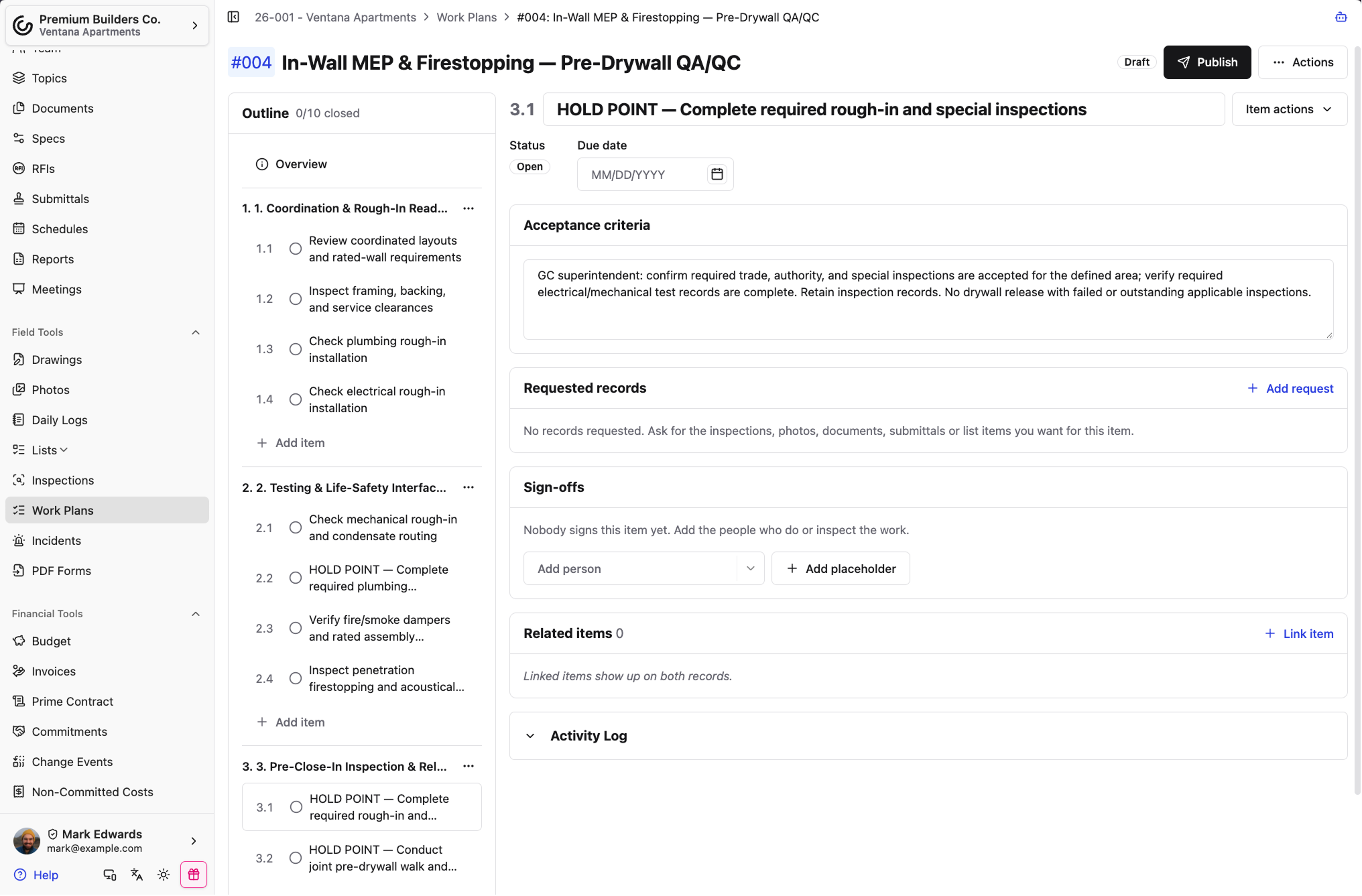
The Work Plans feature in Constructable lets you create Hold Points and assign specific people whose sign-off is required to move forward.
How to build an inspection and test plan (ITP)
An ITP translates the QC plan's inspection commitments into a row-by-row schedule of who checks what, when, and by what standard.
Build it by listing each definable feature of work down the left column, then populating across: applicable specification section, inspection phase, hold or witness point designation, acceptance criteria, responsible inspector, required tests or samples, test frequency, and the record that documents completion. Every row should be completable by whoever owns that trade without referencing another document.
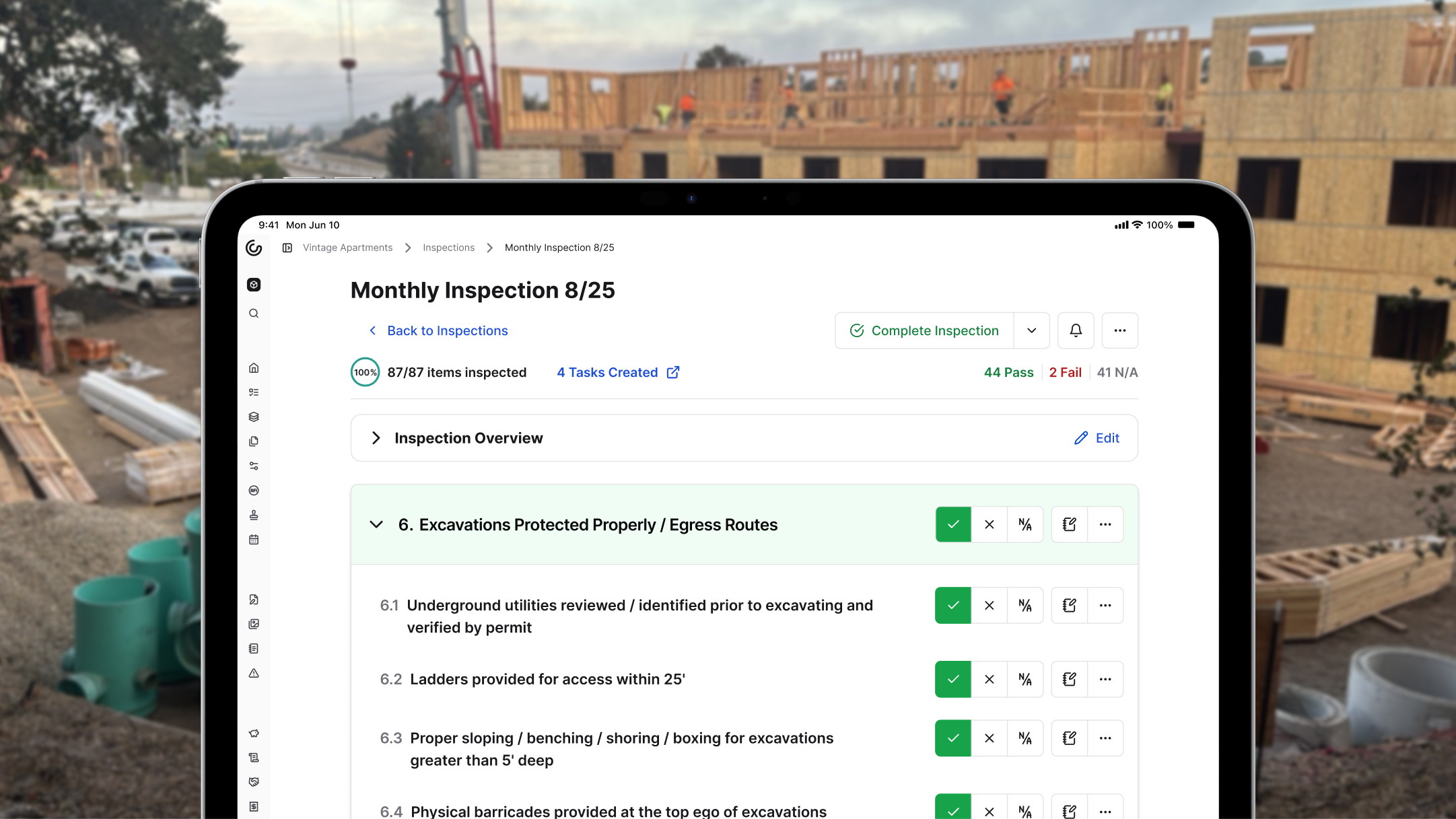
Constructable has a robust, customizable Inspection tool that helps teams maintain QA/QC
Hold points vs. witness points
The distinction matters for sequencing. A hold point stops work until the designated inspector signs off and the sign-off is recorded. A witness point invites inspection but doesn't require it to continue; the contractor notifies the responsible party and documents that notification whether or not the inspector shows up. Federal contracts typically define which features require hold points. On commercial work, you make that call based on concealment risk, spec tolerance, and how much sequencing authority you want to retain.
What gets tested and how often
For each definable feature of work, specify the test type, the referenced standard (ASTM, ACI, AWWA), the sample size or frequency, and who arranges and pays for testing. "Compressive strength cylinders at one per 50 cubic yards" is a specific instruction. "Test concrete as required" is not. Vague frequency language produces gaps in test records at closeout.
Keep the ITP as a live document, the same way disciplined RFI tracking stays current. Add rows as scope changes, and mark completed inspections with inspector initials, date, and pass or fail. The completed ITP becomes primary evidence of inspection coverage during owner audits and project closeout.
The USACE three-phase quality control process
The USACE three-phase quality control process structures quality control around verifiable readiness at each stage, which is why it's been adopted well beyond federal work.
Preparatory phase
Before any work begins on a definable feature, the team verifies that everything required for quality execution is in place: submittals approved, materials on site and confirmed against specs, equipment calibrated, personnel certified, and the work area ready. The preparatory meeting documents all of this with the trade foreman present, tying directly into broader foreman responsibilities on site.
Most QC plans fail here. When the schedule tightens, teams skip preparation and assume readiness without confirming it. Work starts with unresolved submittal conditions or unverified materials, and the nonconformance surfaces three days later when the installation is half complete.
Initial phase
The initial inspection happens at the start of actual work, once the first element of the definable feature is installed or poured. The CQC manager and superintendent verify that work in progress matches the approved methods, materials, and tolerances from the preparatory phase. If it does, work continues. If it doesn't, the deficiency gets documented and the hold point holds.
Follow-up phase
Daily inspections continue throughout the feature until completion, confirming the initial-phase standard is being consistently maintained. Results go into the daily QC report. The feature closes out when all inspections are documented, test results are filed, and the record shows continuous compliance.
The sequence only works when the preparatory phase is treated as a genuine gate, not a form to backfill.
How to handle nonconformances and corrective actions
A nonconformance report documents a gap between what the specs required and what was actually built. It gets issued when an inspection fails, a test result falls outside tolerance, or work is installed without passing a required hold point.
The CQC manager or designated inspector holds authority to issue an NCR. That authority shouldn't be delegated to the subcontractor whose work triggered it. The NCR should record the location, the specific specification requirement that wasn't met, and a description of the deficiency with photos attached. Vague language ("concrete placement issue at grid E4") won't support a warranty claim or dispute resolution two years later.
Each open NCR needs a disposition: repair, replace, accept as-is with engineer concurrence, or reject and remove. Document it in writing. Once corrective action is complete, re-inspection confirms the work meets the original standard, and that result gets attached to the original NCR record.
The root cause step is what separates a functional NCR process from a paper trail. If fire-stopping fails inspection three times across different floors, fixing each occurrence individually doesn't close the underlying problem. Ask whether it's a materials issue, a crew training gap, or a submittal approved with ambiguous language. Documenting the root cause gives you defensible evidence if the same issue resurfaces during a warranty claim or feeds into delay claims later in the project.
Documentation and recordkeeping requirements
The records you keep during construction are the only evidence you have after it's over.
Daily QC reports cover what was inspected, by whom, the results, any deficiencies, and weather conditions. They go out every working day. A gap in the log sequence raises the same question as a missing NCR: was the work actually inspected, or was documentation created after the fact?
Inspection records and ITPs tie directly to drawing revision numbers. When a design change affects a feature you've already inspected, the record needs to reference the revised sheet, not the superseded one. Missing that link implies the inspection happened against the wrong standard.
Test results belong in the project record with lab certifications attached, not in the testing agency's portal where access lapses after the contract closes. File concrete cylinder reports, compaction tests, weld certifications, and air barrier results against the cost code and specification section they cover.
Corrective action logs track every open NCR through disposition and re-inspection sign-off. At any point, the CQC manager should be able to confirm no NCR is sitting open without a documented corrective action and verification result.
Photo documentation with timestamps and location tags turns daily site conditions into defensible evidence during warranty claims and lien disputes. File photos by date and feature of work, not by who took them.
Retention periods vary by contract and jurisdiction. Many firms use seven years as a floor for commercial projects, but confirm with legal counsel for your jurisdiction before setting a schedule. Federal contracts often require longer. Define the retention schedule in the QC plan before work starts so records don't get purged when a superintendent moves to the next job.
Building a QC plan template: what to customize vs. what to standardize
A template saves you from rebuilding the same structure on every project. The mistake is treating the whole document as reusable.
Some sections can and should be standardized: your company's QC policy statement, the NCR workflow and disposition authority, general recordkeeping requirements, and the organizational chart structure with role titles. These don't change project to project. Build them once, maintain them at the company level, and pull them into every new plan.
Everything tied to actual scope must be project-specific. The DFOW list, ITP rows, the submittal register, testing lab assignments, hold point designations, and named personnel all get rebuilt for each job.
Template format and what each handles well
| Format | Best for | Limitation |
|---|---|---|
| Word (.docx) | Narrative sections, policy language, NCR procedures | Weak for tabular ITP tracking across many features |
| Excel (.xlsx) | ITP tracking, DFOW lists, submittal registers, test logs | Harder to control formatting for formal submittal to owner |
| Final submission copies, locked records | Not editable in the field without additional tools |
Most teams use Word for the plan document itself and Excel for the ITP and submittal register as working documents that feed into the plan. The PDF version is the formal deliverable. Whatever format you choose, customizable sections need clear placeholders so the person filling them in can't accidentally submit a template with the last project's DFOW list still inside it.
Common failures that undermine an otherwise good QC plan
Most QC plans fail not because they were written poorly but because execution diverged from the document and nobody closed the gap.
The preparatory phase gets skipped under schedule pressure. Teams assume submittals are approved because nobody flagged them. Hold points get passed without sign-off because the inspector was tied up on another feature. Each of these feels like a judgment call in the moment, but across a project they accumulate into a record that doesn't reflect what actually happened.
Four failure modes show up repeatedly. The first is a plan that doesn't match the actual scope: DFOW lists get copied from a similar project without checking what this contract requires, and inspection points reference specification sections that were revised during design development or by a construction change directive. The second is personnel assignments that are titles, not people. "QC Manager" with no named individual means accountability floats until something fails, then everyone assumed someone else owned it.
The third is documentation that runs behind construction. NCRs get written after corrective action is already complete, daily reports get filled in at week's end, and test results sit in a lab portal instead of the project record. The fourth is root causes that never get investigated. The same nonconformance recurs in different locations because each instance was closed individually without checking whether the failure was a training gap, a missed submittal condition, or an undispositioned material substitution.
The thread connecting all four is that the QC plan was treated as a compliance document instead of a live one. It satisfied a contract requirement and then stayed in a drawer.
How Constructable puts the quality control plan to work in the field
A QC plan without connected field tools produces documentation that runs behind the work. Constructable's Inspections workflow drafts, schedules, and records results against each item with Pass, Fail, or N/A, matching the ITP phase structure. Quality Lists manage punch list items, observations, and to-dos across the full project lifecycle, through closeout and beyond. AI Autofill from Description auto-populates title, trade, and location from a field note, cutting logging time when a superintendent is moving between trades.
Inspection findings and quality items can be pinned to exact drawing sheet locations as part of drawing-centric collaboration workflows, so the DFOW list in your QC plan becomes a spatially accurate, navigable record inside the project drawings instead of a separate document teams cross-reference manually.
Two limitations worth noting: inspection response options are fixed at Pass, Fail, and N/A with no configurable custom values, and creating a quality list item from within an active inspection requires exiting to the Quality Lists workflow separately. Teams that need more granular response scales should plan for that constraint during QC plan setup.
Final thoughts on quality control plans for construction projects
The firms that keep rework under 5% aren't doing anything exotic. They're just catching problems before installation instead of after. Your QC plan is what makes that possible, but only if it names real people, references actual specs, and gets treated as a working document instead of a submittal requirement. Build it right once and it becomes easier to replicate. Reach out to the Constructable team if you want to see how inspection tracking and quality documentation fit into a connected field workflow.
FAQ
What should a construction quality control plan template include to satisfy federal contract requirements like USACE?
A compliant construction quality control plan template for federal work must name a designated CQC manager, define inspection roles, and document the three-phase control process (preparatory, initial, and follow-up) for each definable feature of work. Generic company policy statements do not satisfy USACE or Federal Highway Administration requirements; the plan must be project-specific with named personnel, referenced specification sections, and scheduled hold points tied to actual scope. Submitting a reused template without customizing these sections is a compliance failure, not a paperwork shortcut.
Construction quality control plan template: Word vs. Excel vs. PDF: which format should I use?
Use Word for narrative sections like your NCR procedures and QC policy language, Excel for your ITP tracking, DFOW list, and submittal register as working documents, and PDF only for the final locked deliverable submitted to the owner. Most teams run Word and Excel in parallel during construction, then export to PDF for formal submission. Whichever combination you choose, build clear placeholders into the customizable sections so the person filling them in cannot accidentally submit a prior project's DFOW list inside a new job's plan.
What's the most common reason a quality control plan for a construction project fails during execution?
The plan is written to satisfy a contract requirement and then treated as a static document instead of an active field tool. The four failure modes that show up most often are: the DFOW list copied from a similar project without checking current contract requirements, personnel fields listing titles instead of named individuals, documentation written after the fact instead of in real time, and nonconformances closed individually without investigating the root cause. Each feels like a minor judgment call in the moment, but across a project they accumulate into a record that cannot support a warranty claim or dispute two years later.
How does Constructable support a construction quality control plan in the field without creating a separate documentation burden?
Constructable's Inspections workflow matches the ITP phase structure, covering drafting, scheduling, and recording Pass, Fail, or N/A results against each inspection item, while Quality Lists manage punch items, observations, and to-dos across the full project lifecycle, including well beyond closeout. Inspection findings and quality items can be pinned to exact locations on drawing sheets, so the DFOW list becomes a spatially accurate record inside the project drawings instead of a cross-referenced standalone document. Two constraints worth planning for: inspection response options are fixed at Pass, Fail, and N/A with no configurable custom values, and creating a quality list item from within an active inspection requires switching to the Quality Lists workflow separately.
Should the QA and QC sections of a construction quality control plan be combined or kept separate?
Keep them in separate sections. QA is focused on process: it covers approved methods, material submittals, trade qualifications, and training requirements before a crew starts work. QC is focused on the finished product, inspecting what was actually built against specification requirements. Combining them blurs responsibility during execution: the person verifying a submittal approval in the preparatory phase is doing QA work, while the inspector recording a compressive strength result is doing QC. Separate sections make that distinction clear and prevent accountability from floating when something fails inspection.