Construction Inspection Readiness August 2026 | Constructable
Learn what causes construction inspection failures and how contractors prevent delays in August 2026 with better documentation, coordination, and field reviews.
Even well-run jobs fail inspections sometimes. The difference between a failure that costs a day and one that costs two weeks is almost entirely a matter of how the team responds. Three things determine whether a failed inspection becomes a minor setback or a scheduling crisis: how quickly the correction notice is triaged, whether re-inspection scheduling starts immediately rather than waiting until the fixes are complete, and whether documentation of the corrected work is ready before the inspector shows up again. Teams that treat these three steps as reflex, not reaction, rarely lose meaningful time to a failed inspection. The underlying preparation is still the real variable, but knowing how to respond when it doesn't go perfectly is what separates contractors who run clean projects from the ones who don't.
TLDR:
-
Failed inspections are rarely about bad work; missing docs and poor trade coordination cause most delays
-
Document rebar placement, rough-ins, and test results with timestamped photos before work gets covered
-
Run internal field reviews before calling official inspections to catch deficiencies your team can fix first
-
Constructable connects RFIs, submittals, daily logs, and photos directly to drawings so inspection questions get answered instantly
Why construction inspections fail (and what it really costs)
Most inspection failures come down to three things: the work wasn't ready, the paperwork wasn't there, or the right trades hadn't finished their scope. Missing permits, unsigned approvals, incomplete submittals, photos that were never taken: these stop a project cold, and inspectors frequently reject work not because it was done wrong, but because there's no record proving it was done right. Poor trade coordination compounds it: when MEP crews aren't sequenced, framing inspections stall, and one trade running behind cascades across every downstream inspection on the schedule.
Nearly all of it is preventable. Inspections fail because the job wasn't managed with inspection readiness in mind from the start.
The real cost of inspection delays on commercial projects
When an inspection fails, the clock keeps running. Subcontractors who sit idle still get paid. Superintendent time gets eaten up chasing re-inspections. Equipment and trailers stay on site longer than budgeted. General conditions costs stack up fast.
A single failed framing inspection can push finish trades back by weeks, rippling straight into the owner's occupancy date. Missed occupancy dates mean the owner can't open, operate, or rent—and that pressure falls on the GC.
The numbers add up fast. Re-inspection fees vary widely by jurisdiction, and some municipalities charge escalating rates after a second failure. Idle subcontractor standby costs when a failed inspection stops a following trade can run into thousands of dollars per day. On larger projects, even a week-long framing inspection delay results in meaningful extended overhead. The exact figures depend on project size, jurisdiction, and contract structure, but the direction is always the same.
Inspection Readiness Starts in Preconstruction
Passing your own internal reviews on time is a scheduling problem before it's ever a field problem. By the time your team walks the job for a check, the window to fix sequencing issues has already closed.
The contractors who run clean internal reviews pull scope requirements early, identify which phases need a walkthrough before the next trade moves in, and build those checkpoints into the schedule before subs are even mobilized. Trade sequencing gets designed around internal hold points, not the other way around.
A few things worth locking down in preconstruction:
-
Map which phases need an internal field review before work gets covered or the next scope begins
-
Identify which reviews require a foreman or engineer to walk the work before sign-off
-
Schedule internal rough-in reviews before framing is on the calendar
-
Confirm submittal approval requirements that must be closed before specific phases begin
Getting this wrong early creates a domino effect. Framing can't be reviewed until MEP rough-ins are done. MEP rough-ins can't be done until submittals are approved. Submittals don't get approved if no one submits them on time.
Common documentation gaps that trigger inspection failures
Even when the work is done right, inspectors can only approve what they can see and verify. If the right documents aren't on site and accessible, the review stops, regardless of how much effort went into the job.
The most common documentation failures:
-
Permit not posted at the jobsite, which is one of the fastest ways to get sent home before the inspector even looks at the work
-
Approved submittal not available on site for the inspector to reference, even if it was approved weeks ago
-
Special inspection reports incomplete or missing entirely, leaving no record that the required observations actually happened
-
Concrete or soil compaction test results not on hand when the inspector asks for them
-
Prior inspection sign-offs not documented in the field set, making it look like steps were skipped
"On site" means physically accessible to the inspector: not in the PM's email, not in a cloud folder, not back at the office. Digital docs are fine if they can be pulled up immediately, but a dead battery is the same as not having it. Assemble a simple packet per phase (permit, current drawings, relevant submittals, test results) and most scrambles disappear.
How trade coordination determines inspection success
Framing inspections are where trade coordination breaks down most visibly. Electrical rough-in is among the most frequently failed inspection types, and plumbing and mechanical rough-ins must also be complete and correct before the inspector arrives. If one trade is still pulling wire when the inspection is called, everyone waits.
The problem is usually not that trades don't know what to do. It's that no one confirmed it was done before the inspection was scheduled. A simple check reveals the HVAC duct isn't roughed in above the ceiling. The inspector shows up, sees it, and leaves. That's a week gone.
A few coordination habits that prevent this:
-
Hold a pre-inspection walkthrough with each trade foreman before calling the inspection, so gaps get caught by your team, not the inspector
-
Confirm that rough-in sign-offs from each trade are complete, actually complete, because 'almost done' fails every time
-
Make sure any required engineer observations are scheduled before the inspection date, since those appointments can take days to book
-
Communicate inspection hold points to subs at the start of their scope, not the day before, so expectations are clear from the beginning
The GC's job here is to be the last set of eyes before the inspector's. If you're relying on the inspector to tell you something isn't ready, the coordination already failed.
What inspectors actually look for during common commercial inspections
Inspectors aren't trying to fail your job. They're working through a checklist, and knowing what's on it takes most of the mystery out of the process.
Foundation Inspections
Inspectors check excavation depth, soil bearing conditions, rebar placement and cover, and whether footing dimensions match the approved drawings. Special inspection reports for concrete placement are expected on-site.
Framing Inspections
The framing inspection covers everything that gets closed up together: structural members, header sizes, shear wall nailing, fire blocking, and draft stopping. Because MEP rough-ins run through the framing and get covered at the same time, all electrical, plumbing, and mechanical rough-ins must be complete before the inspection is called. Notching and boring through framing members are also closely checked.
MEP Rough-In Inspections
Each trade gets its own inspection. Electrical checks wire sizing, box fill, and grounding. Plumbing checks pressure tests and trap configurations. Mechanical checks duct sizing, clearances, and combustion air.
Final Inspections
This is the full pass. Inspectors verify that every previously approved scope is complete, life safety systems are functioning, accessible route compliance is confirmed, and the certificate of occupancy can be issued.
The pattern across all of them: have your approved drawings on site, know what was permitted, and don't call the inspection early.
| Inspection Type | Typical Timing | Key Checkpoints | Required Documentation |
|---|---|---|---|
| Foundation Inspection | After excavation and rebar placement, before concrete pour | Excavation depth and soil bearing conditions, rebar placement and cover distances, footing dimensions match approved drawings, anchor bolt locations | Approved foundation drawings, soil compaction test results, special inspection reports for concrete placement, rebar shop drawings if applicable |
| Framing Inspection | After all MEP rough-ins complete, before insulation or drywall | Structural members and header sizes, shear wall nailing patterns, fire blocking and draft stopping, notching and boring through framing members, all electrical/plumbing/HVAC rough-ins complete | Approved structural and MEP drawings, rough-in sign-offs from each trade, engineer observation reports if required, revised details from any RFIs |
| MEP Rough-In Inspections | After installation complete, before work gets covered | Electrical: wire sizing, box fill calculations, grounding and bonding. Plumbing: pressure test results, trap configurations, vent sizing. Mechanical: duct sizing, clearances, combustion air supply | Approved MEP submittals on site, manufacturer spec sheets for equipment, pressure test documentation for plumbing, applicable code calculation sheets |
| Final Inspection | After all construction complete and all prior inspections passed | All previously approved scopes fully complete, life safety systems working and tested, accessible route compliance verified, certificate of occupancy can be issued | Complete set of approved drawings with all revisions, all prior inspection sign-offs, final special inspection reports, operating manuals for installed systems |
Scheduling inspections without stalling the critical path
Calling an inspection too early stalls trades, but calling it too late burns float. Neither is a good option when you're managing a critical path.
A few habits that keep things moving:
-
Schedule inspections as soon as the prior phase closes, not when you get around to it
-
Know your AHJ's availability windows, as some jurisdictions book out 48 to 72 hours
-
Build one day of buffer after each inspection milestone before the next trade mobilizes
-
Identify inspections that can run concurrently and coordinate them on the same day
When inspections are treated as milestones with lead time rather than afterthoughts, the schedule holds.
Managing inspection corrections and re-inspections
A failed inspection isn't a disaster, but a slow response to one is.
When the inspector leaves a correction notice, the clock starts. Get the deficiency list in front of the right people the same day. Waiting until the next morning meeting costs you a day you probably don't have.
A few habits compress re-inspection turnaround. Before starting any fix, photograph each correction item so you have a record of both the original condition and the corrected work. Assign each item to a specific trade with a clear deadline, not a group conversation. Check with the AHJ (Authority Having Jurisdiction) whether a partial re-inspection is allowed, since some corrections can be reviewed without a full re-inspection. Schedule the re-inspection before the corrections are finished and cancel if needed. Booking early beats scrambling later.
The correction phase is also where documentation matters most. During re-inspections, inspectors want to see that you have addressed their notes and can prove it.
Keep the correction list open until the re-inspection is signed off. Don't close it out in your head before the inspector does.
Building an inspection-ready culture on the jobsite
Checklists and schedules only go so far. Passing inspections comes down to whether the crew on the ground understands what matters and why.
When workers know their scope connects directly to the next trade's start date, they treat it differently. A plumber who understands that an incomplete pressure test holds up framing inspection is more likely to finish clean. That awareness comes from supers who explain the stakes, not just the task.
Walk new subs through the inspection hold points at the start of their scope so they know exactly where their work will be reviewed before the next trade moves in. Post the inspection schedule where crews can actually see it, not buried in a project binder. And when trades finish inspection-ready, call it out publicly—recognition reinforces the standard.
None of this is complicated; just intentional.
Using daily logs and photos to support inspections
Daily logs and photos rarely feel important until an inspector asks a question you can't answer on the spot.
When an inspector wants to know whether rebar was in place before the pour, or what mix design was used, or whether that pipe was installed before the slab closed, your field documentation either backs you up or it doesn't. A timestamped photo and a daily log entry from that day answer the question immediately. Without them, you're asking the inspector to take your word for it.
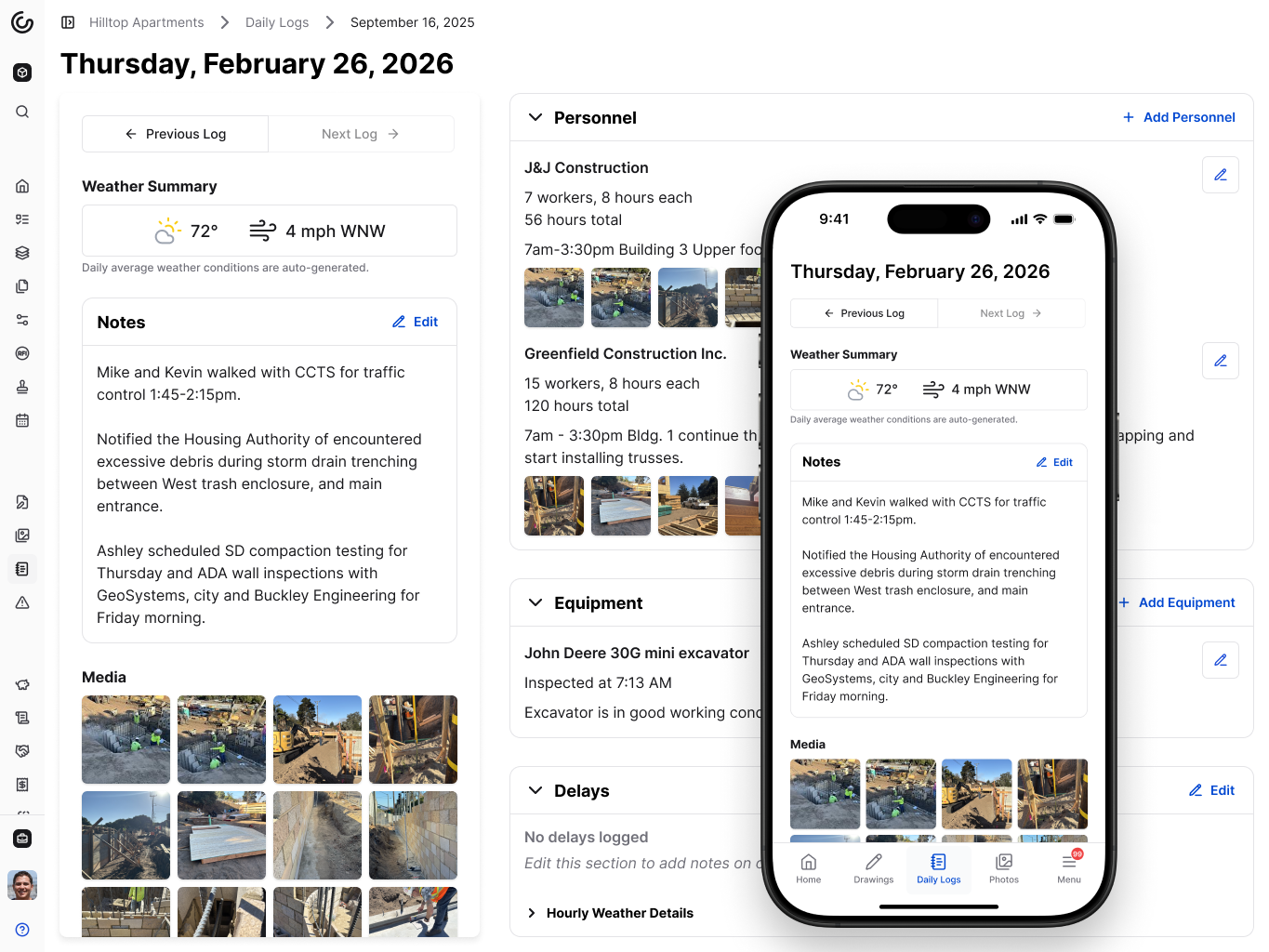
Constructable's Daily Logs feature helps keep everything organized and ready to recall
A few things worth capturing consistently:
-
Photos of work before it gets covered, especially rough-ins, footings, and concealed conditions
-
Daily log entries that note material deliveries, trade activity, and any inspection-related milestones
-
Weather records for days when pours or exterior work happened, since inspectors sometimes ask about conditions
None of this is extra work if it's already part of how the jobsite runs day-to-day.
How better drawing control reduces inspection problems
Inspectors approve work against the permitted drawings. When the field is building from a superseded set, the work and the approved plans tell two different stories.
This happens more than anyone admits. A revised detail gets issued, the super gets the email, but the printed set in the trailer never gets updated. The crew builds to what's on the wall. The inspector references the approved revision. The work fails, not because it was done wrong, but because it was done according to the wrong sheet.
A few habits prevent this. Every printed set needs a clear revision date, and old sheets should be pulled the moment new ones come out. RFI responses and markups belong on current drawings, not buried in an email thread nobody can find. Before the inspection starts, confirm the inspector is referencing the same revision you built to.
The inspector is not going to track down your RFI log to understand why a detail looks different. What's on the drawing is what they check against.
How Constructable keeps inspection documentation and coordination in one place
All the documentation habits covered in this article work better when they live alongside your coordination tools.
In Constructable, RFIs, submittals, daily logs, photos, and quality lists all connect back to the drawings. When an inspector asks why a detail was built a certain way, the RFI response is pinned to that exact sheet. When a question arises about what happened on a specific day, the jobsite photos and daily logs from that date are already available.
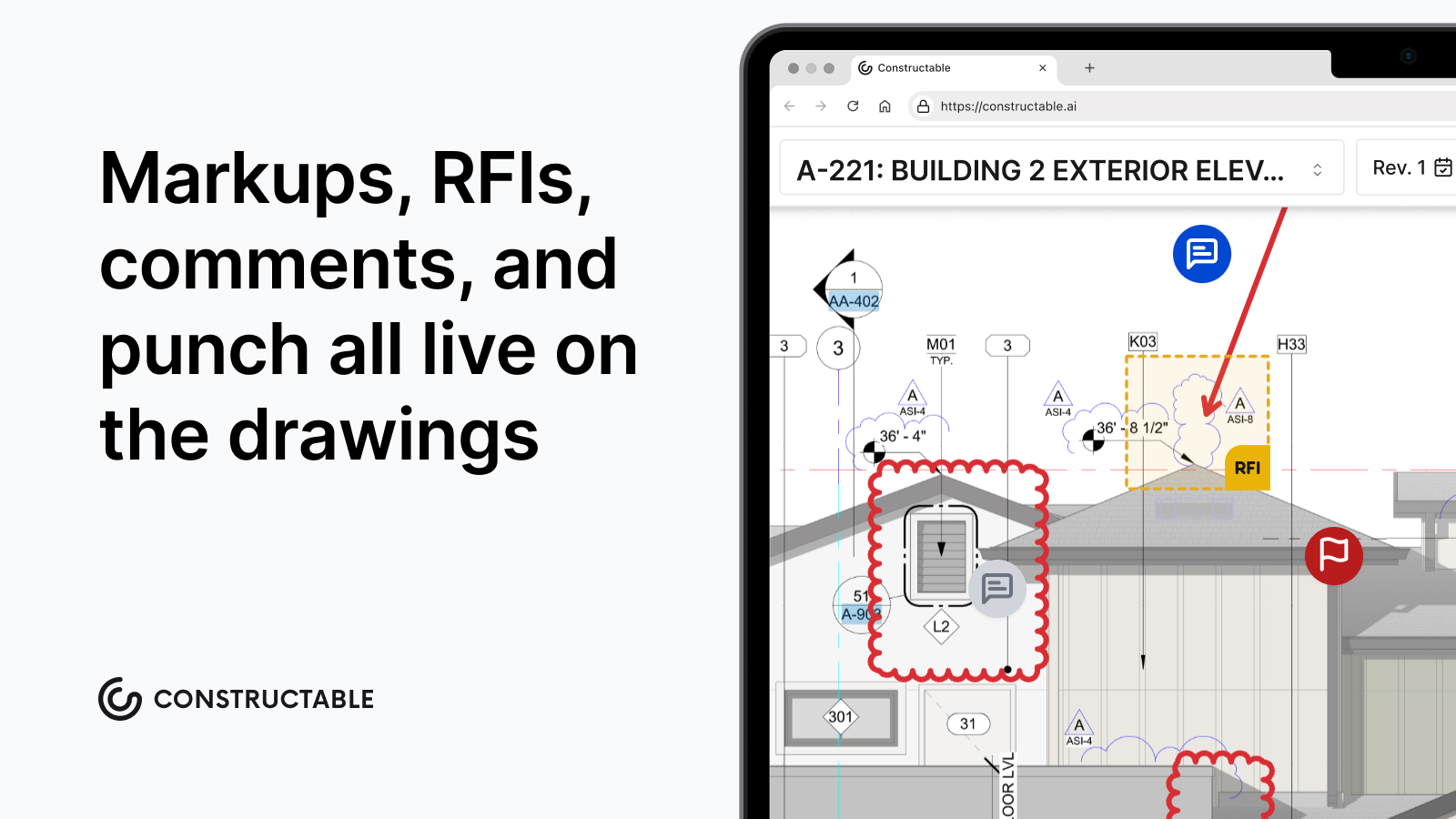
Quality lists handle the pre-inspection walkthrough the same way. Items get assigned, tracked, and closed out before the inspector ever shows up. Nothing falls through because someone forgot to mention it at a morning meeting.
Drawing revisions are automatically tracked, so the field always works from the current set. No outdated sheets in the trailer. No guessing which revision the inspector will reference.
Everything inspection-related stays connected, not scattered.
Running internal field reviews inside Constructable
Constructable's Inspections tool is not a portal to the building department. You can't submit paperwork to the city or schedule an official inspection from it. What it does do is let your team run internal field reviews before the inspector arrives, preventing headaches later.
The workflow moves from draft to scheduled, inspecting, and complete. Teams can build their own checklists, walk the work, and mark each item as pass, fail, or not applicable, with pass/fail tracking, observations, and photo attachments for every item. When the review is done, you have a documented record of what your team found and fixed before anyone official saw it; failed items become documented records, not memory.
A team that catches its own deficiencies first almost always passes on the first try. You know what they say, an ounce of prevention is worth a pound of cure!
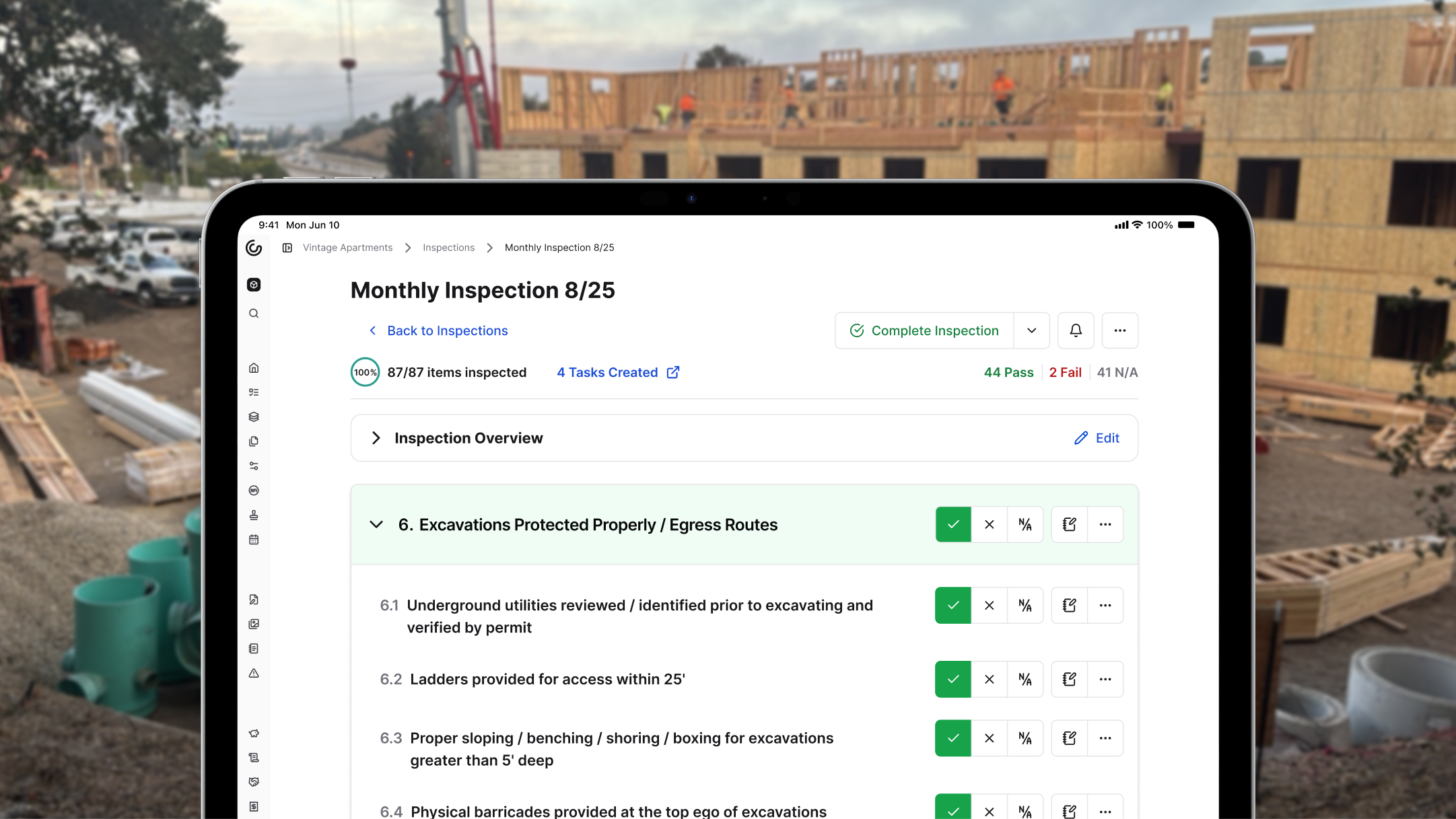
The Inspection tool helps teams stay in compliance before an Inspector sets foot on the jobsite
Final thoughts on construction inspection management
If inspection failures are eating up your schedule, the fix isn't harder work from your crews; it's better coordination before the inspector arrives. Most of what causes re-inspections can be caught by your own team during a walkthrough the day before. Build inspection milestones into your preconstruction plan, keep your documentation connected to your drawings, and make sure your subs know what inspection-ready actually means. Get in touch; we're happy to walk you through how it works.
FAQs
What happens if you fail a building inspection?
The inspector issues a written correction notice listing each deficiency. Work on the failed scope must stop until corrections are made and a re-inspection is passed. The permit remains open during this period, but the project cannot advance to the next phase in the affected area.
How many times can you fail a construction inspection?
There is no universal limit. Most jurisdictions allow repeated re-inspections as long as the permit is active and fees are paid. However, repeated failures trigger closer scrutiny from the AHJ and can result in stop-work orders if corrections aren't made in good faith. Some jurisdictions charge escalating re-inspection fees after the second failure.
Does a failed inspection affect your building permit?
A failed inspection does not void the permit, but it does pause progress on the affected scope. If corrections aren't resolved within a jurisdiction-specified timeframe (often 30 to 180 days depending on the AHJ), the permit can lapse, requiring a renewal application and potentially a full plan re-review.
Can you cover work before the inspection is approved?
No. Covering work before it's inspected is one of the most serious violations a contractor can make. The inspector may require the work to be uncovered at the contractor's expense, and in some cases, the AHJ can issue a stop-work order for the entire project, not just the affected scope.
Can I build a construction inspection checklist without buying separate software?
Yes. Constructable's Inspections tool, available in Field Tools, lets you build custom checklists, run internal field reviews, and track pass/fail results before official inspections. No add-ons or point solutions needed: just draft your sections and items, walk the work, and document what you find.