AIA G706, G706A, and G707: Final Payment Forms (November 2026)
AIA G706, G706A, and G707 explained for GCs: what each closeout form swears to, who signs it, and how to assemble the final payment package without delays.
The building is done and the owner moved in two months ago. The owner is still holding the last 5% of a $4 million contract, and the architect won't sign the final Certificate for Payment. The package you sent came back with two notes: the contractor's affidavit isn't notarized, and there's no consent of surety. Your subs are calling about their retainage, and nobody can pay anyone until three one-page forms are right. This guide covers those forms, AIA G706, G706A, and G707: what each one swears to, who signs it, what to attach, and the order to collect everything in so final payment goes out the first time.
TLDR:
- AIA G706 is the contractor's notarized affidavit that every bill on the job is paid, except the ones you list as exceptions. G706A is the contractor's notarized affidavit that the lien releases attached to it cover everyone who could file a lien.
- AIA G707 is the surety's written consent to final payment on a bonded job. The surety signs it, not you, and it says the bond stays in force after the owner pays.
- The forms answer the conditions AIA A201-2017 Section 9.10.2 puts on final payment: an affidavit that bills are paid, the surety's consent, lien releases if the owner asks, plus insurance certificates and special warranties.
- The most common reasons a package bounces are an affidavit with no notary, an exceptions space left blank instead of "None," a consent of surety with no power of attorney, and a final waiver that doesn't match the final pay app.
- Start the package before final completion. Ask your surety and your subs early, and settle or bond every open claim so the exceptions are ones the owner can accept.
- Constructable tracks conditional and unconditional final lien waivers on every invoice, releases all retainage on the final pay app, and packages pay apps, waivers, and project records for the owner.
What are the AIA closeout forms G706, G706A, and G707?
AIA's G706, G706A, and G707 are the contract administration forms a contractor hands in with the final payment application on a job built under AIA contracts. Together they tell the owner three things: the contractor has paid its bills, nobody down the chain can file a lien, and the surety that bonded the job agrees to final payment.
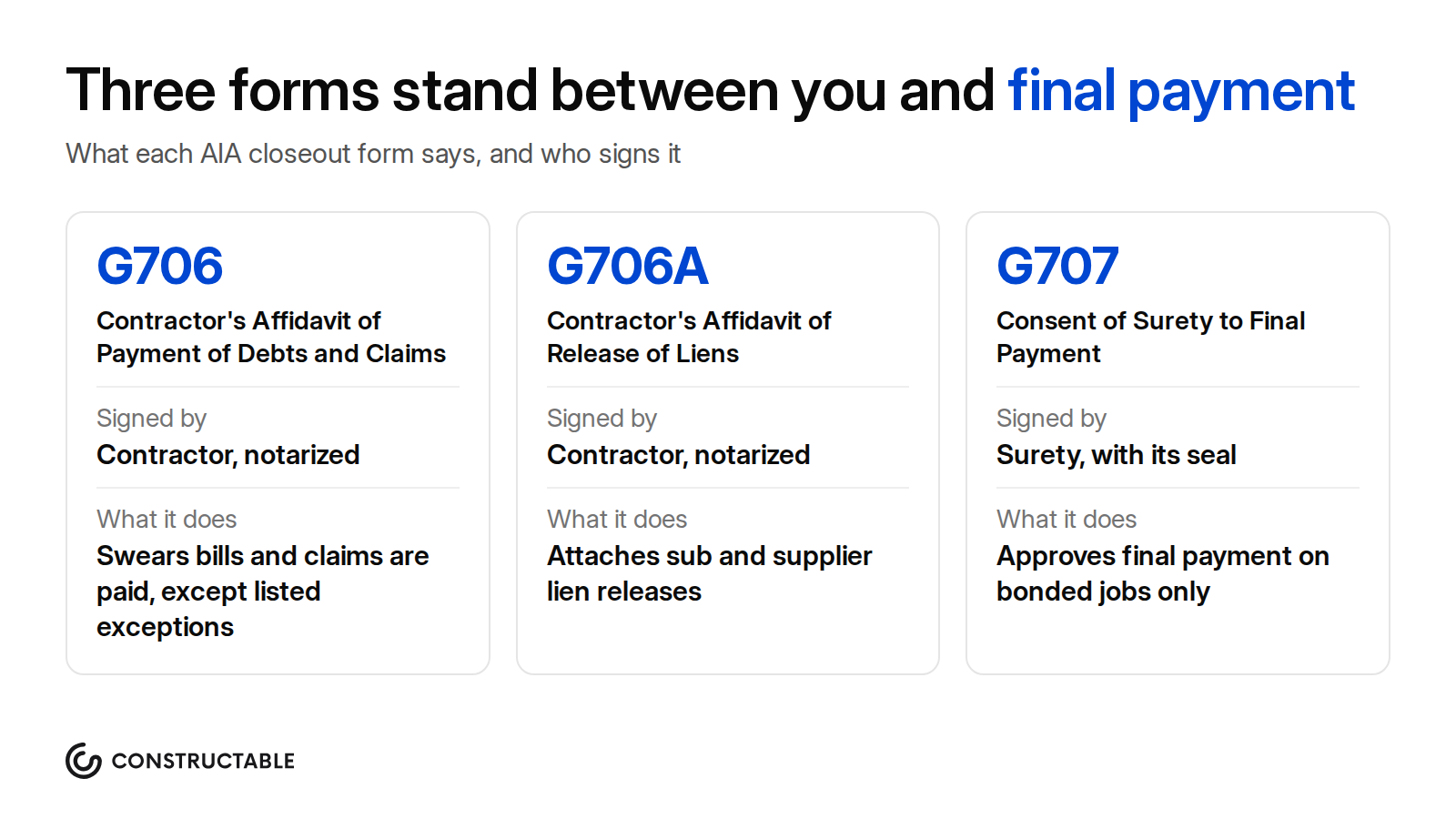
AIA G706, Contractor's Affidavit of Payment of Debts and Claims. The contractor swears, in front of a notary, that it has paid in full for all materials, equipment, labor, and services on the job, and for all known debts and claims the owner or the owner's property could be held responsible for. Anything not paid goes in an exceptions space. AIA intends it for any contract where the contractor must give a sworn statement that debts and claims are settled, and it's usually a condition of final payment.
AIA G706A, Contractor's Affidavit of Release of Liens. The contractor swears, in front of a notary, that the lien releases or waivers attached to it include everyone who has or may have a right to file a lien on the owner's property: the contractor, every subcontractor and supplier, and anyone else who performed work. Anyone who didn't give a release goes in the exceptions. It's the cover sheet for the final lien waivers.
AIA G707, Consent of Surety to Final Payment. The contractor's surety approves final payment to the contractor and agrees that final payment doesn't release the surety from its obligations to the owner under the bond. The surety's authorized representative signs it, and the surety applies its seal. It's used only when the contractor furnished a bond.
AIA G707A, Consent of Surety to Reduction in or Partial Release of Retainage, is G707's partner for earlier in the job. The surety consents to the owner reducing retainage or releasing part of it, often at 50% complete or at substantial completion.
| G706 | G706A | G707 | G707A | |
|---|---|---|---|---|
| Full name | Contractor's Affidavit of Payment of Debts and Claims | Contractor's Affidavit of Release of Liens | Consent of Surety to Final Payment | Consent of Surety to Reduction in or Partial Release of Retainage |
| Who signs | Contractor | Contractor | Surety | Surety |
| Notarized | Yes | Yes | No, the surety's seal | No, the surety's seal |
| What it certifies | Bills and known claims are paid, except listed exceptions | Attached releases cover everyone with lien rights, except listed exceptions | Surety approves final payment, bond stays in force | Surety approves a retainage reduction or partial release |
| What's attached | G707 on bonded jobs, and if the owner asks, final waivers and G706A | Your conditional final waiver, plus sub and supplier waivers with a list | Power of attorney for the signer | Power of attorney for the signer |
| When it's used | With the final pay app | With G706, when the owner wants releases | With G706, on bonded jobs | Before retainage is reduced, on bonded jobs |
All four are 1994 editions, and AIA Contract Documents still sells them as current documents, each on its own page: G706, G706A, G707, and G707A. AIA licenses its documents, so buy them from AIA or through software AIA licenses. This post explains what goes on each form and doesn't reproduce their text.
Where the forms come from: A201 final payment requirements
The forms exist because the general conditions say final payment isn't due until the contractor proves certain things. In AIA A201-2017, General Conditions of the Contract for Construction, Section 9.10.2 says neither final payment nor any remaining retainage is due until the contractor submits to the architect:
- An affidavit that payrolls, bills for materials and equipment, and other debts connected with the work that the owner or the owner's property could be responsible for have been paid or otherwise satisfied.
- A certificate showing that insurance the contract requires to stay in force after final payment is in effect.
- A written statement that the contractor knows of no reason that insurance won't be renewable for the period the contract requires.
- Consent of surety, if any, to final payment.
- Documentation of any special warranties, such as manufacturers' warranties or specific subcontractor warranties.
- If the owner requires it, other data showing payment or satisfaction of obligations, such as receipts and releases and waivers of liens, in the form the owner designates.
Here is how the package answers each one:
| A201-2017 Section 9.10.2 condition | What you hand in |
|---|---|
| (1) Affidavit that debts are paid | G706, notarized |
| (2) Insurance certificate | Certificates for the coverage the contract requires after final payment |
| (3) Statement that insurance is renewable | A signed letter from you, unless the owner provides its own form |
| (4) Consent of surety | G707, with the surety's power of attorney |
| (5) Special warranties | The manufacturer and subcontractor warranties the specs call for |
| (6) Releases and waivers, if required | G706A with your conditional final waiver and every sub and supplier final waiver |
The same section covers a sub who won't sign. If a subcontractor refuses to furnish a release or waiver the owner requires, the contractor may furnish a bond satisfactory to the owner to indemnify the owner against that lien or claim. And if a lien stays unsatisfied after the owner pays, the contractor refunds the owner what it costs to discharge it, including reasonable attorneys' fees. That's why an exception on G706 isn't the end of the package, and why it's still your problem after final payment.
Section 9.10.1 ties the architect to the same list. The architect inspects the work after it receives your notice that the work is ready for final inspection and your final application, and the final Certificate for Payment the architect issues represents that the Section 9.10.2 conditions have been met. That's why the architect won't sign until the package is complete. Once the architect does, AIA A101-2017 has the owner make final payment no later than 30 days after the final Certificate for Payment, unless the agreement sets a different date.
Your contract may not follow A201 word for word. Public owners, state agencies, and many universities use their own versions of these forms, such as the State of New Jersey's Consent of Surety to Final Payment. ConsensusDocs contracts set their own final payment terms. Read the final payment article of your contract and the closeout section of the specs, usually Division 01, and use the owner's form wherever it names one.
AIA G706: Contractor's Affidavit of Payment of Debts and Claims
G706 is one page. The top half identifies the job, the middle is the sworn statement and the exceptions, and the bottom is the attachments, your signature, and the notary.
Project, owner, and contract. Fill these in from the owner-contractor agreement:
- Project. The project's name and address, as the agreement gives them.
- To owner. The owner's legal name and address from the agreement, not the name the owner's staff use in email.
- Architect's project number. The architect's number for the job, from the architect's title block or the pay app.
- Contract for. The scope of the contract, such as "General Construction."
- Contract dated. The date of the owner-contractor agreement.
- Distribution boxes. Check who gets a copy: owner, architect, contractor, surety, or other.
State and county. Where the notary takes your oath, not where the project is. If you sign at your office in one county and the job is in another, use your office's county.
The statement. By signing, you swear that, except for what you list, you've paid in full and satisfied every obligation for materials, equipment, work, labor, and services on the contract, and for all known debts and claims against you for damages that the owner or the owner's property could be held responsible for. That covers more than your subs. It includes suppliers you bought from directly, equipment rentals, and any claim you know about.
Exceptions. List each unpaid bill or open claim with the company, the amount, and what it's for. If there aren't any, write "None." A blank space tells the reviewer you didn't answer, and the package comes back. AIA's instructions say the contract documents may let the owner require a bond for each exception, and A201-2017 Section 9.10.2 lets you furnish one for a sub who won't sign a release. When you list an exception, say what you're doing about it in the same entry, such as "Bond furnished, see attached" or "Amount held in escrow per owner's letter of October 14," so the owner can decide without a phone call.
Supporting documents. The first item is the consent of surety, with a yes or no box. On a bonded job, check yes and attach G707. Below it, the form lists what to attach if the owner requires it:
- Your own release or waiver of liens, conditional on receiving final payment.
- Separate releases or waivers from subcontractors and material and equipment suppliers, to the extent the owner requires, with a list of them.
- G706A, the Contractor's Affidavit of Release of Liens.
Signature and notary. Your authorized representative signs and prints their name and title. The notary gives you an oath on the statements in the form, then signs, seals, and fills in the date and their commission expiration. Sign in front of the notary, not before you get there.
The affidavit is sworn, so treat it that way. Before you sign, have your project accountant run the job's payables and confirm that every sub, supplier, rental company, and open purchase order is paid or on your exceptions list.
AIA G706A: Contractor's Affidavit of Release of Liens
G706A uses the same header as G706: project, owner, architect's project number, contract for, contract dated, distribution boxes, and state and county for the notary.
The statement. You swear that, to the best of your knowledge, information, and belief, the releases or waivers attached include the contractor, every subcontractor, every supplier of materials and equipment, and everyone who performed work, labor, or services who has or may have the right to file a lien on the owner's property. Except for the people you list.
Exceptions. Name anyone with lien rights who didn't give a release, such as a sub with a disputed claim, and what you've done about it. If everyone signed, write "None."
Supporting documents. Two attachments:
- Your own release or waiver of liens, conditional on receiving final payment.
- Separate releases or waivers from subcontractors and material and equipment suppliers, to the extent the owner requires, with a list of them.
The list is the part people skip. Make it a table of every company with lien rights on the job, with each one's final contract amount, the waiver type, and the date it signed. A reviewer checks it against your subcontract log and the subs on your pay apps, so a sub who billed in March and isn't on the list is the first question you'll get.
How it differs from G706. G706 swears that bills are paid. G706A swears that the attached lien releases are complete. A sub can be paid and still not have given a final waiver, and G706A is where that gap shows. Many owners ask for both, and G706 lists G706A as one of its attachments.
State law still controls the waivers. G706A is a cover sheet. The waivers behind it have to be valid under the law of the state where the project is. States with statutory lien waiver forms, such as California, Texas, Georgia, Arizona, and Utah, require their own wording, and a waiver on any other form may not release anything. Final waivers from subs usually start conditional, on the sub receiving its final payment from you, and become unconditional once the money clears. See how lien waivers work in construction for which waiver goes when.
AIA G707: Consent of Surety to Final Payment
The contractor doesn't sign G707. The surety that issued your performance and payment bonds does. The consent protects the owner. Final payment usually ends the owner's leverage over the contractor, and the consent keeps the surety on the hook for the owner's claims under the bond after the owner pays.
What goes on the form. The same project and contract header as G706, then the names and addresses of the surety, the contractor on the bond, and the owner, and the date the surety signs. AIA's instructions say to take the contract date and the names and addresses of the surety, owner, contractor, and project from the bond, so the consent matches it. The surety's authorized representative signs, prints their name and title, and the surety applies its seal.
Power of attorney. The person who signs for a surety is usually an attorney-in-fact who works for the surety or its bonding agency. Most owners and architects want the surety's power of attorney for that person attached to the consent, the same way it was attached to the bonds. A consent without it is one of the most common reasons a package bounces.
What the surety checks before it signs. You request the consent through your bonding agent, and the surety wants to know the job is closing out clean before it agrees the owner can pay. Expect to send:
- The final contract sum, with every change order.
- The final payment application, or the numbers on it.
- Whether any subcontractor or supplier is unpaid or has a claim, and how you're resolving it.
- Whether anyone has filed a claim on the payment bond or a lien on the project.
- The owner's or architect's consent request, if the owner sent one.
Lead time. A surety doesn't sign the day you ask. It's waiting on your answers, then on its own review, then on the agent to get the signed original and the power of attorney to you. Ask as soon as you know the final contract sum, and tell your agent the date the architect expects the package. An open payment bond claim slows the consent down more than anything else, so settle or bond claims before you ask.
The bond stays in force. G707 doesn't release the surety. That's the point of the form. If a latent defect shows up after final payment, or a sub's lien claim surfaces, the owner can still make a claim under the bond as the bond allows.
G707A for retainage reduction
G707A is the same consent for an earlier step. Before the owner reduces retainage or releases part of it, such as at 50% complete or at substantial completion, a bonded contractor's surety approves the reduction or partial release in writing, with the amount or terms stated on the form. The surety agrees the release doesn't relieve it of its bond obligations. A201-2017 Section 9.10.3 also calls for the surety's written consent in one more case: when final completion is delayed through no fault of the contractor, the owner pays for the work that is finished, and the balance left is less than the retainage. See how retainage works for when reductions and releases happen.
Final completion vs substantial completion: where these forms fit
G706, G706A, and G707 come at the very end of the job, after final completion. Substantial completion, usually certified on AIA G704, is when the owner can use the building for its intended purpose, with a punch list still open. The substantial completion guide covers that side. Final completion is when every punch list item is done and the contract is fully performed, and it's what A201-2017 Section 9.10.1 has the architect inspect for before the final Certificate for Payment.
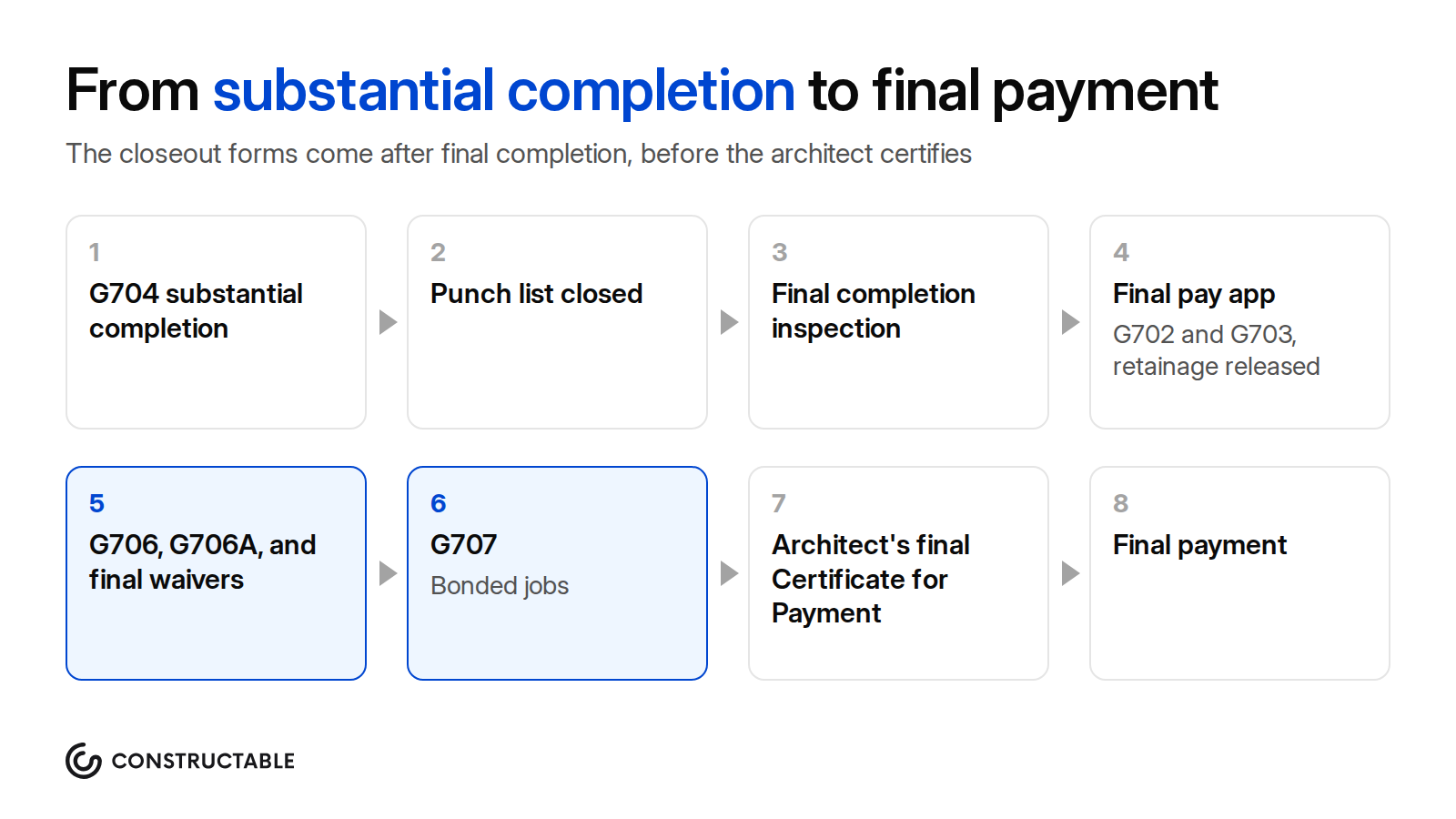
AIA doesn't publish a certificate of final completion. Its help center says AIA Contract Documents doesn't provide a certificate of final completion or project closeout forms. On an AIA job, the architect's final Certificate for Payment on your final G702 is the document that says the work is complete and the balance is due. AIA G734 isn't a final completion form either. It's the Certificate of Substantial Completion for construction manager as adviser projects, G704's counterpart for jobs under A232. If your owner wants a separate final completion certificate, it will come from the owner's own forms or another contract family. ConsensusDocs, for example, publishes ConsensusDocs 815, a Certificate of Final Completion.
Final payment package checklist
Use this list to build the package. Check the contract's final payment article and the Division 01 closeout section for anything your owner adds.
Worked example: closing out a $4.2M bonded job
The numbers, companies, and dates in this example are made up. The job is a two-story medical office building. The original contract was $4,000,000, and approved change orders brought the final contract sum to $4,200,000. The contract follows A201-2017, the owner holds 5% retainage, and the GC has performance and payment bonds.
Retainage. At substantial completion in August, the owner was holding $210,000, 5% of the work. The GC sent a G707A from its surety with that pay app, and the owner released $150,000. The owner kept $60,000, twice the architect's $30,000 estimate for the punch list and the closeout documents.
Final completion. The GC finished the punch list on October 2, and the architect's final inspection on October 6 found nothing open. The GC submitted its final pay app on October 9, with the G703 at 100% on every line and all retainage released. Line 8, Current Payment Due, was $60,000.
Final waivers. The GC was still holding $42,000 of retainage from its own subs. Each sub signs a conditional final waiver now, and an unconditional final waiver once the GC pays it from the owner's final payment.
| Subcontractor or supplier | Scope | Retainage the GC holds | Final waiver |
|---|---|---|---|
| Ridgeline Concrete | Concrete | 0 | Unconditional final, paid when its scope finished in May |
| Ironside Steel | Structural steel | 9,000 | Conditional final now, unconditional after payment |
| Clearwater Mechanical | HVAC and plumbing | 14,500 | Conditional final now, unconditional after payment |
| Bright Line Electric | Electrical | 12,000 | Conditional final now, unconditional after payment |
| Summit Roofing | Roofing | 6,500 | None. Claims 18,400 more for added flashing; the GC disputes it |
| Harbor Glass Supply | Storefront glass | 0 | Unconditional final, paid in full in July |
| Total | 42,000 |
The exception. Summit Roofing says it's owed $18,400 for flashing work it calls extra, and the GC says it was in the subcontract. Summit won't sign a final waiver until it's paid. The GC lists Summit on G706 and G706A as an exception, with the claimed amount. The owner's attorney asks for a bond for 150% of the claim, and the GC has its surety issue a $27,600 bond to the owner against the claim, as A201-2017 Section 9.10.2 allows. The exception on both affidavits reads, in substance: Summit Roofing, claim of $18,400 for flashing, disputed, bond attached. The owner could have held the claim amount in escrow from final payment instead, and some owners prefer that.
The surety's consent. The GC's project accountant asked the bonding agent for G707 on September 29, a week before the final inspection, with the final contract sum, the change order log, the sub retainage table above, and a note on the Summit claim. The surety asked for Summit's subcontract and the GC's position on the claim, issued the bond, and sent the signed and sealed G707 with its power of attorney on October 16.
The package. The GC sent it to the architect on October 17:
- Final G702 and G703, Current Payment Due $60,000.
- G706, notarized, with the Summit exception and the bond.
- G706A, notarized, with the GC's conditional final waiver for $60,000, four sub waivers, the supplier's waiver, and the list.
- G707 with the power of attorney.
- Insurance certificates for completed operations coverage, with the GC's statement that the coverage is renewable.
- Warranties, O&M manuals, and record drawings, delivered with the closeout documents in September.
The architect issued the final Certificate for Payment on October 22. The owner paid $60,000 on November 13, within the 30 days the agreement allowed. The GC paid its four subs their retainage within the time its subcontracts and the state's prompt payment law required, collected their unconditional final waivers, and sent the owner its own unconditional final waiver. Summit's claim was the GC's to resolve under its subcontract, with the bond protecting the owner until it was.
Common mistakes that hold up final payment
- The affidavit isn't notarized. G706 and G706A are sworn statements. Without the notary's signature, seal, and commission date, they aren't affidavits.
- The exceptions space is blank. Write "None," or list each exception with what you've done about it.
- An exception with no answer. Listing an unpaid sub without a bond, escrow, or the owner's agreement sends the package back for a decision.
- No power of attorney with G707. Attach the power of attorney for the person who signed for the surety.
- The consent doesn't match the bond. Use the surety, contractor, and owner names and the contract date from the bond.
- The final waiver doesn't match the pay app. Your conditional final waiver should be for Line 8 of the final G702. A different number, or a final contract sum on the waiver that doesn't match the change orders, means something changed and the reviewer will ask what.
- A sub is missing from the waiver list. Check the list against every company that billed on the job, including suppliers you paid directly.
- The wrong state form. In a state with statutory waiver forms, a sub's waiver on your company form may not release its lien rights.
- The project, owner, or contract date doesn't match the agreement. Copy them from the owner-contractor agreement, not from an old pay app.
- Asking the surety last. The consent is often the last document in. Ask for it before the final inspection.
How Constructable keeps the final payment package together
Constructable keeps the pieces of the final payment package on the invoices and project records you already work from, so the package comes together from one place. Here is what it does for this job:
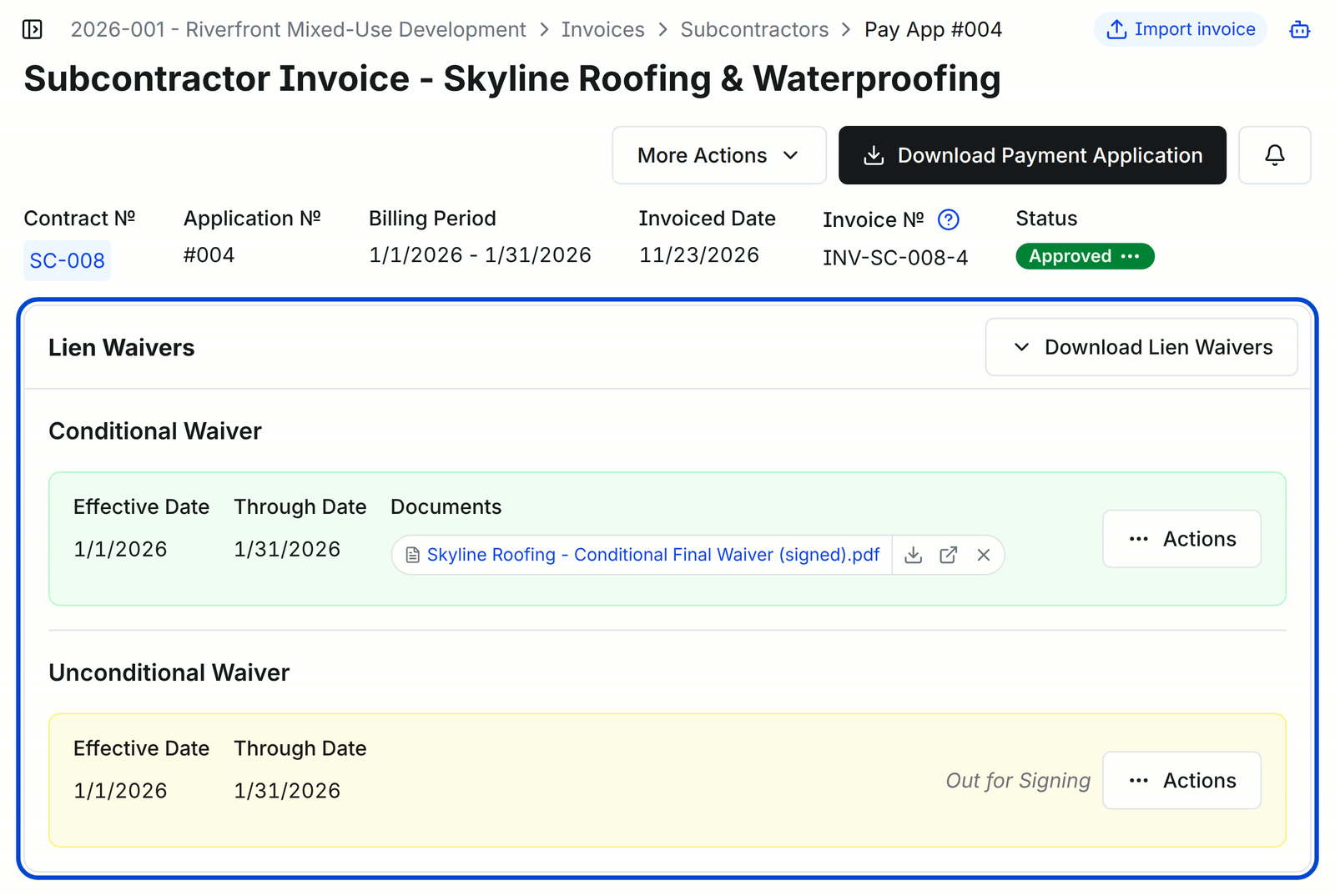
- Final lien waivers on every invoice. Each invoice's Lien Waivers block has a Conditional Waiver section and an Unconditional Waiver section. Choose Send Lien Waiver on a subcontractor invoice and set the Billing Type to Final Payment to create a Conditional Final Payment or Unconditional Final Payment waiver, pick the signer from the sub's contacts on the Project Team, and track it through Draft, Out for Signing, and Fully Executed. When a sub signed on paper, use Upload Lien Waiver and attach the file. See the lien waiver software page.
- Your own waiver forms. Lien Waiver Templates let you upload your own waiver PDFs, such as a state's statutory forms, with merge fields and a signature field, and set a default template for each of the four waiver types on the organization or on a project. Waivers fill in the claimant, the through date, and a payment amount that is this period's billing less retainage held, plus retainage released.
- Release all retainage on the final pay app. On the final invoice, More Actions → Release All Retainage releases the retainage held on every line. Each invoice prints an AIA-style payment application. See the pay application software page.
- The sub backup in one download. Download Pay Applications on the Subcontractors tab, or Download All Subcontractor Pay Applications on an Owner invoice, packages subcontractor pay applications by billing period with their attachments and lien waivers. That's the backup behind your G706A list.
- Closeout packages for the owner. From Project Settings → Closeouts, generate a ZIP with the sections the owner wants, such as Documents, Drawings, Specs, and Punch List, and the Financial Tools sections: Prime Invoices, Vendor Invoices, Prime Commitments, Vendor Commitments, and Change Orders. See the closeout software page.
- Completion dates on the project. Project Info tracks the actual and substantial completion dates and the warranty start and end dates, so everyone works from the same dates.
Final thoughts on AIA G706, G706A, and G707
The last payment on a job depends on paperwork that takes an afternoon to fill out and weeks to collect. Ask your surety and your subs before the final inspection, settle or bond every claim so the exceptions have answers, get both affidavits notarized, and check every waiver against the final pay app before the package goes to the architect. To see how Constructable keeps final lien waivers, retainage, and closeout records together, book a demo with our team.
FAQ
What is an AIA G706 form?
AIA G706, Contractor's Affidavit of Payment of Debts and Claims, is a notarized statement the contractor signs with its final payment application. It swears that all bills for labor, materials, equipment, and services, and all known claims the owner could be responsible for, are paid, except for exceptions the contractor lists. It answers the affidavit A201-2017 Section 9.10.2 requires before final payment.
What is the difference between G706 and G706A?
G706 swears that the contractor has paid its bills and known claims on the job. G706A swears that the lien releases or waivers attached to it cover the contractor, every subcontractor and supplier, and everyone else with lien rights. A sub can be paid and still not have signed a final waiver, so owners often ask for both, and G706 lists G706A as one of its attachments.
Does the G706 need to be notarized?
Yes. G706 is an affidavit, and it has a notary block where the notary signs, gives the date, and notes when their commission expires. AIA's instructions say the notary gives the contractor an oath on the statements in the form, then signs and seals it. G706A has the same notary block.
What is a consent of surety to final payment?
A consent of surety to final payment is the surety's written approval of final payment to a bonded contractor. On AIA jobs it's usually AIA G707. The surety also agrees that final payment doesn't release it from its obligations to the owner under the bond, which keeps the owner's bond rights intact after it pays. A201-2017 Section 9.10.2 makes consent of surety, if there is one, a condition of final payment.
Who signs the AIA G707?
The surety's authorized representative signs G707, and the surety applies its seal. The contractor doesn't sign it. The signer is usually an attorney-in-fact for the surety, and most owners want the surety's power of attorney for that person attached. The contractor requests the consent through its bonding agent.
Is a consent of surety required on every job?
No. It's required only when the contractor furnished a bond, usually a performance and payment bond, and the contract makes the surety's consent a condition of final payment. A201-2017 asks for consent of surety "if any." Federal projects over the Miller Act threshold and most state and local public projects above their own thresholds require bonds, so they require a consent too, often on the public owner's own form.
What documents are required for final payment in construction?
Under A201-2017 Section 9.10.2, final payment waits for an affidavit that bills are paid, a certificate for insurance that must stay in force after final payment, a statement that it's renewable, consent of surety if the job is bonded, special warranties, and lien releases if the owner asks. On AIA jobs that means a final G702 and G703, G706, G706A with final waivers, and G707. Most contracts also require O&M manuals, record drawings, and the other closeout documents in Division 01.
Does AIA have a certificate of final completion form?
No. AIA's help center says AIA Contract Documents doesn't provide a certificate of final completion or project closeout forms. On an AIA job, the architect's final Certificate for Payment states that the work is complete and the balance is due. AIA's completion certificates, G704, G734, and G744, are all for substantial completion.