Retainage in Construction: How It Works (November 2026)
Retainage in construction explained for GCs: typical rates, state limits, how it's calculated on pay apps, how to account for it, and how to get it released.
The building is open, the tenants are moving in, and the owner still has 10% of every pay app you've sent for the last 14 months. Your subs want their retainage, your bank wants to know when the money lands, and the architect wants one more warranty binder before anyone signs the final application. Retainage is the biggest single payment on most commercial jobs, and it's the one that comes last and slowest. This guide covers how retainage works from both sides of a GC's job: what the owner holds from you, what you hold from your subs, how to calculate it on each pay app, how to book it, and how to get it released without waiting a year.
TLDR:
- Retainage, also called retention, is a percentage of each progress payment that the payer holds back until the work is finished. On commercial work it's usually 5% to 10%, and the contract and state law set the number.
- A GC sits in the middle of the chain. The owner holds retainage from you, and you hold retainage from your subs, often on the same job at different rates.
- Calculate retainage on work completed and on stored materials separately, since contracts can set a different rate for each. Many contracts cut the rate or stop withholding at 50% complete.
- Retainage the owner holds is a receivable you've earned but can't collect yet. Retainage you hold from subs is a payable you owe but don't pay yet. Track both by job, every month.
- Most retainage comes back in two steps: most of it at substantial completion, and the rest with the final payment application once the punch list, closeout documents, and final lien waivers are in.
- Constructable sets retention on each contract and line, holds and releases it on every pay app, and syncs it to QuickBooks.
What is retainage in construction?
Retainage in construction is a portion of each progress payment that the owner or contractor holds back until the work is complete. The money is earned, but the payer keeps it as security until the payee finishes the job, corrects the punch list, and turns in the closeout documents.
Owners hold retainage for three reasons:
- Completion. If the contractor walks off the job, the owner has money in hand to finish the work.
- The punch list. Held money gives the contractor a reason to come back and correct deficient work after the building is in use.
- Closeout. As-built drawings, O&M manuals, warranties, and final lien waivers are easy to put off once the work is done. Retainage keeps them moving.
Retainage and retention are the same thing. "Retainage" is the common term in US commercial construction and on AIA documents. "Retention" is common in contracts, in some state statutes, and outside the US, and many accounting systems label their fields "retention." This post uses both.
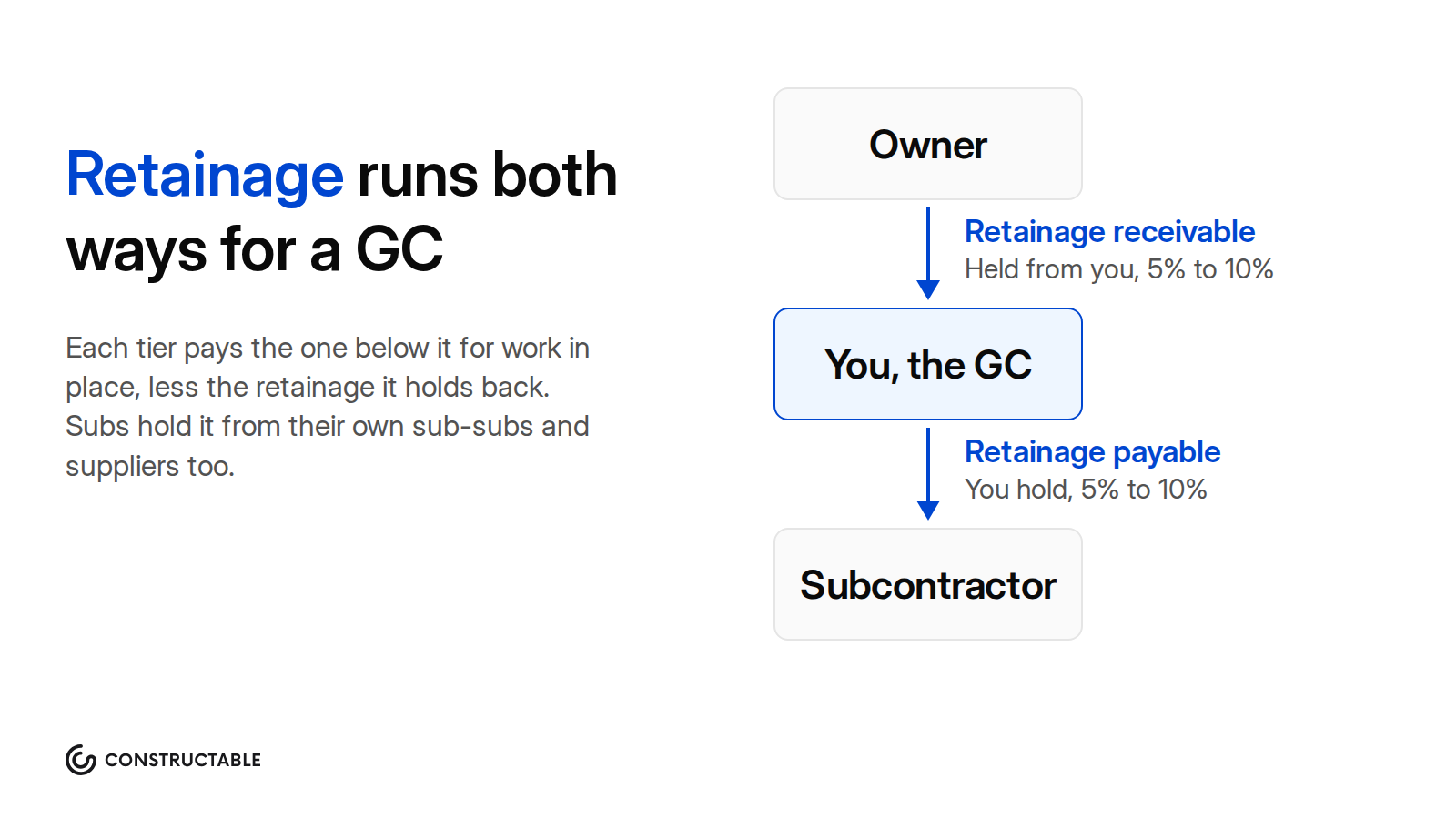
Retainage runs down the whole payment chain. The owner holds it from the GC, the GC holds it from its subcontractors, and subs often hold it from their own sub-subs and suppliers. For a GC, retainage runs both ways at once. You're waiting on the owner's retainage while your subs wait on yours.
How much retainage is typical?
On commercial work, retainage is usually 5% to 10% of each progress payment:
- 10% is common on private work, especially early in a job.
- 5% is common on public work, where many states cap retainage, and on jobs where the rate drops partway through.
- Reduced or zero is common after the job passes a milestone, usually 50% complete, when the contract allows a reduction.
Federal fixed-price construction has its own rule. Under FAR 32.103 and the payments clause at FAR 52.232-5, the contracting officer pays progress payments in full when the contractor is making satisfactory progress, and can retain up to 10% of a payment only when it isn't. At substantial completion, the government keeps what it considers adequate protection and releases the rest.
No single number applies everywhere. Your contract sets the rate, and state law can cap it, especially on public jobs. Read the retainage clause in the prime contract and in each subcontract before you send the first pay app.
How to calculate retainage
Retainage on a pay app is the retainage rate times the amount billed. Calculate it separately for work completed and for stored materials, because many contracts set a different rate for each:
- Retainage on work completed = work completed × work retention %
- Retainage on stored materials = materials presently stored × materials retention %
- Retainage this period = the two added together, for the work and materials billed this period
- Retainage held to date = retainage held on every application so far, less any retainage released
Here's one month on a $1,500,000 contract with 10% on work and 5% on stored materials. This period you bill $120,000 of work in place and $40,000 of switchgear delivered and stored on site.
| Amount billed | Rate | Retainage | |
|---|---|---|---|
| Work completed this period | $120,000 | 10% | $12,000 |
| Materials stored this period | $40,000 | 5% | $2,000 |
| This period | $160,000 | $14,000 |
The owner pays $146,000 this month, before anything is released, and the $14,000 joins the retainage already held.
On an AIA pay application, retainage lands in three places. G702 Line 5a is retainage on completed work, Line 5b is retainage on stored material, and Line 5 is their total, which comes off the amount earned before the current payment is figured. When the rate differs by line, G703 Column I carries each line's retainage. The AIA G702 and G703 pay application guide walks through each line with a worked example, and the schedule of values guide covers the lines retainage is calculated against.
Retainage example: one job from first pay app to final payment
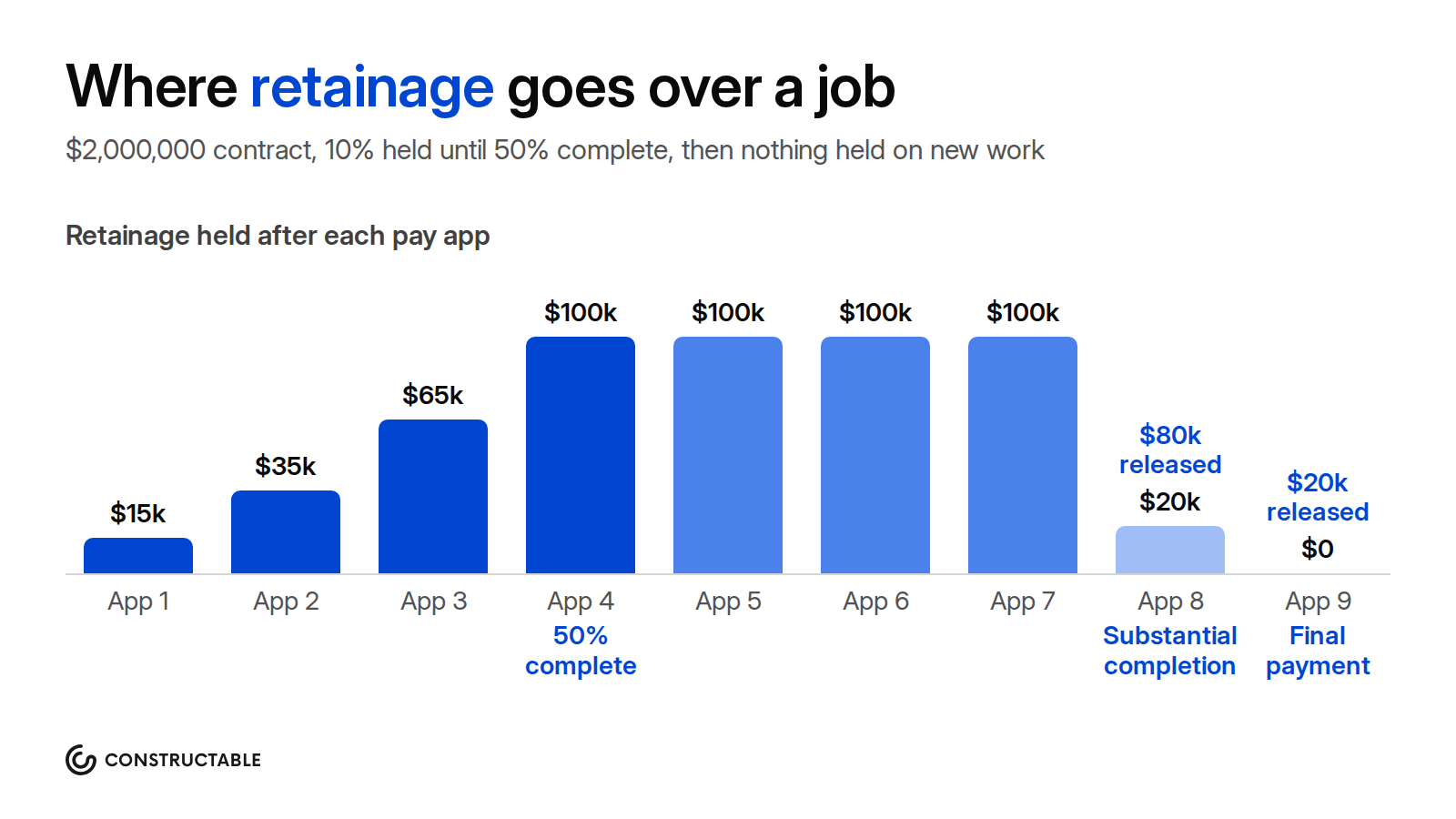
Here is one job's retainage from the first pay app to final payment. The prime contract is $2,000,000. The owner holds 10% until the job is 50% complete, then holds nothing on new work. At substantial completion, the owner releases all but $20,000, which it keeps for the punch list and closeout. The final payment application releases the last $20,000. To keep the math simple, there are no change orders or stored materials.
Amounts are in dollars. "Held to date" is the retainage the owner is holding after each application.
| Pay app | Work this period | Work to date | % complete | Held this period | Released | Held to date | Payment due |
|---|---|---|---|---|---|---|---|
| 1 | 150,000 | 150,000 | 7.5% | 15,000 | 0 | 15,000 | 135,000 |
| 2 | 200,000 | 350,000 | 17.5% | 20,000 | 0 | 35,000 | 180,000 |
| 3 | 300,000 | 650,000 | 32.5% | 30,000 | 0 | 65,000 | 270,000 |
| 4 | 350,000 | 1,000,000 | 50.0% | 35,000 | 0 | 100,000 | 315,000 |
| 5 | 350,000 | 1,350,000 | 67.5% | 0 | 0 | 100,000 | 350,000 |
| 6 | 300,000 | 1,650,000 | 82.5% | 0 | 0 | 100,000 | 300,000 |
| 7 | 250,000 | 1,900,000 | 95.0% | 0 | 0 | 100,000 | 250,000 |
| 8, substantial completion | 100,000 | 2,000,000 | 100.0% | 0 | 80,000 | 20,000 | 180,000 |
| 9, final payment | 0 | 2,000,000 | 100.0% | 0 | 20,000 | 0 | 20,000 |
| Total | 2,000,000 | 100,000 | 100,000 | 2,000,000 |
Each row's payment due is the work billed that period, less retainage held, plus retainage released. Application 4 is the one that reaches 50% complete, so it's the last one with retainage withheld. Held retainage stops at $100,000, 5% of the contract, and stays there for three months while the job finishes. The $100,000 is the GC's money the whole time. It just arrives last.
The same retainage, flowed down to a sub
Now the other side. The GC's electrical subcontract is $300,000 with 10% retainage for the whole job. Once the electrician has billed the full $300,000, the GC is holding $30,000 of the sub's money.
Notice the two contracts don't match. The owner stopped withholding at 50% complete, but the subcontract didn't, so the GC holds 10% on the electrician's later billings while the owner holds nothing on the GC's. That cushion protects the GC if the electrician doesn't finish the punch list or turn in its closeout documents.
When the GC can pay that $30,000 depends on the subcontract and the state:
- Pay-when-paid. The GC pays the sub's retainage within a set time after the owner pays the GC. In most states, courts read this as a timing clause. If the owner never pays, the GC still has to pay the sub within a reasonable time.
- Pay-if-paid. The owner's payment is a condition of the GC's duty to pay. Some states enforce these clauses if they're written clearly, and others refuse to.
- State prompt payment laws. Many states require the GC to pay subs their share of released retainage within a set number of days after the GC receives it. In Minnesota, for example, a contractor must pay its subs their remaining retainage within 10 days of receiving it, unless the sub's work is in dispute, under Minn. Stat. § 337.10.
Because the owner released $80,000 at substantial completion, a GC under a typical pay-when-paid subcontract owes the electrician its retainage once the electrician's work is accepted and the owner's release comes in, minus anything the subcontract lets the GC keep for the electrician's own punch list.
Retainage reduction and the 50% milestone
Many contracts reduce retainage once the work is half done, on the idea that a contractor who has performed well through 50% has earned some trust. The common forms are:
- Stop withholding on new work. Retainage already held stays, and nothing more is held. This is the example above.
- Drop the rate. The rate falls from 10% to 5% on work after the milestone, and sometimes on work before it, with the difference released.
- Hold a fixed cap. Retainage stops once it reaches a set amount, such as 5% of the contract sum.
Reduction is rarely automatic. Most contracts let the owner or architect decide whether progress is satisfactory before cutting the rate. To ask for it:
- Read the contract for the trigger, the new rate, and who approves it.
- Send a written request once you reach the milestone, with the pay app that shows 50% complete and a schedule showing the job is on track.
- Include consent of surety on a bonded job if the contract or the surety requires it. AIA G707A is the form for consent to a reduction or partial release.
- Get the architect's or owner's approval in writing before you change the rate on the next application, and note the change on that application.
Line-by-line reduction for early trades
Sitework, concrete, and structural steel can finish a year or more before closeout. Holding 10% of those lines until the last pay app ties up money the GC has to keep holding from those subs, or pay out of its own pocket. Ask for line-item release in the contract: once a trade's work is complete and accepted, the owner releases the retainage on that line of the schedule of values, and the GC releases the matching subcontract retainage. On the G703, this is what Column I is for: each line carries its own retainage.
State retainage laws: what changes from state to state
Every state handles retainage differently, and many have one set of rules for public work and another for private work. These are the kinds of rules that change your numbers, with one example of each:
| Rule | What it does | Example |
|---|---|---|
| Cap on public work | Limits how much a public owner can hold | Virginia: no more than 5% retained on public construction contracts paid by percentage of completion, and the same limit applies to subcontracts on those projects (Va. Code § 2.2-4333) |
| Cap on private work | Limits retainage on private jobs too | Minnesota: retainage on a building and construction contract may not exceed 5%, and the rule excludes public agencies (Minn. Stat. § 337.10, subd. 4) |
| Reduction after a milestone | Stops or cuts retainage partway through | North Carolina public projects of $150,000 or more: retainage is capped at 5%, and at 50% complete the owner stops withholding if the contractor is performing satisfactorily and the surety consents in writing (N.C.G.S. § 143-134.1) |
| Release deadline | Sets how soon held money must come back | Ohio public improvements: retainage and its interest are paid within 30 days of substantial completion, occupancy, use, or acceptance, less what's reasonably needed to finish (R.C. 153.13) |
| Escrow or interest on public work | Lets the contractor earn on held money | Washington public improvements: retainage of up to 5% is held, at the contractor's option, in a fund, in an interest-bearing account with the interest paid to the contractor, or in escrow invested in securities (RCW 60.28.011) |
| Flow-down to subs | Makes the GC pass payments down on time | North Carolina public projects: the prime pays each sub within 7 days of receiving a periodic or final payment, or owes 1% a month interest, and can't hold a higher retainage percentage from subs than the owner holds from the prime (N.C.G.S. § 143-134.1) |
These are examples, not a complete list. Many states have several of these rules, some apply only to certain owners or contract sizes, and statutes change. Check your state's statute and your contract before you set the rate on the first pay app and before you hold retainage from a sub.
How to release retainage
Retainage release is a closeout process, not a single request. Most owners and architects ask for the same things, in roughly this order. Use this as a checklist:
Then do the same for your subs. Release each sub's retainage once its work is accepted and its closeout items and final waivers are in, within the time your subcontract and your state's prompt payment law allow.
Retainage receivable vs retainage payable
A GC carries retainage on both sides of the balance sheet. Your CPA will set the exact treatment for your company, but the general logic is the same everywhere.
Retainage receivable is retainage the owner holds from you. You've billed and earned it, but you can't collect it until the contract says so. On pay app 1 in the example, the GC bills $150,000 and the owner holds $15,000:
| Account | Debit | Credit |
|---|---|---|
| Accounts receivable | $135,000 | |
| Retainage receivable | $15,000 | |
| Contract revenue or billings | $150,000 |
When the owner releases it, move it to regular accounts receivable, then record the cash when it arrives: debit accounts receivable $15,000, credit retainage receivable $15,000.
Retainage payable is retainage you hold from subs. You owe it, but you don't pay it until the subcontract says so. When the electrician bills $30,000 and you hold 10%:
| Account | Debit | Credit |
|---|---|---|
| Job cost: subcontract | $30,000 | |
| Accounts payable | $27,000 | |
| Retainage payable | $3,000 |
When you release it, debit retainage payable and credit accounts payable, then pay it.
A few points that trip people up:
- Track both by job. Retainage receivable and payable belong to a contract, and you need to see each job's balances to know what you can collect and what you owe at closeout.
- Age them separately. Retainage isn't overdue just because it's 120 days old, so keep it out of your regular AR and AP aging, or you'll chase the wrong money and miss the retainage that really is late.
- On the balance sheet, both usually show as current, because they'll be settled within the job's operating cycle, and many companies list them on their own lines. Some contractors who report under ASC 606 show retainage that depends on finishing the work as a contract asset instead of a receivable. Ask your CPA.
- On the WIP schedule, billings to date include retainage held, so retainage doesn't change whether a job is over- or underbilled. It changes when you get the cash.
How to get retainage paid faster
The best time to speed up retainage is before you sign. The rest comes from keeping closeout moving from the first month.
- Negotiate the rate and the trigger. Ask for 5% instead of 10%, a reduction or stop at 50% complete, and a clear standard for approving it. Check what your state allows before you agree to more.
- Ask for line-item release. Early trades shouldn't wait for the last pay app. Write release by line into the contract.
- Match your subcontracts to the prime. Hold subs at least the owner's rate, and write sub retainage release to follow the owner's release so you're not paying it out of your own cash.
- Build closeout from month one. Collect submittals, warranties, O&M data, and conditional lien waivers as the work happens, not after substantial completion. The closeout guide has the full list.
- Track retainage by job every month. Know what each owner holds and what you hold from each sub, so the release request goes in the day you're eligible.
- Use a retainage bond where the owner allows it. Some owners accept a retainage bond from the contractor's surety in place of cash retainage, and some public owners let contractors post securities instead. Compare the bond premium with the cost of the money it frees up.
- Know your state's release deadline and interest rules. If your state requires release within a set number of days or charges interest on late retainage, cite the statute in your request.
How Constructable tracks retainage on every pay app
Constructable keeps retainage on the same contracts and invoices you bill from, so what you hold from subs and what the owner holds from you are both on the line items, every month. Here is what it does for retainage:
- Default Retention on each contract. The Prime Contract and every Commitment carry a Default Retention rate that new SOV lines start from, and you can set a different rate on individual lines. The organization's Default Retention Percent in Financial Settings supplies the starting rate.
- Work and materials at their own rates. In Edit Invoice Line Item, each line has a Work Retention % and a Materials Retention %, so stored material can carry its own rate.
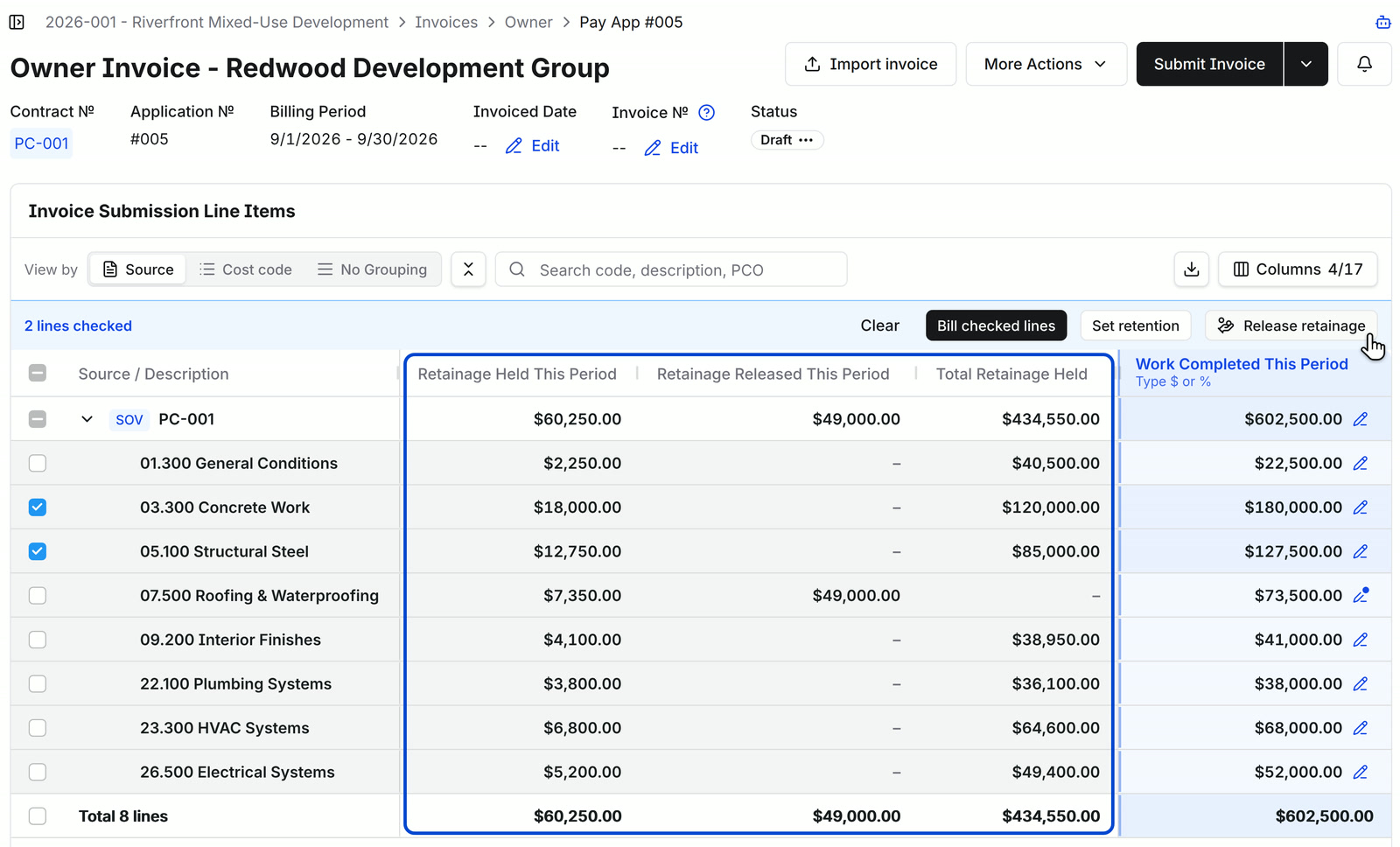
- Held and released on every line. Each invoice line shows Retainage Held This Period, Retainage Released This Period, and Total Retainage Held, so a reviewer sees each line's retainage at a glance.
- Set retention and release retainage on checked lines. On an owner invoice, check the lines you want and choose Set retention to change the work and materials rates on all of them at once, or Release retainage to release what's held on just those lines. That's line-item release for a finished trade, without touching the rest of the pay app.
- Release All Retainage for the final pay app. More Actions → Release All Retainage releases the held retainage on every line, including a line whose SOV amount was revised down to $0 by a deductive change order.
- Retainage on reports. The project's owner invoice list shows Retainage Total and Remaining Retainage for each invoice, and the organization's all-invoices report shows Retainage Total across jobs.
- AIA-style pay applications. Each invoice prints an AIA-style payment application, with retainage on completed work and stored material on the summary sheet. See the pay application software page.
- Lien waivers that match the pay app. Lien Waiver Templates fill a Payment Amount that is this period's billing less retainage held, plus retainage released, so the waiver matches the check. See the lien waiver software page.
- QuickBooks sync. Approved invoices sync to QuickBooks Online and QuickBooks Desktop, and retainage posts to the Retention Receivable Item and Retention Payable Item you choose in the integration settings.
For budgets, commitments, and billing in one place, see the financial management page.
Final thoughts on retainage
Retainage is money you've earned that arrives last, and on a commercial job it's often your margin. Negotiate the rate and the reduction before you sign, know what your state allows, keep the receivable and the payable straight by job, and run closeout from the first month so the release request goes in the day you qualify. To see how Constructable holds and releases retainage on every pay app, book a demo with our team.
FAQ
What is retainage in construction?
Retainage in construction is a percentage of each progress payment that the owner or contractor holds back until the work is complete, usually 5% to 10% on commercial jobs. It's security that the contractor finishes the work, corrects the punch list, and turns in closeout documents. The owner holds it from the general contractor, and the general contractor holds it from subcontractors.
How is retainage calculated?
Multiply the amount billed by the retainage rate, for work completed and for stored materials separately, since contracts can set a different rate for each. On a $160,000 pay app with $120,000 of work at 10% and $40,000 of stored materials at 5%, retainage is $12,000 plus $2,000, or $14,000. Retainage held to date is the total held on every application, less anything released.
What is a typical retainage percentage?
Most commercial contracts hold 5% to 10% of each progress payment. 10% is common on private work, and 5% is common on public work, where many states cap retainage, and after a reduction at 50% complete. Your contract sets the rate, and state law can limit it.
When is retainage released?
Most contracts release retainage in two steps. At substantial completion, the owner releases most of it, less an amount held for the punch list and closeout. The final payment application releases the rest once the punch list is done and the closeout documents, final lien waivers, and any consent of surety are in. Some states set deadlines for release after completion.
Can a general contractor hold retainage from subcontractors if the owner doesn't hold it from the GC?
Often yes, on a private job, because the subcontract sets the sub's retainage, not the prime contract. Some states limit it, especially on public work: Texas and North Carolina, for example, don't let the prime hold a higher retainage than the owner holds from the prime on public projects. Check your state's statute before you hold more from a sub than the owner holds from you.
Is retainage the same as retention?
Yes. Retainage and retention both mean money held back from each progress payment until the work is complete. Retainage is the common term in US commercial construction and on AIA documents, while retention is common in contracts, some state statutes, accounting systems, and outside the US.
Is retainage a receivable or revenue?
Retainage the owner holds is part of the revenue you've earned on the work, and the uncollected amount sits on your balance sheet as retainage receivable, separate from regular accounts receivable. Some contractors who report under ASC 606 show retainage that depends on finishing the work as a contract asset instead. Retainage you hold from subs is retainage payable, a liability. Confirm the treatment with your CPA.
What can a contractor do if retainage isn't released?
First, make sure every closeout item is in: the punch list sign-off, closeout documents, final lien waivers, and consent of surety on a bonded job. Then send a written request that cites the contract's release terms and any state statute that sets a release deadline or interest on late retainage. If the owner still doesn't pay, a contractor may have lien or payment bond rights, which come with strict deadlines, so talk to a construction attorney.