Use this guide to configure, create, complete, review, export, and troubleshoot Daily Logs. It covers the exact controls for recording weather, labor, equipment, materials, deliveries, inspections, delays, notes, phone calls, photos, and files on desktop web, mobile web, and the native app.
Start here
- I configure field reporting: Configure Daily Log sections → Create the first log.
- I complete the report each day: Build the daily record → Add photos and attachments → Export the finished log.
- I only log my crew's headcount: Record personnel with limited Daily Log entry.
- I review project history: Find logs by date → Read activity and evidence.
- I send the log to the owner or architect: Distribute a Daily Log.
- Something is missing or blocked: Start with Troubleshooting Daily Logs.
Common task recipes
- Start today's report quickly: Add the log for today's date, repeat eligible labor, time cards, equipment, and materials from the prior log, then update quantities and notes.
- Send the day's report out: Open the log, choose Actions → Distribute, pick the photo sections and recipients, and send.
- Document a failed field inspection: Add an Inspection entry, mark it Failed, add notes and attachments, and include inspection photos in the PDF.
- Record a delay: Select the applicable delay types and explain the impact in the log so the delay indicator is visible from the index.
- Log a jobsite phone call: Open the day's log, select Add Phone Call in Phone Calls, set Direction, who was on the call, and Start Time, then save.
- Log a toolbox talk or near miss: Open Safety, write the day's record, and attach the sign-in sheet or photos there so they export as Safety Photos.
- Turn over the full history: Select Export Daily Logs in the Daily Logs page header, then generate the package from Closeout.
Understand access and availability
Understand how Daily Logs work
A Daily Log is one dated record of a single day on the project — weather we capture for you, entries your crews fill in, and the photos and files that back them up. Saved entries update the live record, there is one log per date, and where you attach a photo decides where it lands in the PDF.
Date → weather and overview → field entries → notes, delays, and evidence → PDF or Closeout package
Your project has one dated sequence of Daily Logs. Anyone with write access edits the live record — which is exactly what you want when a correction surfaces three days later.
Which optional entry sections you see comes from organization settings rather than from each project, so logs read the same way across your work. Weather, delays, and activity stay part of every log no matter how those settings are configured.
Note: Where you attach a file decides where it lands. A file added inside a labor, delivery, dumpster, or inspection entry stays with that entry, files added under Safety stay with the safety record, and media added to the overview belongs to the Daily Log itself. The difference shows up at export time, because photos come through grouped by where you put them.
Permissions, visibility, and platform availability
If you can open a Daily Log but can't change anything, or the log reads fine while its photos are nowhere to be found, that's permissions working as configured rather than something broken. Daily Logs check a few separate kinds of access.
- View daily logs opens the Daily Logs page and the records themselves.
- Create new daily logs, make changes to existing daily logs covers creating a log, editing it, adding entries, attaching media, and deleting.
- Limited Daily Log Entry is a separate, default-off action for Subcontractor, Consultant, and Owner roles. It lets those people open Daily Logs, add a dated log, and record their own Personnel rows — nothing else. See Record personnel with limited Daily Log entry.
- View daily log photos is a separate Photos permission, so someone can read a log without seeing its photos.
- Changing which sections appear isn't a Daily Log permission at all. That takes organization-settings access.
By default, administrators, managers, and employees can both view and write Daily Logs. Limited Daily Log Entry starts off for every role, including Subcontractor, Consultant, and Owner — an administrator turns it on when those companies should log their own headcount. Your project may be set up differently, so if what you're seeing doesn't match this, check with your Admin before assuming something is broken.
Once you have the access, writing the day's log works wherever you are — web and the app both handle creating logs and editing entries. You can export a single log or prepare the full history through Closeout.
- Everyday creation and entry editing work on desktop web, mobile web, and the app.
- The app gives you a single running list of dates instead of the web layout's weekly groupings, and a + button in the header to add a log.
- Exporting one log to PDF works everywhere. On web it's Actions → Export to PDF; in the app it's the ⋯ button in the header.
- Export Daily Logs opens the Closeout workflow for the full history. It needs Generate closeout packages; check the page header or actions menu for your layout.
Troubleshooting Daily Logs
Most Daily Log surprises come down to one of three things: a section your organization turned off, a permission you don't have, or a browser that can't save files. Find your symptom below and work through the checks in order.
An entry section is missing
Sections are an organization-wide setting, not a project one. Ask an organization administrator to open Organization Settings → Daily Log Settings. Personnel, time cards, safety, equipment, deliveries, dumpsters, inspections, phone calls, and materials can each be disabled for the organization.
Repeat from the last log is missing
The action appears only when a prior log contains eligible entries for that section — there's nothing to copy otherwise. Create the first entry manually, or confirm that the previous dated log has active entries.
A photo is missing from the PDF
The export dialog only lists photo groups that actually contain photos, and it ticks every one it lists. So a missing group usually means the photos aren't attached where you think they are — check whether the delivery ticket went on the delivery entry or on the log overview. Also confirm the attachment wasn't deleted and that your role has View daily log photos.
The Export Daily Logs button is missing
It's a web button, so it never appears in the app — open the project in a browser. On web it's gated on Generate closeout packages, which is a Closeout permission rather than a Daily Logs one, so ask your Admin to check that rather than your Daily Logs access.
Weather looks incomplete
Weather depends on the project's location and the weather data available for it. When the historical or automatic weather doesn't describe the site conditions, add what you actually saw in the notes.
A control is read-only
Confirm Daily Log write permission. Viewing a log or its photos does not grant permission to edit entries. Someone with only Limited Daily Log Entry can add and edit their own personnel rows; the rest of the log is not theirs to change.
I only see Personnel on the Daily Log
That's Limited Daily Log Entry working as configured. Notes, weather, equipment, and the other sections stay hidden unless the role also has View daily logs. If this person should fill out the full report, they need Create new daily logs, make changes to existing daily logs instead.
Set up and complete daily work
Configure Daily Log sections
Every organization reports a little differently, and a log full of sections nobody fills in teaches people to skip the whole thing. Show the sections your organization actually uses so your field teams get a focused, consistent report each day.
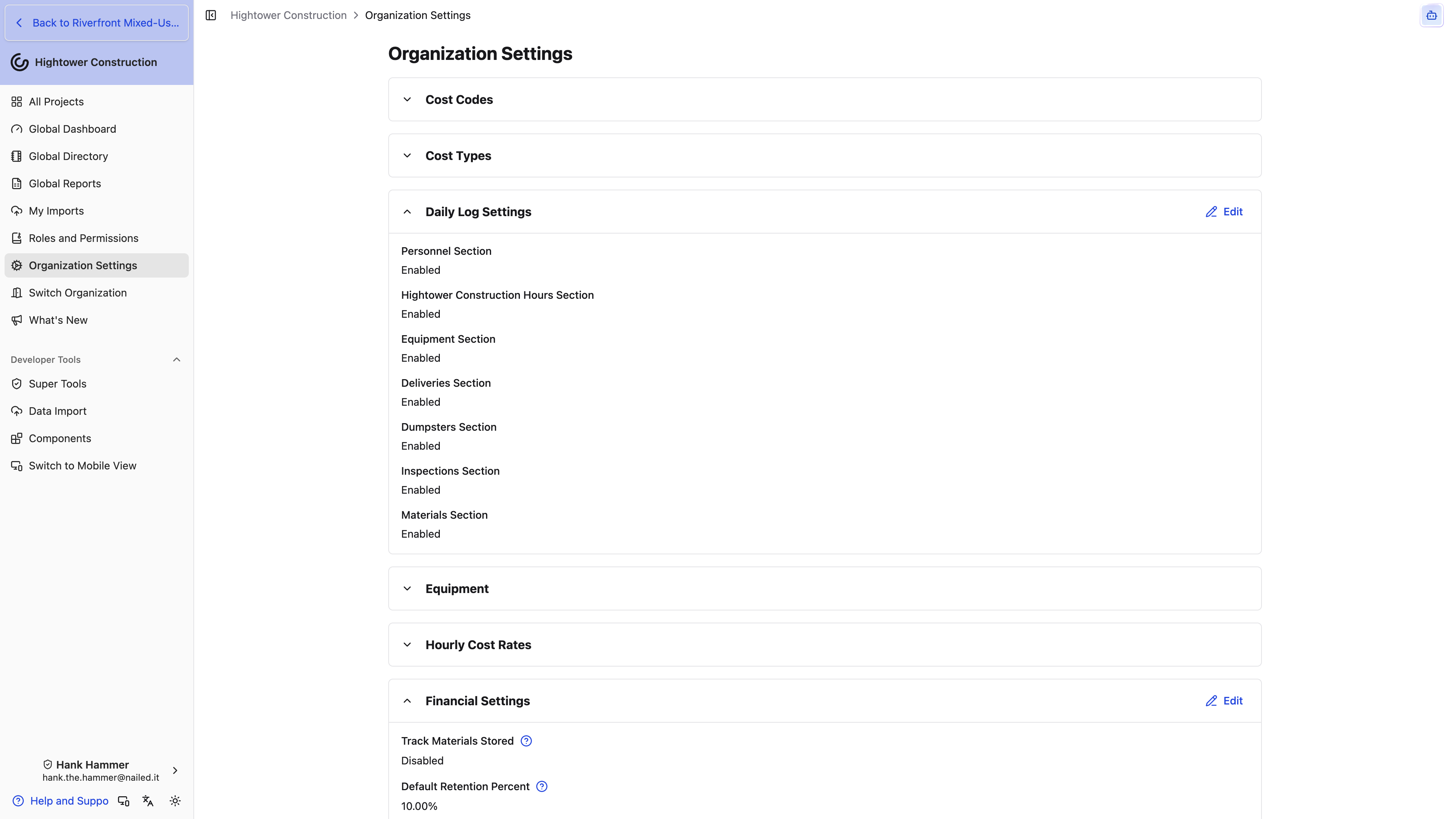
- Open Organization Settings.
- Select Daily Log Settings.
- Enable or disable:
- Personnel Section
- Time Cards Section
- Safety Section
- Equipment Section
- Deliveries Section
- Dumpsters Section
- Inspections Section
- Phone Calls Section
- Materials Section
- Save.
These settings apply across your organization, not just one project. Disabling a section hides that part of the Daily Log, but it does not delete historical entries. Before you change a setting, check the reporting requirements for active projects.
Note: Notes, Weather, and Delays aren't in this list because they can't be turned off. Every Daily Log keeps them.
In the log itself, Phone Calls sits with Overview on the left. The other optional sections always appear in the same order on the right — Notes, Personnel, Time Cards, Safety, Equipment, Materials, Deliveries, Dumpsters, Inspections, Weather, Delays — so the report reads the same way on every project and anyone reviewing a stack of them knows where to look.
Set this once and every crew in your organization fills out the same report.
Will turning a section off delete what we already recorded?
No. Disabling a section hides that part of the Daily Log, and historical entries stay in the record.
Can I enable a section for just one project?
No. These settings apply across your organization, so the change follows every project. If one job has different reporting requirements, check them before you save.
Create and find Daily Logs
Today's report starts as an empty dated record, and the same index is where you go months later when someone asks what happened on a Tuesday in March. Create one record for the day, then use the index whenever you need to look back through project history.
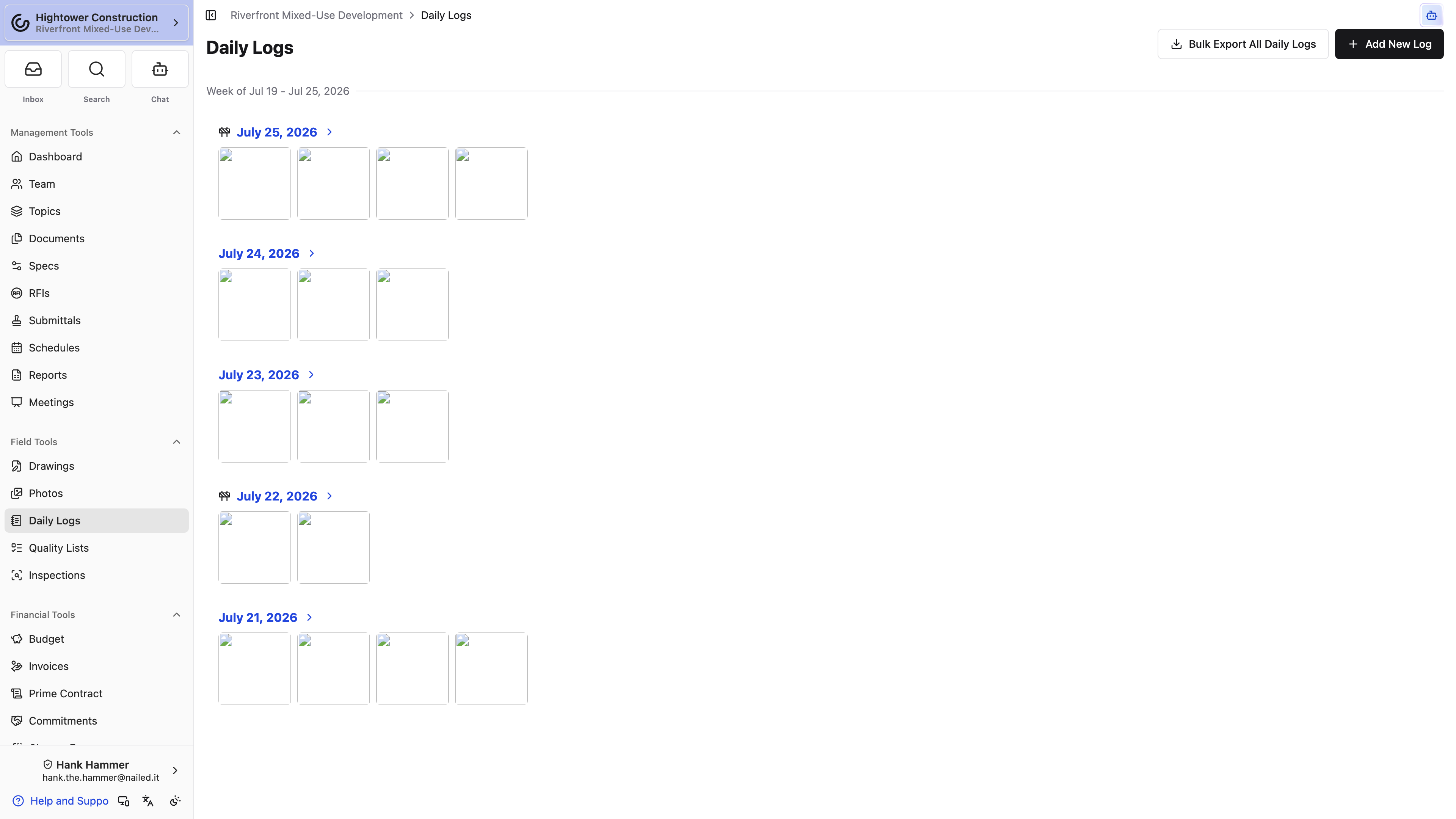
- Open Daily Logs.
- Select Add New Log. In the app, it's the + button in the header.
- The Add Daily Log dialog opens on today's date. Change it if you're catching up, then select Create.
- Open the new date from the index.
A project can only hold one log per date. If you pick a day that already has one, the dialog tells you so rather than creating a second — open the existing log and add to it.
On web, logs are grouped into Sunday-through-Saturday weeks under a Week of heading, newest week first. In the app you get a single running list, newest first, without the week headings. A construction indicator beside a date tells you that a delay was recorded, and photo previews on the web index give you quick context. Select any date to open the full record.
Pro Tip: Add the log in the morning rather than at quitting time. An open record you top up through the day beats reconstructing eight hours from memory at 4:30.
You now have a dated record to fill in, and a history you can scan a week at a time.
Why doesn't my phone show the weekly headings?
The app uses a single running list, newest first. Week groupings are part of the web layout.
What's the small indicator next to some dates?
That's the construction indicator, and it means a delay was recorded on that day. It's there so you can scan back through a month and spot the difficult days quickly.
Record personnel with limited Daily Log entry
A subcontractor on site often needs to record who showed up without writing the rest of the day's report. Limited Daily Log Entry is that narrower access.
It starts off for every role. An administrator turns it on for Subcontractor, Consultant, or Owner when those companies should log their own headcount.
- Open Daily Logs. The item appears with this permission even without View daily logs.
- Select Add New Log. In the app, it's the + button in the header.
- Pick the date and select Create. That creates an empty dated log — you can't fill in notes, weather, or safety on the way in, and you can't edit those fields on a log that already exists.
- Open the date and add a Personnel row. Company Name is locked to the company on your project membership. You can create, edit, and delete only the rows you submitted.
Personnel appears when the organization has Personnel Section on. Repeat — the action that copies yesterday's personnel — stays hidden on this permission. Distribution, delete, and export stay with View daily logs and Create new daily logs, make changes to existing daily logs.
Without View daily logs, the rest of the log is hidden: notes, weather, safety, delays, time cards, equipment, phone calls, and attachments. That's expected, not a missing section.
If this person should fill out the whole Daily Log, they need write access instead of limited entry. Limited entry plus write behaves as full write.
You now have the day's headcount on the project log without opening the rest of the report.
Why is Company Name locked?
Limited entry records labor for the company you're on this project with. Changing the company would put someone else's crew on your row.
Can I edit yesterday's personnel?
You can edit or delete a row you submitted. You can't change someone else's personnel row, and you can't edit the log's notes or weather.
Build the daily record
As you complete the day's log, focus on what another person will need to understand later: who was there, what happened, and what affected progress.
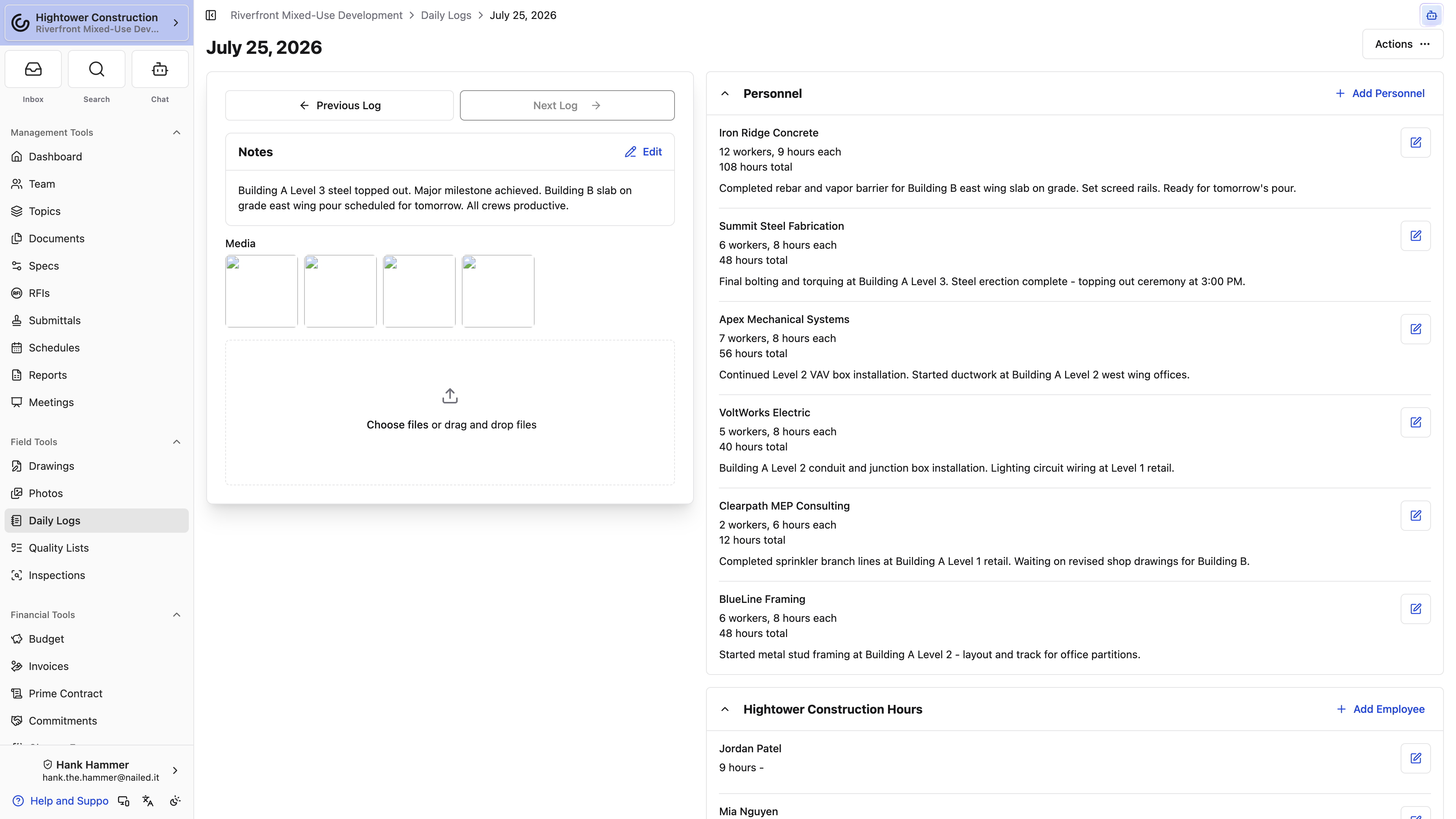
Overview and weather
Add overview photos or videos, check the day's weather, and record general notes. Use notes for useful context that does not fit a structured entry.
You don't record the weather yourself — we capture it hourly for the project's location and attach it to the log. Expand Hourly Weather Details to see the working day hour by hour, from 6:00 AM through 6:00 PM, with columns for Time, Temp, Conditions, Precip, and Wind.
Note: Precip is the chance of precipitation for that hour, not how much fell, and Wind is speed without direction. If a rain delay is going to matter in a claim, write what you actually saw in the Delays notes rather than leaning on the forecast column.
Weather comes from the project's coordinates, which we derive from the project address. A log showing weather for the wrong town usually means the project address needs fixing in Project Settings.
Phone calls
Phone Calls sits with Overview on the left of the log when Phone Calls Section is on — it starts enabled. Empty copy reads No phone calls logged.
- Select Add Phone Call.
- Choose Direction: Inbound or Outbound.
- Fill Call From or Call To (whichever matches the direction) and Phone Number.
- Set Start Time. End Time is optional but must be after the start if you enter it.
- Optionally write a Summary. Leave it blank to generate a summary automatically from the recording.
- Optionally add one Recording — audio files only. The hint reads One optional audio file. Transcribed automatically.
- Save.
Each call can have only one recording. Remove the existing recording to replace it. After save, open the call to read Transcript, Search transcript, and Logged By. While a recording is still being processed, the call shows Transcribing…. Couldn't transcribe this recording. and No speech detected in this recording. are the two failure states.
Phone calls with a summary or transcript ride along in the Daily Log PDF whenever the section is on and the call isn't still a draft. They are written content, so they are not a photo-group tick box at export.
Labor and time cards
- Personnel records company labor by trade and workforce details.
- Time Cards records the hours your own employees worked.
Personnel totals do the arithmetic for you: enter the number of workers and the hours each worked, and the entry shows the combined total. Workers and Hours Worked can stay blank when you don't have a count yet.
A personnel entry starts with Company Name, and your own organization is the first option in that list — pick it when the headcount you're recording is your own crew rather than a subcontractor's. The rest of the list is the project team's companies. If the subcontractor isn't on the project team yet, type the company name; we create a subcontractor company in the Global Directory, or reuse one that already has that name. That does not add them to the Project Team — staff them separately if they need project access. Notes on a personnel entry is a formatted field, so you can use a bulleted list to break out what three separate crews were doing instead of running it all together in one line.
Time cards are per employee. Select Add Time Card and fill in Employee, Cost Code, Cost Type, Hours Worked, and Notes. The entry sheet opens over the log, so you stay on the day you're writing. Cost Code and Cost Type are optional — although filling them in is what lets those hours become job cost, so leave them blank only if your team doesn't track labor that way. If the employee has an hourly cost rate on file, we fill both in for you.
Pro Tip: Most crews are the same today as yesterday. Repeat Personnel from last log — along with the matching actions for Time Cards, Equipment, and Materials — brings yesterday's entries over so you only have to correct what changed. If your time-card write access is Only my time cards, Repeat copies Your Time Cards from last log. On a phone the button shortens to just Repeat.
When you're adding several entries in a row, use Save and Add Another instead of saving and reopening the form each time. It's on Personnel, Equipment, Materials, Deliveries, Dumpsters, and Inspections.
Hours entered here are the same records you'd find under Time Cards in the organization menu — there's no separate daily-log-only copy. See Time Cards for reviewing, exporting, and costing them.
Safety
Safety is where the day's safety record goes — the toolbox talk you held, the near miss nobody wrote up anywhere else, the corrective action you took after a walk. Select the edit action on the block, write it in Add safety notes here..., and attach the sign-in sheet or the photo of the guarded opening under Attachments. Until someone writes something, the block reads No safety notes logged.
Safety notes ride along in the Daily Log PDF like any other section, and safety attachments that are images become their own Safety Photos group at export and distribution time. That grouping is the reason to attach a JHA photo here rather than on the log overview.
Note: This is the day's narrative safety record, not an inspection result. If you're walking the site against a checklist, use the project's Inspections workflow instead — see Inspections.
Equipment and materials
Record the equipment used and material quantities for the day. Equipment choices come from the organization's managed inventory. Creating a new piece of equipment from the Daily Log picker needs Add, edit, and archive equipment and other material assets — without it, the picker only lists equipment that already exists.
Deliveries, dumpsters, and inspections
Create a separate entry for each delivery, dumpster event, or inspection so the details and evidence stay clear. Daily Log inspection results can be Passed, Failed, or N/A. These are field-report entries and are separate from the project's Inspections workflow.
Delays
Pick the delay types that apply:
- Weather
- Permitting
- Owner Directive
- Material Acquisition
- Waiting on RFI/Submittal
- Other
Then use Delay Notes to explain what was actually affected. The notes field is always available, whichever types you pick — you don't have to select Other to write something. Say which crew or activity stopped and for how long; that's the detail a reviewer needs months later, and it's the detail nobody can reconstruct from memory.
Once you record a delay, the log is flagged in the index so delayed days are easy to spot when you scan back through the project.
Filled in this way, the log answers the questions people actually come back with: who was on site, what stopped, and for how long.
Are Daily Log inspections the same as the project's Inspections?
No. An inspection entry here is part of the field report for that day and records a Passed, Failed, or N/A result. The project's Inspections workflow is separate.
Do I have to select Other before I can write delay notes?
No. Delay Notes is available whichever delay types you pick, so choose the types that genuinely apply and explain the impact in the notes.
Add photos and attachments
A photo is only evidence if someone can tell what it's showing. Add each photo or attachment to the record it supports, and your exports will still make sense to someone who was not on site.
Where you attach something decides where it ends up:
- Add general site media from the Daily Log overview.
- Add files or photos inside Personnel, Delivery, Dumpster, and Inspection entries.
- Add the safety sign-in sheet or hazard photo under Safety.
- In the app, choose the camera or your photo library from the photo action. Taking a photo needs your device's media permission.
Note: Wait for pending uploads to finish before navigating away from the Daily Log.
At export time, images become photo pages grouped by where you attached them — Daily Log Photos, Personnel Photos, Delivery Photos, Dumpster Photos, Inspection Photos, Safety Photos — and non-image attachments appear in linked attachment lists. That grouping is exactly why it pays to put the delivery ticket on the delivery entry rather than on the overview. See Export one or many Daily Logs.
Attach things this way and the day's evidence arrives already sorted.
Where should I put a delivery ticket or an inspection report?
On the entry itself. Files and photos added inside a Personnel, Delivery, Dumpster, or Inspection entry stay with that entry, which is what keeps the export readable.
Why isn't my photo in the exported PDF?
The export dialog lists only the groups that hold photos, and ticks them all. If a group you expected wasn't listed, the photo is attached somewhere other than where you think — check the entry rather than the log overview. Then confirm the attachment wasn't deleted and that your role has View daily log photos.
Review and correct a Daily Log
Daily Logs stay editable, so a mistake you find next week is still fixable. Use the activity area when you need to understand a change, and correct the specific entry instead of replacing the whole log.
- Open the log by date.
- Compare the overview, structured entries, weather, notes, and delays.
- Open the entry that needs correction.
- Save the corrected fields or remove that entry.
- Review the activity section when you need change context.
Note: There is no publish or approval state on a Daily Log. If your team needs daily signoff, set an internal cutoff and make any later corrections deliberately.
The record now matches the day it describes, and the rest of the day's work is untouched.
Someone already exported the PDF. Can I still fix the log?
Yes. The log stays editable, so correct the entry and export a fresh PDF.
Should I delete the log and start the day over?
Almost never. Edit a wrong value, delete a wrong entry, and leave the rest of the day standing — see Delete a Daily Log or entry.
Export and retain
Export one or many Daily Logs
Sooner or later the record has to leave Constructable — an owner asking about a rain week, a claim, a turnover package. Export one PDF when you need to share a day's report, or send the whole history through Closeout when you're preparing a larger project record. Export a single log from its actions menu or use Export Daily Logs for the full history.
Export one log
- Open the dated log.
- On web, choose Actions → Export to PDF. In the app, open the ⋯ button in the header and choose Export to PDF.
- Review the photo groups. Every group that has photos in it is listed and already ticked — untick the ones this reader doesn't need.
- Download the PDF.
The PDF carries all of the log's written content no matter what — including Phone Calls when that section is on and the day has calls. The tick boxes only control photo pages: Daily Log Photos, Personnel Photos, Delivery Photos, Dumpster Photos, Inspection Photos, and Safety Photos. A group with no photos in it isn't listed at all.
Warning: Because the groups start ticked, the risk is sending more than you meant to, not less. A day with a hundred site photos exports all hundred unless you untick them, and a personnel photo that made sense internally reads differently in an owner's inbox. Look at the list before you download.
Export every log at once
Select Export Daily Logs in the Daily Logs page header, beside Add New Log. That takes you to the project's Closeout page with the package dialog already open and only Daily Logs ticked; select Generate Closeout to start it.
The package builds in the background, so you don't have to keep the tab open. We email you when it's ready, and the tile on the Closeout page carries the Download button and the finished ZIP size. Only you see the packages you generate.
Organization-level Reports also provide cross-project Daily Log reporting for users with access, including personnel, equipment, deliveries, dumpsters, inspections, materials, and phone calls. Employee hours have their own report — Daily Logs - Time Cards Report in project Reports, and the Time Cards card in Global Reports — and both need View time cards rather than Daily Logs access.
You now have a shareable record for someone who will never log in.
Why can't I find Export Daily Logs?
Confirm Generate closeout packages, then check the Daily Logs page header or actions menu for Export Daily Logs. See Closeout for the rest of that workflow.
Does the PDF include photos automatically?
Yes. Every photo group that has photos in it starts ticked, so a plain export includes all of them. Untick the groups you don't want before you download.
Distribute a Daily Log
Exporting a PDF gets the day's record onto your own machine. Distributing sends it — to the owner, the architect, whoever on your team reads the logs — and keeps a record on the log of who received it and when.
- Open the dated log.
- Choose Actions → Distribute. In the app it's the ⋯ button in the header. If the log has already gone out once, the action reads Redistribute.
- Step 1 of 3 is Include Photos. The PDF always carries all of the log's written content; these tick boxes only control which photo sections ride along. Select all and Deselect all are there for a day with a lot of photos. Select Continue to Step 2: Recipients.
- Step 2 of 3 is Notify Recipients, split into your organization's recipients and External Recipients. Your project's default recipients arrive already selected — add or remove people for this particular day. Select Continue to Step 3: Review.
- Step 3 of 3 shows the Email that goes out. Read it, then send with Distribute or Redistribute.
Leave Send email on to deliver the notification. Turn it off and the distribution is still recorded against the log, but nobody gets a message — useful when you've already handed the PDF over another way and just want the record straight.
Once a log has been distributed, a banner on the log shows Distributed or Redistributed with the time, the Recipients, the Attachments, and the Distribution Message. View Sent Emails takes you to the Email Activity report to confirm delivery.
Note: Redistributing doesn't replace the earlier send. Each distribution is added to the log's history, so a corrected log that goes out twice shows both.
To stop rebuilding the same recipient list every day, set Default distribution recipients under Daily Log defaults. Open Project Settings → General → Daily Log Settings. Until someone sets them, the field shows -- and every distribution starts from an empty list.
You now have the day's report in the right inboxes, and proof on the log that it went.
Do I have to send an email to distribute?
No. Clear Send email and the distribution is recorded on the log without notifying anyone.
Can I change who gets the log by default?
Yes. Open Project Settings → General → Daily Log Settings. Default distribution recipients under Daily Log defaults pre-selects people in Step 2. You can still adjust the list for any single day. Editing those defaults needs Create new daily logs, make changes to existing daily logs. Organization Daily Log Settings is a different page — that's where you turn sections on and off for the whole organization.
Delete a Daily Log or entry
Deleting is the bluntest tool in Daily Logs and it's rarely the one you want. Delete only as much as you need to correct the record, which is usually a single entry rather than the whole day.
- Open an entry and choose Delete to remove only that personnel, time card, equipment, material, delivery, dumpster, or inspection entry.
- Open the log's Actions menu — the ⋯ button in the app — and choose Delete Daily Log to remove the full dated record.
Deleting the full log takes the whole day with it: every entry, every note, the delays, and the attached media. The confirmation says the action can't be undone, and it means it. If one value is wrong, edit it. If one entry is wrong, delete that entry instead of the entire day.
Time card hours that carried a project, a cost code, and an hourly cost rate also produced payroll costs under Non-Committed Costs. Deleting the log deletes those linked costs along with the hours, so check the financial impact before removing a log that fed cost tracking. See Send time card hours to Non-Committed Costs.
Note: Export the PDF before deleting a full log. The dated record is often the only place a day's conditions were written down, and once it's gone there's nothing to recover.
Corrected this way, the project history stays intact and only the mistake goes away.