Best Construction Communication and Collaboration Tools in February 2026
Compare the best construction communication and collaboration tools in February 2026. Find software that keeps field teams connected and project data organized.
You spend half your day tracking down information that should be easy to find. Which system has that drawing markup? Where did that submittal response go? Did your super log the daily report yet, and if so, where? When you're coordinating architects, engineers, subs, and owners across multiple jobs, information disappears fast. The right construction team collaboration software stops the chaos by giving everyone access to the same project data, so you can answer questions in seconds instead of spending an hour digging through files.
TLDR:
- Poor communication costs construction projects $177,000 on average across delays and rework
- Top tools unify drawings, RFIs, submittals, and daily logs in one system vs juggling apps
- Constructable combines field-first mobile access with AI search
- Choose systems your field team will use, if it's too cumbersome, adoption lacks and then collaboration lacks
What are Construction Communication and Collaboration Tools?
Construction communication and collaboration tools are software systems that help general contractors keep everyone on the same page throughout a project. They connect field teams, office teams, consultants, trade partners, and owners by centralizing documents, conversations, RFIs, submittals, photos, financial and daily logs in one accessible place.
Some examples of collaboration tools you should be looking for:
- All team members using one system, internal and external
- Easy to use mobile app, and easy to communicate through the system. Not a bunch of forms to fill out
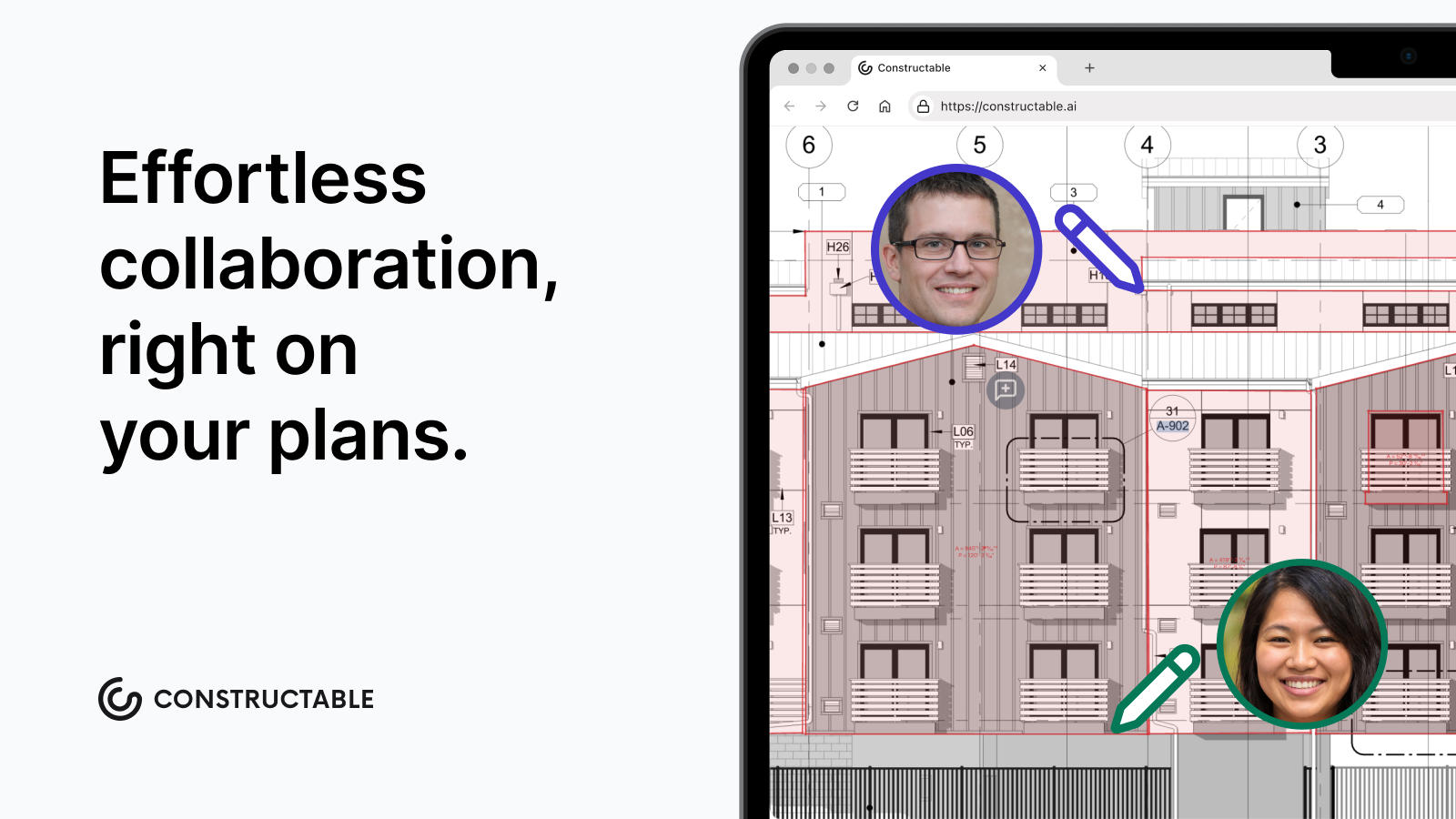
- Markup / Collaboration features on the drawing viewer are easy to adopt and teams use it
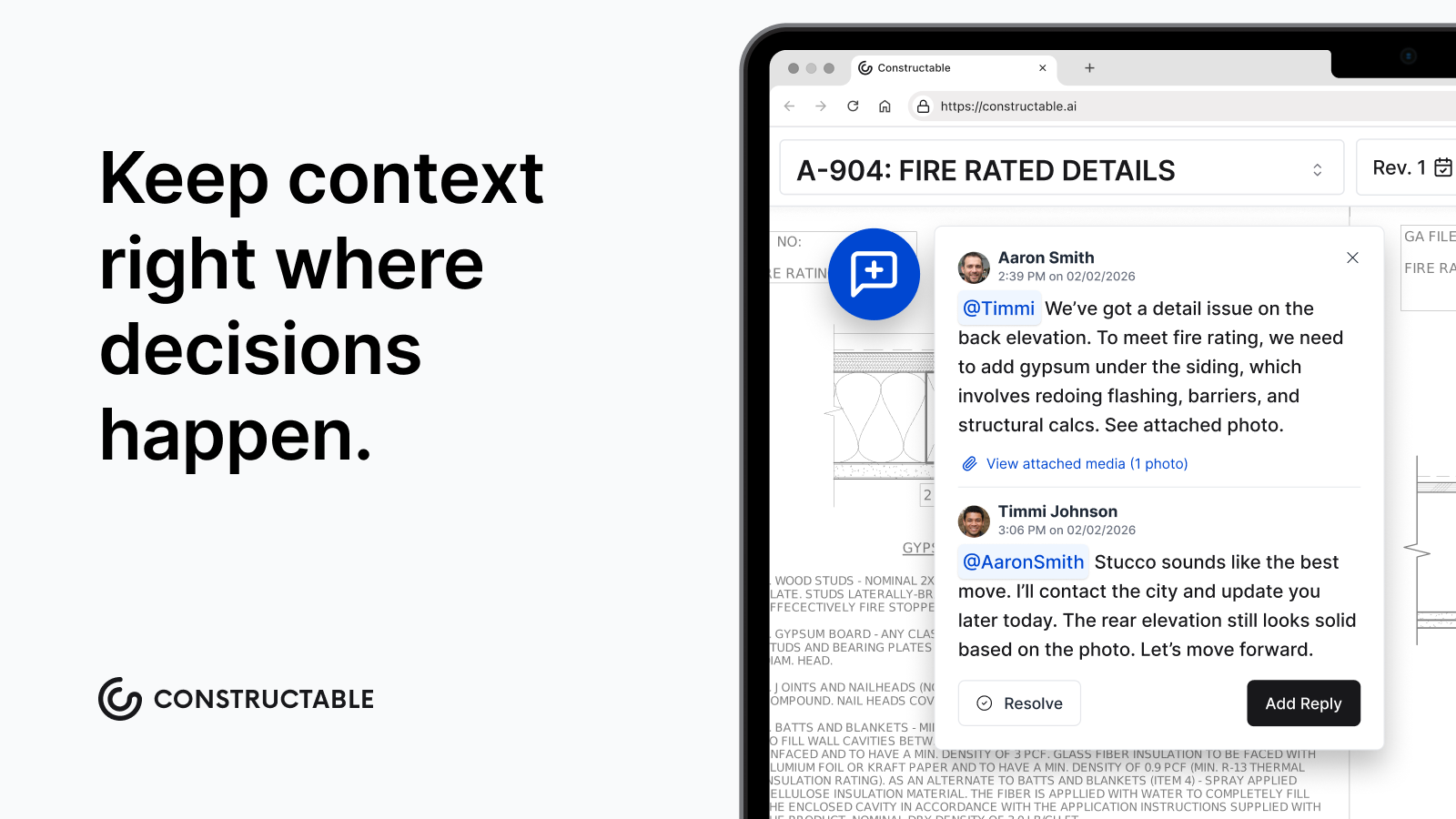
- Commenting / @ Mention users so the user can comment in the system vs outside living in email
- Appropriate notification system, so the user isn't spammed by email, and notifications are helpful and solicit action
These tools exist because commercial construction projects involve too many moving parts to manage through email, text messages, and spreadsheets alone. When you're coordinating architects, engineers, subs, inspectors, and owners across multiple jobsites, information gets lost fast. Poor communication costs projects an average of $177,000 and construction professionals spend 5.5 hours per week just searching for project data, plus nearly 5 hours on conflict resolution, totaling almost 10 hours weekly per person on tasks better communication could avoid.
The right software gives your team a single source of truth. That means fewer miscommunications, less time hunting for the latest drawing revision, and better visibility into what's actually happening in the field.
How We Evaluated Construction Communication and Collaboration Tools
We looked at these tools through the lens of what matters when you're running large commercial projects. That means asking the practical questions: Can your field team pull up the information they need on a mobile device quickly, Can you find what you need without clicking through five different tabs? Does it handle the daily workflows you can't avoid, like RFIs, submittals, and drawing markups? Is it easy for the field and office team to input important information.
We focused on whether each tool centralizes project information or forces you to juggle multiple systems. We considered mobile access. We looked at how they handle real-time communication when decisions need to happen fast. Pricing mattered too. Some tools punish you as your team grows or your project volume goes up.
Best Overall Construction Communication Tool: Constructable
We built Constructable to replace the mess of disconnected tools most mid-market general contractors deal with. Instead of juggling separate systems for drawings, RFIs, submittals, daily logs, and communication, everything lives in one place and out of your email inbox.
Because Constructable was built with collaboration in mind, we've minimized RFIs by almost 50% on similar size projects (comparing Procore to Constructable) because design teams were able to collaborate through Constructable. Questions and concerns were addressed quicker and in a way that inspired teamwork and collaboration versus the typical finger pointing.
Because Constructable has unique features, like Topics (grouped markup that can be shared with certain people), it means that more information is staying in one system, vs living in someone's email inbox or a sharepoint folder. So information is right at the teams fingerprints.
Your team gets AI-powered search that finds answers across all project data. Drawings become the collaboration surface where you can @mention teammates, attach photos, do a screen recording and keep context right where decisions happen. RFIs, submittals, and punch lists work without the bloat. Field teams can work offline when wifi disappears.
The pricing doesn't penalize you as you grow. We want your whole team using it, not just the office staff.
If you want one system that your field team will actually use and your PMs won't fight with, this is it.
Procore
Procore is an enterprise construction management system with features across project management, quality and safety, and financials. It's built for large contractors operating at serious scale.
Project scheduling and budget management, RFI and submittal tracking with document control, quality and safety management with forms and inspections, and financial management with cost tracking and forecasting.
Best for large enterprise contractors with dedicated IT resources who can support formal training programs and extended onboarding timelines.
The downside: mid-market teams describe Procore as heavy and complex. Excessive clicking, deep menu navigation, and a steep learning curve that requires structured training and internal champions. Onboarding is lengthy and often involves multiple formal sessions. Pricing is expensive and rising, especially for contractors in the $10M to $200M range, who often times don't need robust and complex project management features.
Autodesk Construction Cloud
Autodesk Construction Cloud bundles several acquired products (BIM 360, PlanGrid, BuildingConnected) into one offering. You get document control, model coordination, clash detection for BIM workflows, RFIs, issues tracking, and connections to Autodesk design software.
It fits large companies already locked into the Autodesk ecosystem who want one vendor across design and build.
The downside: multiple acquisitions mean inconsistent interfaces and workflows that don't feel like they belong together. Onboarding often requires expensive third-party consultants on top of licensing fees. Updates come slowly because of legacy architecture holding everything back.
Constructable was built as one system from the start, with faster adoption and a single interface your team will actually use.
Fieldwire
Fieldwire is a field management tool focused on task execution, plan markup, and punch list management for site teams. It's built to get superintendents and field crews moving fast without loading them down with features they don't need.
Good for field teams needing a lightweight tool focused on task execution and plan markup without broader project management needs, so the office to field collaboration is still often separated.
The limitation is what's missing. Fieldwire doesn't include financial management, budgeting, or office-driven project controls that GCs need to manage full project lifecycles. If you're using Fieldwire, you're deploying additional systems for financials and project management. That creates fragmented tool stacks and duplicate data entry.
RedTeam
RedTeam is a budget-oriented construction management system covering estimating, scheduling, project management, and accounting workflows.
They offer estimating and bid solicitation with templates, job cost tracking with QuickBooks Online integration, contract management and change orders, and time tracking with expense management.
If you're working with tight margins and need something that checks basic boxes without breaking the bank, RedTeam can get you there. But users report dated interfaces and rigid workflows that make daily use feel like a chore. Field teams rarely adopt the mobile app because it's clunky and limited.
Most teams stick with RedTeam because of the price tag, not because they love using it. You end up trading upfront cost for slow adoption and frustration down the line.
Feature Comparison Table of Construction Communication Tools
Here's how the core capabilities line up when you're actually running jobs:
| Feature | Constructable | Procore | Autodesk Construction Cloud | Fieldwire | RedTeam |
|---|---|---|---|---|---|
| Drawing Collaboration | Yes | Yes | Yes | Yes | No |
| AI-Powered Search | Yes | No | No | No | No |
| Financial Management | Yes | Yes | Yes | No | Yes |
| Offline Mobile Access | Yes | No | Yes | Yes | No |
| Fast Onboarding | Yes | No | No | Yes | No |
| Field-First Design | Yes | No | No | Yes | No |
| Transparent Pricing | Yes | No | No | No | Yes |
Why Constructable is the Best Construction Communication Tool
Mid-market GCs need simple and fast collaboration tools, because the better the team collaboration, the better the outcome of the project, and everyone knows that.
Constructable works because it replaces the fragmented stack with one easy to use system your team can adopt from day one. Your super can mark up drawings, log daily reports, and close punch items without switching apps or waiting for wifi. Your PMs can find answers in seconds with AI search that pulls from every RFI, submittal, photo, and conversation in the project. Your team can talk to each other, without all the finger pointing or form filling.
96% of construction professionals believe better collaboration improves project outcomes. But collaboration only works when everyone's looking at the same information.
We don't charge per user or take a cut of your construction volume. We want your whole team using it from day one, not just the people who can afford a login.
You know your construction communication software is working when people stop complaining about it. The goal isn't fancy features, it's getting home on time because you're not hunting for information. If you want to talk through how this would work for your projects, grab time with us and we'll keep it straightforward. We built Constructable for teams who just want their software to work without the drama.
FAQ
Which construction communication tool is best for mid-size general contractors?
Constructable works best for GCs running $20M-$150M in volume who need one system their field teams will love using. No training headaches, no jumping between tools, and pricing that doesn't punish you as you grow.
How do I choose between these tools if I'm already using email and spreadsheets?
Start with what's breaking first: if your field teams are drowning in paperwork and can't find the right drawing revision, you need mobile-first tools like Constructable or Fieldwire. If you're wanting to invite external parties to collaborate and access drawings and documents, then Constructable is the right choice because the pricing model is flat, not a pay-per-user. If you're an enterprise operation who can afford a lengthy and costly onboarding, don't mind complex interfaces, but need a lot of customization and controls, look at Procore or Autodesk.
What's the real cost difference between these platforms?
Procore and Autodesk charge based on project volume and user counts, which gets expensive fast; Constructable and RedTeam use transparent pricing that won't spike when you land a bigger job or add your whole crew. Fieldwire is a cost per user, which is good when your're small, but if you want to collaborate, the user count will increase quickly.
When should I switch from my current construction software?
If you're spending more than 2 hours a week hunting for information across multiple systems, or your team is bouncing between bluebeam and project management software and a file system, it's time to look at something your whole team will actually use. Constructable is the easiest to adopt, with flat pricing, and easiest onboarding and migration.