Best Software for Construction Companies in July 2026
We break down the 9 best construction company software tools in July 2026, covering who each one is built for and how they handle field, office, and financials.
Your team is already using software to run jobs. The question for 2026 is whether that construction company software is actually connected or whether you're the one manually closing the gaps between the drawings, the RFIs, and the numbers. These nine tools are worth a real look, and we've broken down exactly who each one is built for.
TLDR:
-
Many GCs run several disconnected tools, and the gaps show up as duplicate data entry and missed RFIs.
-
Judge construction software on pricing model, onboarding speed, field adoption, and two-way accounting sync.
-
Procore fits enterprise GCs running $500M or more; tools like Fieldwire and Buildertrend serve trades and residential work.
-
Tool fit depends on company size and workflow type: portfolio developers, specialty trades, and mid-size GCs each need different systems.
-
Constructable is a connected system built for mid-size commercial GCs, with flat-fee pricing, onboarding in days not months, and AI built into existing workflows.
What is construction company software?
Construction company software covers the tools a general contractor uses to run a commercial project from bid through closeout: field operations, documentation, communication, and the financial side. For years these lived as separate products, one for drawings, another for RFIs, a third for daily logs.
The category has been moving toward connected construction management systems in one place. The reason is the cost of fragmentation. Many GCs run several disconnected tools, and the gaps show up as duplicate data entry, missed RFIs, and onboarding that drags on. When information jumps from one login to the next, someone eventually rekeys it, and something falls through.
How we ranked these tools
We ranked around what matters to a mid-size commercial GC, not feature counts. These are the questions worth asking before you sign.
-
Core workflow coverage. Does it run field, office, and financials in one connected system, or will you bolt on more products? For a deeper look at all-in-one construction software options, see our dedicated roundup.
-
Pricing model. Flat-fee keeps costs steady as you add subs; per-user pricing climbs every invite.
-
Onboarding. How fast can a crew run a live project, and who owns the migration?
-
Field adoption. Mobile has to work the way desktop does, offline included.
-
AI integration. The useful kind removes a step inside a workflow you already run.
-
Accounting integrations. Two-way sync with QuickBooks Online, Sage Intacct, or your ERP decides whether numbers match up or get rekeyed.
Best overall construction company software: Constructable
Built for mid-size commercial GCs running $20M to $150M in annual volume, Constructable is one product built by one team, with AI worked into the actions you already take instead of sitting off in a separate tab. The frame is friction reduction: fewer steps, a faster start, and drawings as the center of gravity everything pins back to.
-
Flat-fee pricing with unlimited users on every plan, covering team members, owners, consultants, subcontractors, and vendors.
-
Onboarding can be done in days with no migration fees, against the 6+ months most implementations run.
-
RFIs, quality list items, comments, and markups pin to exact locations on the sheet.
-
AI that sets drawing scale on upload, autofills quality items, drafts RFI messages for your review, and runs an Answer Engine with source-linked answers.
-
Two-way sync with QuickBooks Online and Sage Intacct, no middleware.
-
Full offline access on iPhone and Android, with mobile mirroring desktop.
Bottom line: Constructable is the connected system for mid-size GCs seeking project management software without enterprise pricing or drawn-out rollout.
Procore
Procore is the dominant enterprise system, covering the full module range a large contractor needs: drawings, RFIs, submittals, change orders, financials, quality, and safety.
That coverage fits enterprise GCs running $500M or more, with staff to own configuration. Below that scale, the friction shows. See our Constructable vs Procore breakdown for a direct comparison. Pricing ties to annual construction revenue and climbs with team size, and implementation typically runs several months. Plus, if you want e-signing, that will mean paying for a separate DocuSign subscription.
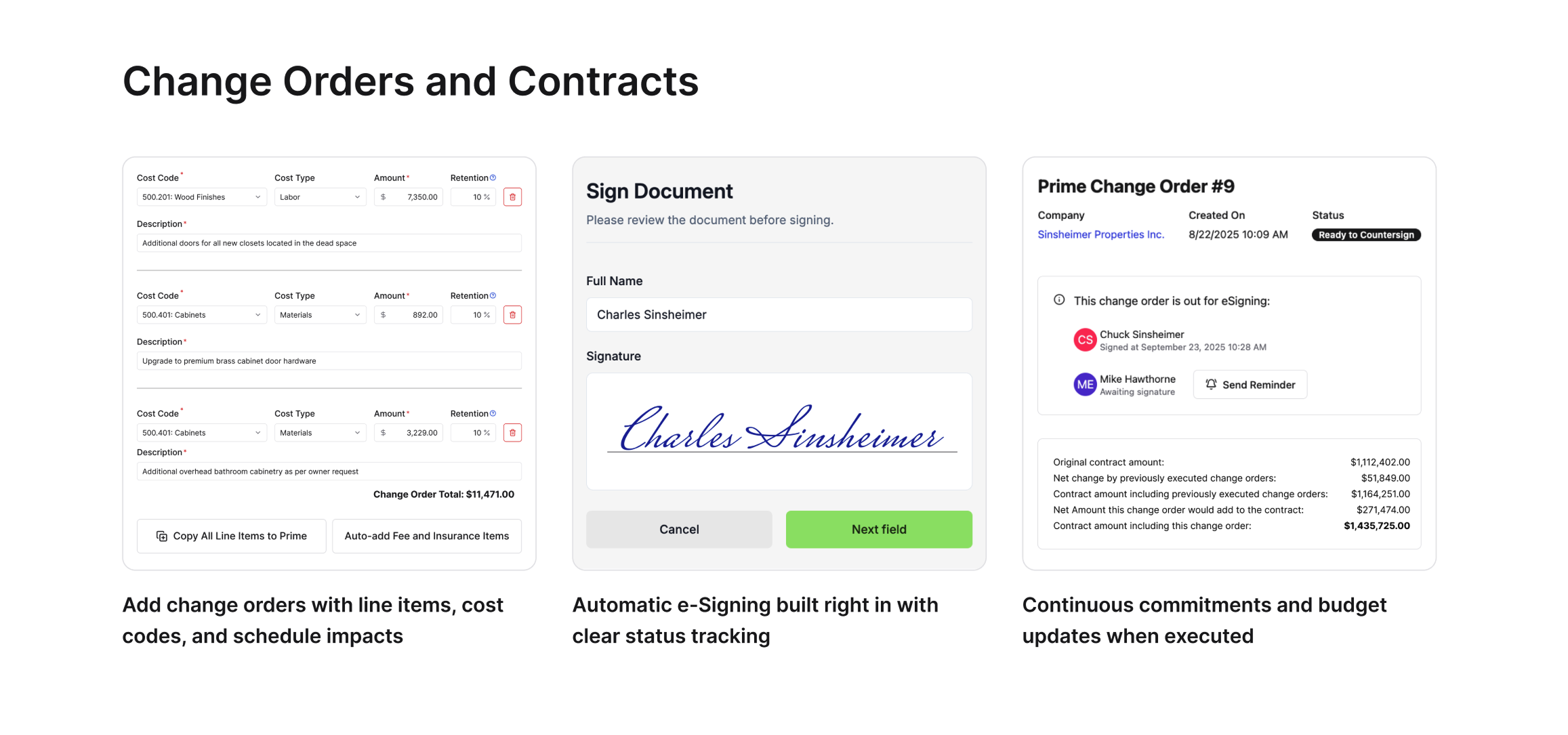
Constructable includes eSigning functionality built right in to Contracts and Change Orders without the need for a separate DocuSign subscription
Autodesk Forma (f.k.a. Construction Cloud)
Autodesk rebranded Construction Cloud to Autodesk Forma in March 2026, a broad industry cloud spanning planning, design, construction, and operations, with tight ties to Revit and AutoCAD.
Forma is a strong fit for large AEC firms already on Revit and AutoCAD who need planning-through-operations coverage. That fits large AEC firms already invested in Autodesk, with staff to run implementation. Forma stitches together acquired products, so mental models shift between modules. Field teams cite the interface as tough to adopt on site, some features lag on iPads, and migration usually goes to third-party consultants billed separately from licensing. See our Constructable vs Autodesk Forma comparison for more detail.
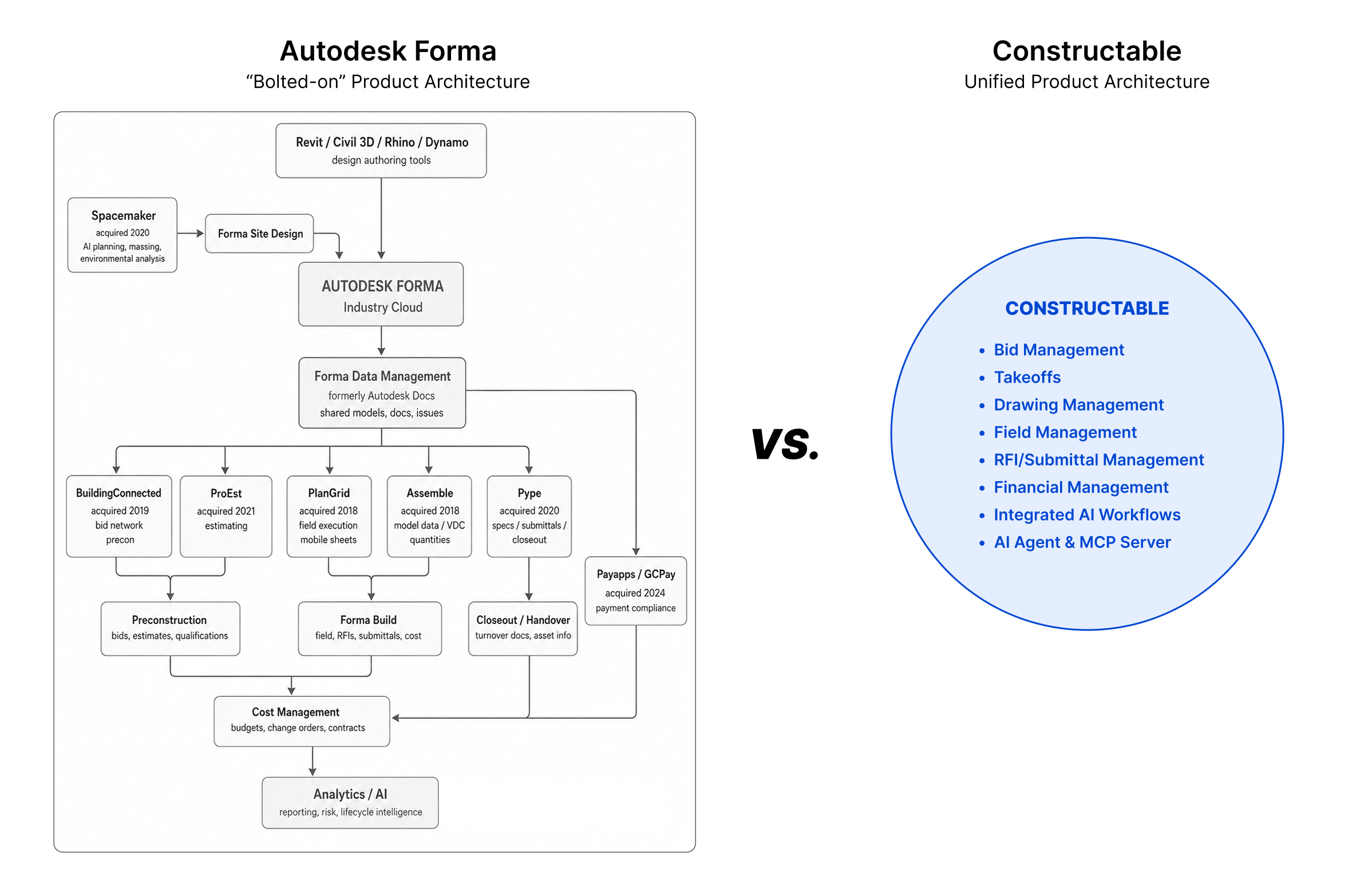
Autodesk Forma is made up of many distinct software products under the Forma brand. Constructable's all-in-one software makes it a better solution for mid-size general contractors.
Fieldwire
Hilti acquired Fieldwire in 2021, and it remains a strong field execution tool for drawing-heavy work. Version control tracks revisions, markups and punch items link to plans, and the mobile app holds up offline. Pricing is per user, free for teams up to five.
That fits specialty trades comfortable running project management and accounting separately. The gap is financial: no budgets, schedule of values, commitment tracking, or change orders. GCs sort out financial data by hand, and per-user costs climb with every sub, owner, and consultant added, which is why many teams look at Procore alternatives for mid-market contractors.
RedTeam
Since 2006, RedTeam pairs project management workflows (RFIs, submittals, change orders) with financial reporting mid-market teams value, particularly work-in-progress reports. It bundles estimating and proposal generation, and subcontractor access carries no per-user charge. Low entry pricing keeps it a middle-ground option between point tools and enterprise systems.
That fits cost-conscious GCs running mostly office-side work. The field is where it thins out. Users describe the mobile experience as hard to use on site, RFIs and punch items cannot pin to drawing locations, and the native scheduler has reliability issues with work not saving. Our Constructable vs RedTeam comparison covers these gaps in detail.
INGENIOUS.BUILD
INGENIOUS.BUILD is built around portfolio oversight, giving owners and developers financial visibility across many projects at once. Cost tracking and reporting run deep, which users tend to flag as a real strength, and the project hierarchy handles multi-project organization the way a development portfolio needs.
That fits developers and owner organizations watching a portfolio, but less so for a GC running a handful of concurrent projects. Creating an RFI means associating it to a project after the fact, not starting inside the project. GCs who think projects first find the portfolio-level structure a poor fit for day-to-day project delivery workflows. Read our Constructable vs INGENIOUS.BUILD comparison for a full side-by-side.
Buildertrend
Buildertrend runs scheduling, change orders, daily logs, and document management in one system, with a client portal built for homeowner-facing communication and selection management. Estimating and takeoff tools handle residential scoping, and it syncs to QuickBooks and Xero.
That fits home builders, remodelers, and specialty contractors on residential or light commercial work. The commercial side thins. Buildertrend was built for residential workflows, not the RFI-intensive, multi-stakeholder projects mid-size commercial GCs run, so scheduling and field coordination stay lighter than dedicated commercial systems.
Trimble ProjectSight
Trimble ProjectSight handles RFIs, submittals, drawings, and cost tracking, and it ties into Trimble's wider portfolio of field, survey, and estimating products.
That fits mid-to-large GCs already standardized on Trimble hardware and software, where the shared ecosystem pays off. Outside that ecosystem, the pull weakens, and pricing and setup lean toward larger teams with staff to run configuration.
CMiC
CMiC runs as a full construction ERP, with accounting, payroll, job costing, and project management sharing one database. That single-database design keeps financial and project data tied together without a separate sync layer, and the accounting depth goes well past what most project management tools attempt.
That fits large enterprise GCs with in-house IT and finance to own a long rollout. For mid-size teams the math changes. Implementation runs many months, licensing sits at the enterprise tier, and field users find the mobile experience thinner than the office side. A GC running $20M to $150M rarely needs ERP weight this heavy.
Feature comparison table of construction company software
Here is how the nine systems line up against the criteria we ranked on.
| Feature | Constructable | Procore | Autodesk Forma | Fieldwire | RedTeam | INGENIOUS.BUILD | Buildertrend | Trimble ProjectSight | CMiC |
|---|---|---|---|---|---|---|---|---|---|
| Native financial tools (budgets, SOV, invoicing) | Yes | Yes | Yes | No | Yes | Yes | Yes | Yes | Yes |
| Flat-fee unlimited-user pricing | Yes | No | No | No | No | No | No | No | No |
| Built-in AI embedded in workflows | Yes | No | No | No | No | No | No | No | No |
| Drawing-linked RFIs and quality items | Yes | Yes | No | No | No | No | No | No | No |
| Offline mobile access (drawings and logs) | Yes | Yes | Yes | Yes | No | No | No | No | No |
| Native two-way ERP sync (QuickBooks or Sage Intacct) | Yes | No | No | No | No | No | Yes (QuickBooks) | No | No |
Final thoughts on choosing construction company software
The construction company software market has a tool for almost every situation, which makes the decision feel bigger than it needs to be. Narrowing it down to your actual workflow, your team size, and whether the financial side is covered gets you most of the way there. For mid-size commercial GCs who want field, office, and money in one place without a six-month rollout, Constructable is worth a conversation.
FAQ
How do I choose between Constructable, Procore, and Autodesk Forma for a mid-size commercial GC?
Start with your project volume and team size. Procore and Autodesk Forma are built for enterprise contractors with staff to own configuration and budgets to absorb per-user pricing and multi-month rollouts. Constructable is built for $20M to $150M GCs who need a connected system running field, office, and financials from day one without a dedicated software team behind it.
Is Fieldwire a viable alternative to Constructable for GCs who also need financial tools?
Not without a separate system running alongside it. Fieldwire handles drawing-heavy field work well, but it has no budgets, schedule of values, commitment tracking, or change orders. GCs end up sorting financial data by hand and paying per-user costs that climb with every sub, owner, and consultant added to a project.
When does RedTeam make more sense than Constructable for a construction company?
RedTeam fits cost-conscious GCs who run mostly office-side work and want bundled estimating and proposal generation at a lower entry price. If your team relies heavily on mobile, needs RFIs and punch items pinned to drawing locations, or wants offline field access, RedTeam's mobile experience and drawing workflow create friction that compounds on active jobsites.
Which construction company software tools work best for firms managing a development portfolio versus a single project at a time?
INGENIOUS.BUILD is built around portfolio oversight for owners and developers tracking cost and reporting across many projects simultaneously. The tools listed here that fit day-to-day GC project delivery (Constructable, Procore, Autodesk Forma) are organized around individual projects as the primary unit of work. The right choice depends on whether your primary job is watching a portfolio or running a project.
What should a construction company check before committing to any software on this list?
Verify three things: whether the ERP or accounting system you use has a native two-way sync (not every tool connects to Sage 100, Viewpoint Vista, or QuickBooks without manual workarounds), whether the mobile app works offline in the field, and how long the vendor's actual onboarding takes compared to what they advertise. Most implementations run two to six months in practice regardless of what the sales sheet says.