Constructable vs Procore: Which is Better in January 2026?
Compare Constructable vs Procore in January 2026. See pricing, ease of use, and which construction management software is better for mid-market general contractors.
You're three menus deep trying to find a submittal, your inbox is chalk full of notifications, and your renewal cost just went up 30% for no clear reason. If Procore feels like it was built for someone else's problems, that's because it probably was. This Constructable vs Procore guide walks through what matters for mid-market GCs: pricing that stays predictable, software your whole team is happy with, and enterprise power without all the enterprise baggage.
Looking for a Procore alternative for commercial general contractors? Use this comparison to evaluate Constructable against the workflows your team relies on, then explore pricing, migration support, and customer switching stories on our dedicated comparison page.
TLDR:
- Procore ties pricing to construction volume, often hitting six figures for mid-market GCs.
- Constructable includes all features in one system with transparent, flat pricing.
- Field teams adopt Constructable faster due to intuitive design and minimal training needs.
- AI-powered search finds answers across everything, like drawings, RFIs, and more in plain language.
- Constructable serves mid-size commercial GCs doing $20M-$200M in annual volume.
What is Procore?
Procore is a cloud-based construction management software designed to centralize project communication, documents, and workflows for contractors and project teams. Founded in 2002, it's become one of the most recognized names in construction tech, serving general contractors, specialty contractors, and owners across commercial, industrial, and infrastructure projects.
The product covers a wide range of construction workflows: project scheduling, RFIs, submittals, document control, financial tracking, budgeting, and field management. You get tools for everything from preconstruction through closeout, with mobile apps for field teams and web dashboards for office staff.
Procore uses a modular structure. Companies don't buy one complete product—they select specific tools based on their needs. Want document management but not financials? You can pick and choose. Need quality and safety but already have accounting software? You can add those modules separately.
The pricing model ties to your annual construction volume, not per-user seats. The more revenue your company generates, the more you pay. This can work well for smaller contractors just starting out, but the costs scale up quickly as your business grows. For mid-market GCs doing $50M to $150M in volume, the annual investment typically runs into six figures once you add the modules you actually need.
What is Constructable?
Constructable is construction project management software built for mid-size general contractors who want one system that actually works together. We handle the full lifecycle of commercial projects—from bidding through closeout—without forcing you to stitch together a dozen different tools.
The product brings together drawings, RFIs, submittals, daily logs, punch lists, change orders, and project communication in one place. You're not buying modules or add-ons. Everything is included, built by the same team, designed to share the same data. When you mark up a drawing, create an RFI, or log a photo, it all lives in the same system where your whole team can find it.
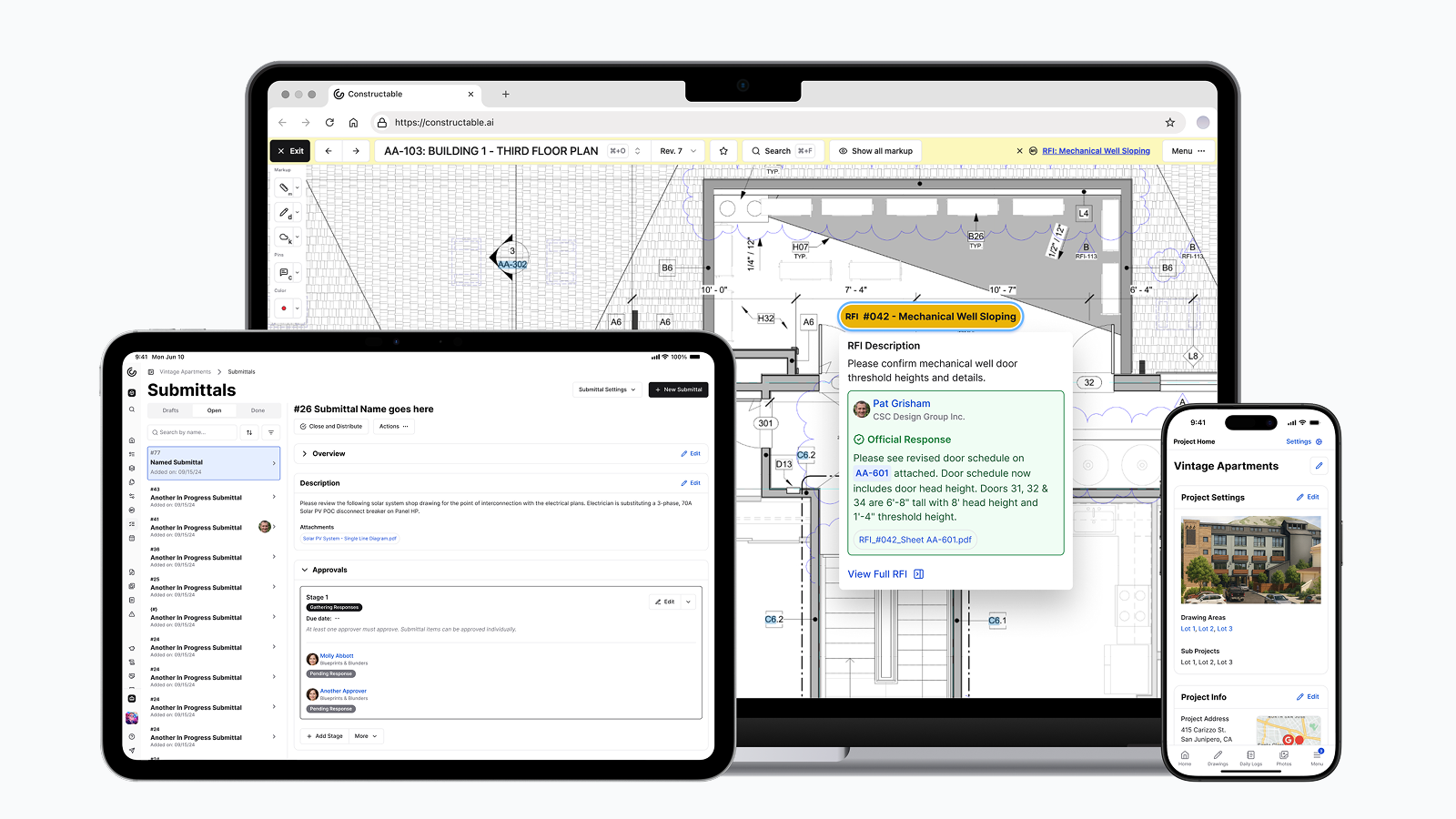
What makes us different is the AI-powered search layer. You can ask questions in plain language and get answers pulled from across your project files, emails, and documents. Looking for that electrical detail someone mentioned three weeks ago? Or trying to remember which subcontractor submitted the revised HVAC specs? Just search for it. No digging through folder trees or trying to remember which system you used.
We built Constructable for project managers and supers who are tired of wrestling with software that feels like it was designed for someone else. It's simple enough to use in the field on day one, but complete enough to run your whole operation.
Ease of Use and Team Adoption
The difference between evaluating software in a demo and actually getting your team to use it is where most construction tech decisions fall apart. Procore offers deep functionality, but that power comes with operational weight.
Procore requires structured onboarding and ongoing training to keep teams proficient. The interface is click-dense, with navigation paths that make sense once you know them but feel buried when you don't. Occasional users—owners, subcontractors, inspectors—often struggle to find what they need. Many mid-size GCs end up hiring a dedicated Procore administrator or assigning someone internally to manage the system, field questions, and run recurring training sessions. Adoption tends to split: power users in the office get comfortable, while field teams and external collaborators treat it like homework.
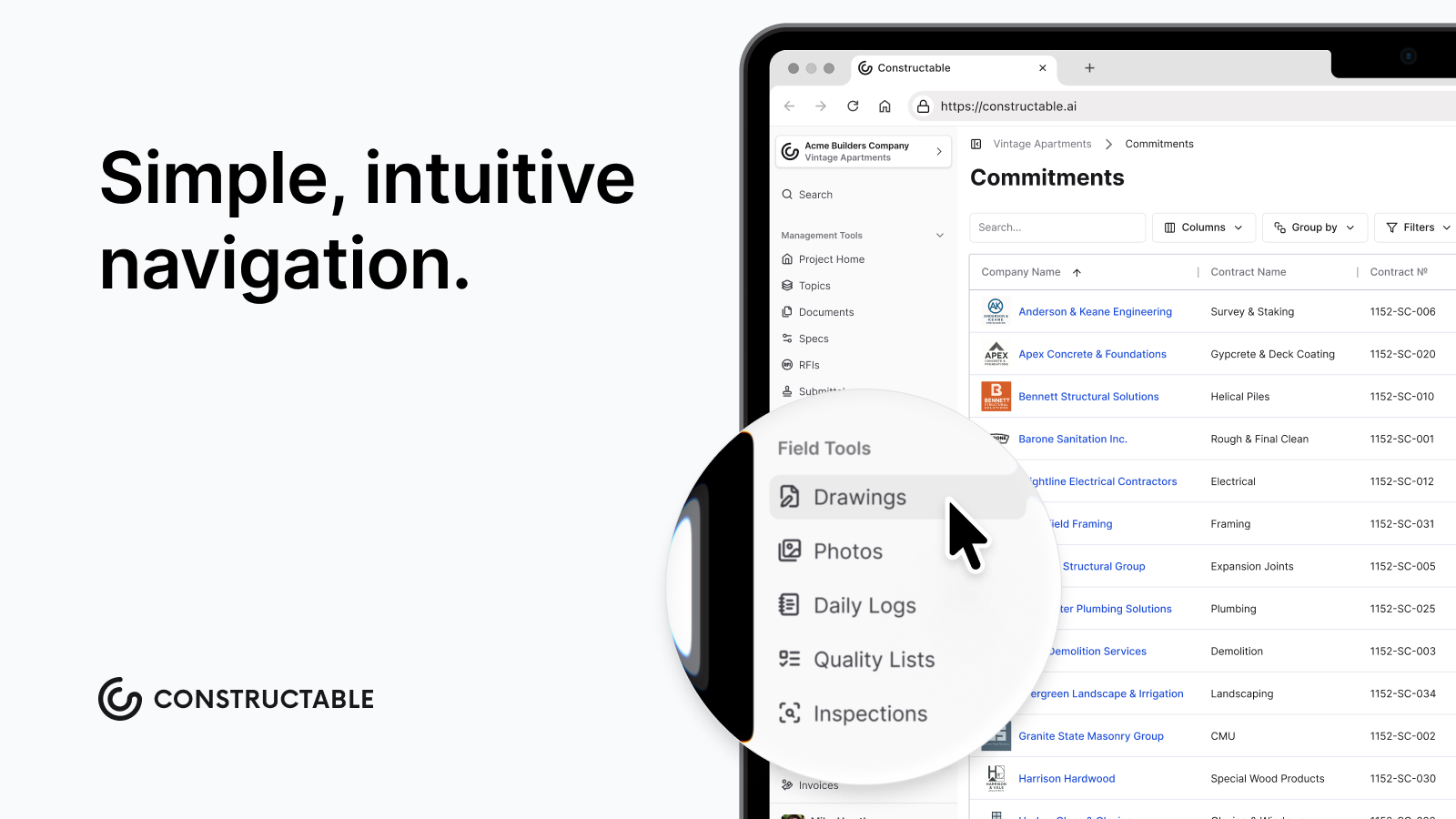
We built Constructable to work on day one. No certification courses. No multi-week rollout plans. The interface mirrors how construction teams already think and work, so the learning curve flattens out fast. Superintendents can log daily reports or punch lists without a tutorial. Project managers can create RFIs without hunting through nested menus.
Onboarding takes days or weeks, not months. We treat migration as a high-touch process—white glove setup, real conversations about how your team works, and help moving your data over without disrupting active projects. Field teams, office staff, and external stakeholders can all jump in without needing a dedicated champion to hold their hand.
When software feels intuitive, you don't need to sell your team on using it. They just do.
Pricing Structure and Value Alignment
Procore's pricing model creates predictability problems. Because costs tie to your annual construction volume, every time your business grows, your software bill grows with it. A contractor doing $50M in volume might pay $80,000+ annually, but scale to $100M and that number can double or triple—same features, same users, just more revenue on your books. The pricing isn't published, so you need to go through Sales to get a quote. And at renewal time, many contractors report surprise increases that don't match any meaningful product improvements.
The structure also gets expensive fast once you add the modules you actually need. Document management might be affordable, but layer in quality control, financials, and field productivity tools, and you're looking at a six-figure commitment. For mid-market GCs, the math starts feeling disconnected from what you're getting back.
We price Constructable differently because we think the standard construction software pricing model is broken. You get everything—no modules, no add-ons, no surprise fees when you win more work. Our pricing is transparent, published, and stays predictable as you grow. We don't punish success.
The goal is simple: you should know what you're paying, why you're paying it, and feel good about the trade. Software should be an investment that pays back in time saved and mistakes avoided, not a line item that makes you wince every renewal cycle.
Software Architecture and User Experience
How software is built shapes how it feels to use every day. Architecture choices that seem technical on paper translate directly into speed, frustration, and whether your team actually wants to log in.
Procore's modular build means different tools can feel like different products. Navigation patterns shift between modules. Terminology changes. Field teams report excessive clicking to complete basic tasks, with information buried several menus deep. The system requires heavy configuration upfront to match your workflows, and even then, loading times lag when you're pulling data from the server. AI features feel tacked on rather than woven into the core experience—new buttons to learn, not friction removed from what you already do.
Local data storage means pages load instantly. You're not waiting for the server to respond every time you open a submittal or search a drawing. The interface assumes smart defaults and cuts out unnecessary steps. Need to create a punch item? Use your voice. Looking for that change order detail buried somewhere in your files? Search in plain language and get an answer in seconds. The AI isn't a separate module you turn on—it's just how the software works.
Offline functionality keeps work moving when jobsite internet drops. Your team isn't stuck waiting for connectivity to log reports or review plans. According to industry research, construction management software adoption increasingly depends on mobile reliability and field-first design—areas where architecture directly determines whether software helps or just gets in the way.
Why Constructable is the Better Choice
Procore works well for very large enterprises that can support dedicated IT admins, extensive training programs, and higher price points. Teams choosing Procore typically need broad configurability and can invest resources in implementation and ongoing management.
We built Constructable as one opinionated system where every feature shares the same interaction logic and data model. Research shows that moving to a unified platform could save construction leaders approximately 10.5 hours per week compared to juggling multiple data environments.
Constructable is the better choice for mid-size commercial general contractors who want professional-grade project management without enterprise complexity. You get faster time-to-value with intuitive software that requires minimal training, transparent pricing that aligns with actual value, and a relationship-driven approach where customer feedback directly shapes the product.
Where Procore prioritizes breadth and configurability, we deliver speed, clarity, and software that fits how builders actually work. You're not managing a software stack or justifying six-figure renewals tied to your revenue. You're running projects with one system that your whole team will actually use.
If you're a mid-market GC tired of overpaying for tools built for someone else's problems, we built Constructable for you. Simple enough for the field, complete enough for the office, and priced like we're on the same team.
Final Thoughts on Procore Alternatives for Commercial Contractors
The Procore comparison highlights a clear split in who each product serves best. Large enterprises with dedicated IT resources and complex workflows get value from Procore's extreme configurability, but mid-size commercial GCs end up paying for features they don't need while struggling with adoption. We built Constructable to close that gap with complete functionality, intuitive design, and transparent pricing that doesn't punish growth. You get professional-grade project management that your field and office teams will actually use from day one.

Evaluating a Procore alternative before renewal
A demo is only part of the decision. Ask how your active projects, historical records, and accounting workflows will move. Holladay Construction Group’s switching story explains how its team planned the transition ahead of renewal, with setup and training coordinated around the move.
FAQ
How should I decide between Constructable and Procore for my company?
If you're a mid-size GC ($20M–$200M volume) who wants software that works on day one without dedicated IT support or months of training, Constructable is built for you. Procore makes more sense for very large enterprises that need heavy configurability and can support ongoing training programs and six or seven figure budgets tied to construction volume.
What's the main difference in how these two products are built?
Procore uses a modular structure where you buy separate tools that can feel like different products, while Constructable is one complete system where everything shares the same data and interface. This means with Constructable, you're not jumping between different navigation patterns or waiting for modules to talk to each other—it just works together from the start.
Who is Constructable best suited for?
We built Constructable for mid-market commercial general contractors with 10–150 team members running multiple active projects. If you're tired of overpaying for enterprise complexity you don't need, want your field teams to actually use the software, and prefer transparent pricing that doesn't scale with your revenue, that's exactly who we designed this for.
Will my team actually adopt Constructable without extensive training?
Yes. Onboarding takes days or weeks instead of months, and superintendents can log daily reports or punch lists without tutorials. We handle migration as a white glove process and design the interface to mirror how construction teams already think, so field staff, office teams, and external collaborators can jump in without needing a dedicated champion.
How does pricing change as my construction volume grows?
It doesn't. Unlike Procore's model where your software bill doubles when your revenue doubles, Constructable pricing stays predictable as you grow. You get everything included—no modules, no add-ons, no surprise renewal increases tied to how much work you win.