Delay Types in Construction: A Field Guide | September 2026
This September 2026 guide covers construction delay types, from excusable to concurrent, and how each affects time extensions, damages, and claims.
When a project runs behind, the first question rarely gets answered fast enough: did that delay hit the critical path, and whose fault was it? Those answers sort every delay into a few categories that determine whether the contractor gets more time, more money, both, or neither.
TLDR:
-
Only delays hitting the critical path earn a time extension or damages claim; non-critical slips rarely support either.
-
Excusable delays buy time, compensable delays buy time plus money, and non-excusable delays buy nothing except daily liquidated damages.
-
Concurrent delays are the hardest to untangle; courts split on entitlement, so define them in the contract before a dispute does it for you.
-
Defensible delay claims rest on contemporaneous records: daily logs, site weather data, RFI timestamps, and a written correspondence trail captured the day the delay hits.
-
Constructable logs daily delay causes by category and pulls automatic weather data from the project zip code, building the documentation trail inside a connected system with RFIs, submittals, and change events.
What are construction delays?
A construction delay is any event that pushes a project past a date the contract treats as binding, whether a milestone, substantial completion, or final turnover. A delay only carries weight once it touches a date someone can be held to.
Late finishes are the norm. Research consistently shows most projects run over on cost or schedule, and large projects routinely finish up to 20% longer than scheduled, according to McKinsey.
On a 24-month job, 20% late means five extra months of general conditions, overhead, and crews still on site. Who caused it, whether it hit the critical path, and what the contract says decide who absorbs the cost.
Critical vs. non-critical delays
Before any delay gets labeled excusable or compensable, one question comes first: did it move the finish date? That answer lives in the schedule.
A critical delay sits on the critical path, the chain of tasks with no slack. Push any one of them and the completion date moves with it. A non-critical delay hits a task with float, so it can slip within its window without touching final completion.
The distinction matters because claims turn on it. A delay that never reaches the critical path rarely supports a time extension or delay damages, no matter how disruptive it felt on site.
Excusable vs. non-excusable delays
Once a delay hits the critical path, the question is who bears responsibility. An excusable delay comes from events outside both parties' control, and it earns the contractor more time.
Excusable delays trace to unanticipated outside events, with neither party at fault, as Long International explains. Think severe weather, strikes, or government actions. Most contracts grant a time extension, which matters when liquidated damages are at stake. FAR 52.249-14 builds this into federal work.
A non-excusable delay is the opposite. It traces back to the contractor's failures: understaffing, poor sequencing, or late procurement. No extension follows, and liquidated damages accrue each day past the deadline.
Compensable vs. non-compensable delays
An excusable delay splits again on money. Compensability determines whether the contractor recovers costs on top of the time extension.
A compensable delay traces to the owner or someone the owner controls: late design deliverables, owner-directed changes, restricted site access, or slow responses. Since the owner caused the slip, the contractor can pursue both a time extension and delay damages, extended general conditions, idle equipment, and prolonged overhead.
A non-compensable delay grants time but no money. Weather and strikes fall here, since no breach is involved and neither party owes the other.
To support a compensable claim, you need dated records tying the owner's action to the critical-path impact and the resulting costs.
Concurrent delays
Concurrent delay is the messiest category. It happens when two independent delay events overlap on the critical path at the same time, each tracing to a different party, one to the owner, one to the contractor.
The challenge is untangling entitlement: whether the contractor earns a time extension for the owner's delay while the owner pursues liquidated damages for the contractor's. Courts split. Some apportion responsibility between parties; others grant time but deny money.
Because treatment varies by jurisdiction and contract wording, define concurrent delay in the contract before a dispute forces someone else to define it for you.
Common causes of each delay type
Each cause on a jobsite lands in one of the categories above. A quick map:
| Cause | Usual classification |
|---|---|
| Severe weather, strikes, government actions | Excusable, non-compensable |
| Owner-directed changes via construction change directive, late design, restricted access | Excusable, compensable |
| Understaffing, poor sequencing, late procurement | Non-excusable |
| RFI management breakdowns | Compensable when the owner or design team owns the lag |
| Design errors and omissions | Compensable or concurrent, depending on responsibility |
Design errors deserve attention; they drive 31% of total change orders and compound delays on dependent tasks.
Material shortages and permitting slowdowns often read as excusable, though contract wording decides whether either buys time or money.
Effects of construction delays on projects
Once a delay takes hold, the costs compound in every direction. Direct spend climbs first: extended general conditions, idle subcontractor crews billing standby time, materials escalating while work waits, and carrying costs on financing that keeps accruing.
Then the contract bites. A non-excusable slip past the deadline exposes the contractor to liquidated damages that accrue daily, separate from any change order costs, eroding margin the job never planned to spend.
The quieter damage is relational. Missed dates strain owner confidence, sour relationships with design and trade partners, and follow a firm into its next bid, where reputation shapes whether the phone rings at all.
No-damages-for-delay clauses and other contract defenses
Before a delay happens, the contract has usually already decided who can recover. A few provisions carry most of that weight:
-
No-damages-for-delay clauses bar the contractor from recovering delay costs, limiting the remedy to a time extension even when the owner caused the slip. Courts often enforce them, with narrow exceptions for bad faith or active interference.
-
Notice requirements set a window to submit written notice. Miss it, and an otherwise valid claim can be waived outright.
-
Force majeure provisions define which outside events count as excusable, and how much time they buy.
-
"Time is of the essence" language makes deadlines strictly binding, strengthening the owner's path to liquidated damages.
Read these before signing, since they decide what a delay is worth long before one occurs.
How to document a delay properly
A delay classification holds up only if you captured the facts as the delay unfolded. Records reconstructed from memory once a claim is filed rarely survive scrutiny.
Defensible documentation is contemporaneous. The pieces that carry weight:
-
Daily log entries recording crew counts, work performed, and the delay cause, entered the day it happened.
-
Weather records tied to the site, showing conditions severe enough to stop work.
-
Timestamped photos, plus inspection entries marking what was and wasn't ready.
-
Change event tracking that dates the triggering action before details fade.
-
A correspondence trail: written notice, RFI tracking timestamps, and emails linking an owner action to critical-path impact.
Capture it as it happens; the right daily reporting software makes that automatic, and the classification defends itself.
How to mitigate and recover from construction delays
Recovery starts the moment a slip shows on the critical path, supported by field management tools that surface it in real time, not at the next owner meeting. A few moves that actually pull time back:
-
Build a recovery schedule that resequences remaining work, adds extra crews, or runs trades in parallel where the logic allows.
-
Weigh acceleration carefully, since crashing tasks and stacking crews buys days but drives up cost and rework risk.
-
Flag risk early: long-lead procurement, permit sequencing, and design gaps almost always surface before they hit the schedule.
-
Keep owners, designers, and subs talking, so a shared plan replaces the finger-pointing that stalls decisions.
Contingency float, protected from day one, absorbs the hits you cannot see coming.
How Constructable captures delay documentation in the field
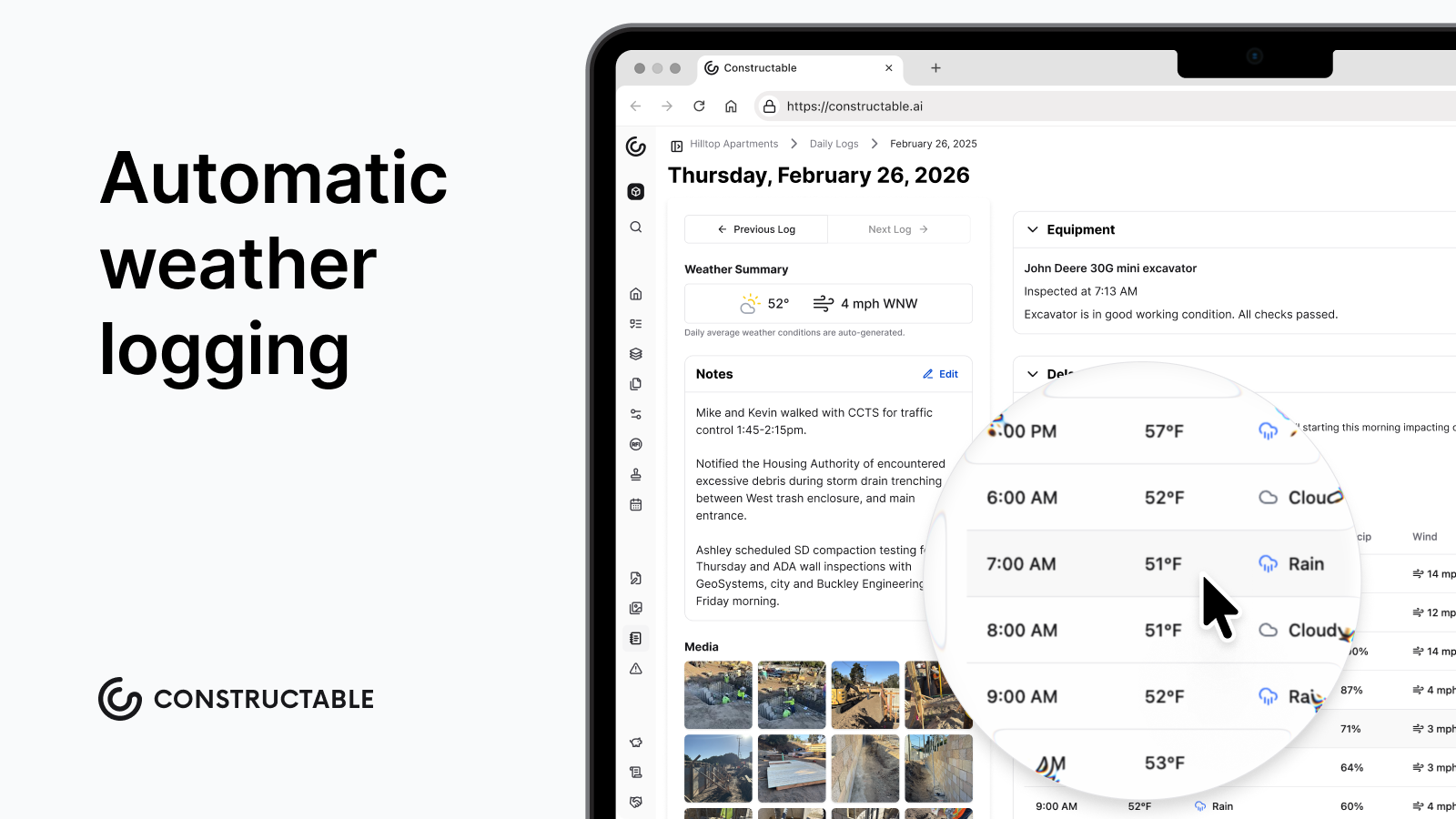
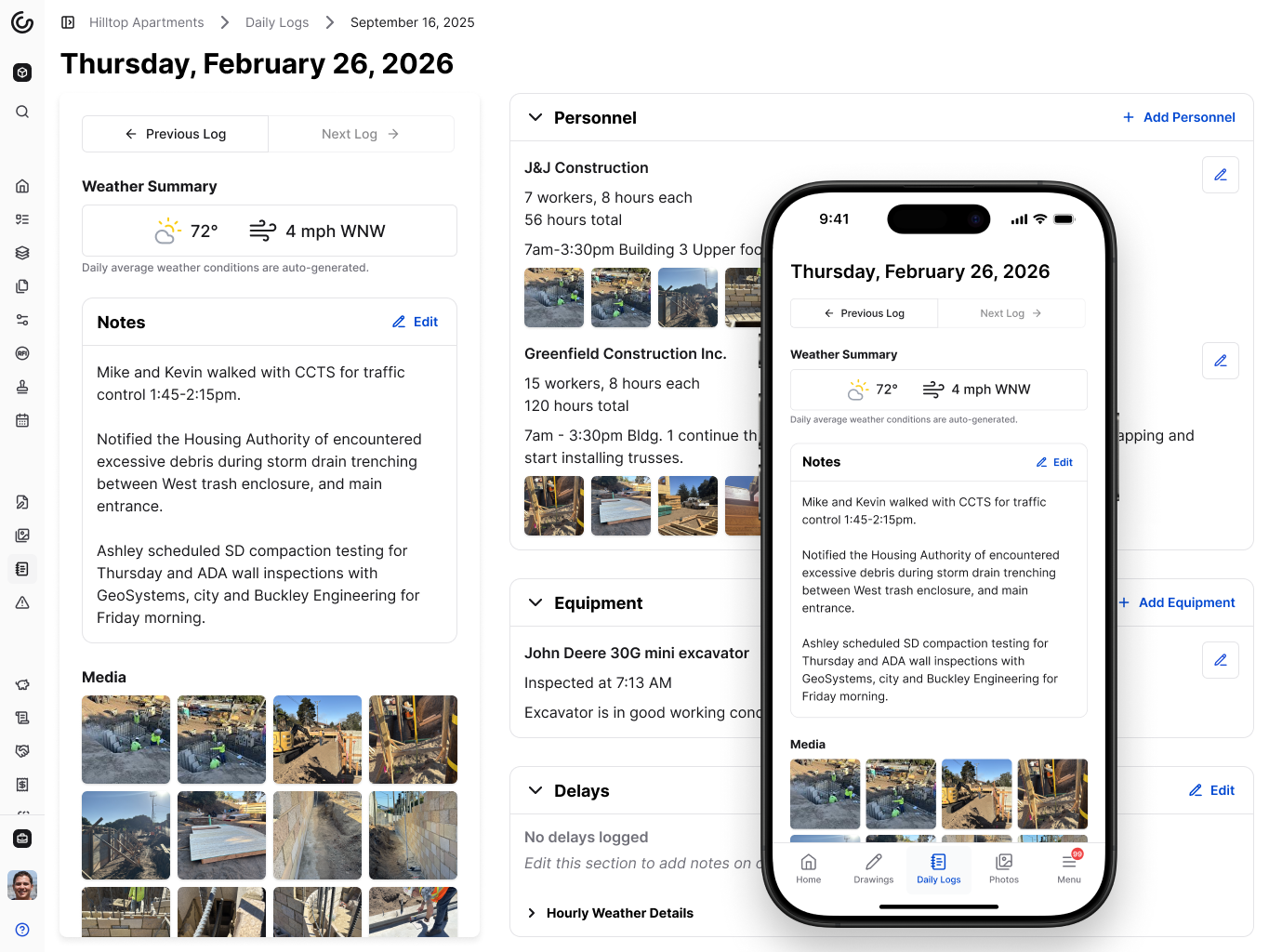
Most teams already know delays need contemporaneous records. Constructable builds that capture into the Daily Log, categorizing each delay by cause: Weather, Permitting, Owner Directive, Material Acquisition, Waiting on RFI, Waiting on Submittal, or Other. Weather pulls automatically from the project zip code, logging hourly temperature, conditions, precipitation, and wind the same day the delay hits; the evidence that separates an excusable claim that holds from one that folds.
Because daily logs share one connected system with RFIs, submittals, change events, and drawings, the trail behind a classification builds continuously instead of getting reassembled during a dispute.
Constructable's AI Answer Engine can query across it all to surface delay patterns without manual report compilation.
Final thoughts on delay types and documentation in construction
Most contractors know a delay happened long before they know who's paying for it, and by then the records that decide the answer are already fading. The frameworks here give you the language, but your daily logs, RFI timestamps, and correspondence trail give you the proof. Start capturing that evidence the day a delay shows up, not the day you file a claim.
Talk to the Constructable team to see how daily logs and connected project records make documentation part of your normal workflow.
FAQs
What's the difference between excusable and non-excusable delays in construction contracts?
An excusable delay traces to events outside both parties' control, such as severe weather, strikes, or government actions, and typically earns the contractor a time extension. A non-excusable delay traces to the contractor's own failures, such as understaffing or late procurement, and carries no extension; liquidated damages accrue each day past the deadline.
Excusable vs. compensable delays in construction: what's the actual difference?
Excusable means the contractor gets more time; compensable means the contractor gets money too. A compensable delay traces to the owner (late design deliverables, restricted site access, slow RFI responses), so the contractor can pursue both a time extension and delay damages covering extended general conditions, idle equipment, and prolonged overhead. An excusable but non-compensable delay, like a hurricane, buys time but no additional cost recovery because no breach occurred.
How do I document a construction delay so it holds up in a claim or dispute?
See the documentation section above for the full list. The short answer: daily logs, weather data, RFI timestamps, and change events captured the same day the delay hits. Courts and arbitrators consistently discount records reconstructed from memory weeks later.
Can concurrent delays let a contractor avoid liquidated damages while still recovering delay costs?
Not reliably, and the answer depends heavily on jurisdiction and contract language. When overlapping critical-path delays trace to different parties simultaneously, some courts apportion responsibility while others grant time but deny money to both sides. Because treatment varies by contract wording and venue, defining how concurrent delay is handled, and by whom, before a dispute forces someone else to define it is the only reliable protection.
What should a construction team do the moment a delay shows up on the critical path?
Act before the next owner meeting, not at it. The recovery steps, which include resequencing work, weighing acceleration, flagging long-lead risks, and keeping all parties aligned on a shared plan, are covered in the mitigation section above, along with the role of protected contingency float.