Time and Materials Agreement: Complete Guide for August 2026
Time and materials agreement guide for August 2026: Learn T&M contract rates, not-to-exceed clauses, and documentation that prevents billing disputes
Setting up a time and materials agreement template is straightforward once you know the rates and markup percentages. The harder part is making sure that contract actually protects you when billing time comes around. On a time and materials project, your invoice is only as strong as the documentation behind it. Miss a few daily logs, lose some receipts, let a scope change happen verbally, and suddenly you're reconstructing the entire month just to prove you billed fairly. The real challenge isn't writing the contract; it's keeping records tight enough that every line item has a clear answer when someone questions it.
TLDR:
-
T&M contracts bill actual hours at preset rates plus real material costs, best for unclear scope.
-
Include hourly rates per role, material markup %, not-to-exceed ceiling, and written change process.
-
Fixed-price locks owner costs but risks contractor; T&M protects contractor margin, owner absorbs overruns.
-
Log hours daily and flag cost trends before invoices to avoid billing disputes.
-
Constructable captures crew hours, weather, and change events as work happens, so there's no invoice reconstruction needed.
What Is a Time and Materials Agreement?
A time and materials agreement is a contract in which the owner pays for actual hours worked at preset hourly rates, plus the actual cost of materials. No lump sum guessing. No padding the number to cover unknowns. You bill what the job actually takes.
When to Use a Time and Materials Contract
T&M fits best when the scope is genuinely unknown upfront. Some jobs can't be priced as a lump sum without someone getting burned.
Use a T&M agreement when:
-
Scope changes frequently or can't be fully defined before work starts
-
Emergency repairs need to begin before drawings or specs exist
-
Renovation work involves hidden conditions (old buildings are full of surprises)
-
A client wants early work started while design is still in progress
-
You're doing investigative or exploratory work with unpredictable outcomes
If you can clearly define the scope, a fixed-price contract probably serves you better. T&M is the right call when honest uncertainty exists and both parties agree to share that risk fairly.
Core Components of a Time and Materials Contract
Every solid T&M contract covers the same core elements. Miss one, and you're setting up a billing dispute down the road.
Labor Rates
Spell out hourly rates for each role or trade. Foreman, journeyman, apprentice, project manager—each gets its own rate. Rates should include overhead and markup, stated clearly upfront.
Material Cost Provisions
Define how materials get billed. Most T&M contracts use actual cost plus a markup percentage. Spell out whether that markup applies to sub invoices too.
Not-to-Exceed (NTE) Ceiling
A price ceiling protects the owner from runaway costs. Without one, T&M agreements carry real risk. The NTE doesn't change how you bill; it just sets a hard stop.
Approved Change Process
Scope creep is real. Your contract should require written sign-off before any work outside the original scope begins, similar to how change orders require formal approval. Verbal approvals get forgotten fast.
Payment Schedule and Invoice Requirements
Set billing frequency (weekly, biweekly, monthly) and define what each invoice must include: dates worked, hours per worker, materials with receipts, and running totals against the NTE.
Time and Materials vs Fixed Price Contracts
The difference between these two contract types lies in who bears the cost when reality doesn't match the estimate.
With a fixed-price contract, the contractor carries that risk. You bid the job; you own the number. If it takes longer or materials cost more than expected, that's your problem. Owners love fixed pricing because their budgets are predictable. Contractors can do well on it too, if the scope is tight and the estimate is sharp.
T&M flips the equation. The owner pays for what the job actually costs. Scope creep, hidden conditions, design changes, unforeseen complexity—the owner absorbs those. The contractor's margin is protected, but the owner's final cost isn't locked in.
| Factor | Time and Materials | Fixed Price |
|---|---|---|
| Cost risk | Owner | Contractor |
| Best fit | Undefined or evolving scope | Clearly defined scope |
| Owner budget certainty | Low (use NTE clause) | High |
| Contractor margin protection | High | Low if scope drifts |
| Admin burden | Higher (tracking required) | Lower |
Neither contract type is better across the board. A fixed-price deal on a gut renovation with unknown conditions is asking for trouble. A T&M deal on a straightforward concrete pour with a fully drawn set is just unnecessary paperwork. Pick the contract that matches how well the scope is actually defined.
Federal T&M contracts operate under stricter rules than private work. FAR 16.601 governs when and how the government may use T&M arrangements, permitting them only when the scope, duration, or costs can't be estimated with reasonable confidence.
The contract type should follow the job, not the preference of whoever holds the pen. Get that match right at the start and most of the hard arguments later never happen.
Advantages and Disadvantages of T&M Agreements
T&M has real upsides and real downsides. Neither side should go in blind.
Where T&M Works in Your Favor
-
Work can start before full scope is defined
-
Contractors don't carry risk for conditions they couldn't foresee
-
Scope changes don't require renegotiating the entire contract
-
Margins stay intact even when complexity grows
Where It Gets Uncomfortable
-
Owners face cost uncertainty without an NTE ceiling
-
Billing disputes happen when tracking is loose
-
More administrative work on both sides
-
Clients sometimes push back on hours or material markups after the fact
The tracking burden is what contractors underestimate most. Every hour needs to be logged. Every receipt matters. If your documentation isn't tight, you'll spend more time defending invoices than running the job.
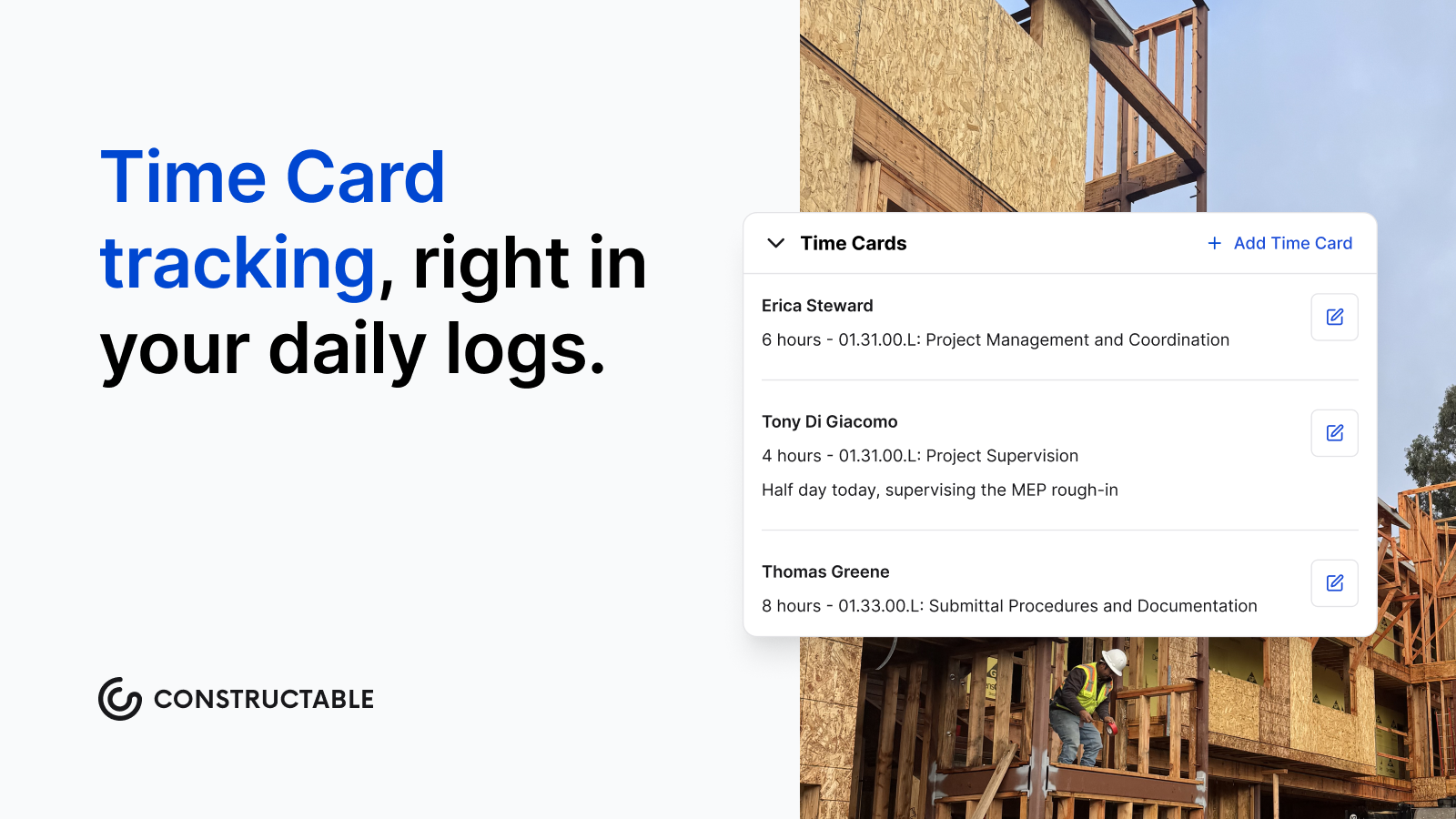
Best Practices for Managing Time and Materials Projects
Three habits separate T&M jobs that run clean from ones that end in billing fights: log daily, communicate early, and never let surprises land on the owner's desk with an invoice. Strong T&M contract management comes down to documentation discipline and transparent communication with owners.
-
Log hours every day, not at the end of the week
-
Keep material receipts organized as you go, not at billing time
-
Flag scope additions before the work starts, not after
-
Send owners a running cost update with each invoice so nothing shocks them
If the job is trending toward the NTE ceiling, tell the owner before you hit it.
Documentation and Tracking Requirements for T&M Contracts
T&M billing is only as good as your records. You need signed daily time sheets for each worker showing hours and tasks completed; material invoices and receipts tied to specific dates and scopes; written change authorizations before the scope expands; and weekly progress notes explaining what was done and why. No documentation means no defense when a client questions an invoice.
Common Pitfalls and How to Avoid Them in T&M Contracts
Four mistakes show up on T&M jobs more than any others. Skipping a not-to-exceed clause leaves the owner with no cost ceiling and the contractor exposed to disputes. Logging time weekly instead of daily means memory doesn't hold up when an invoice gets questioned, and unbillable hours disappear fast. Adding scope verbally without written sign-off quickly becomes a he-said-she-said problem. And leaving material markups undefined up front causes invoice disputes at closeout. Fix these before the job starts.
How Project Management Software Supports T&M Contract Execution
T&M documentation requirements are real. The more disconnected your tools, the harder it gets to defend every invoice.
When RFIs, change orders, daily logs, and photos live in separate systems, hours get logged late, receipts go missing, and change authorizations sit in someone's inbox. By billing time, reconstructing what happened becomes a job in itself.
Connected management software closes those gaps as the job runs; not after it.
Managing T&M Projects With Constructable
Running T&M work means your documentation has to keep pace with the job. When it falls behind, billing disputes follow.
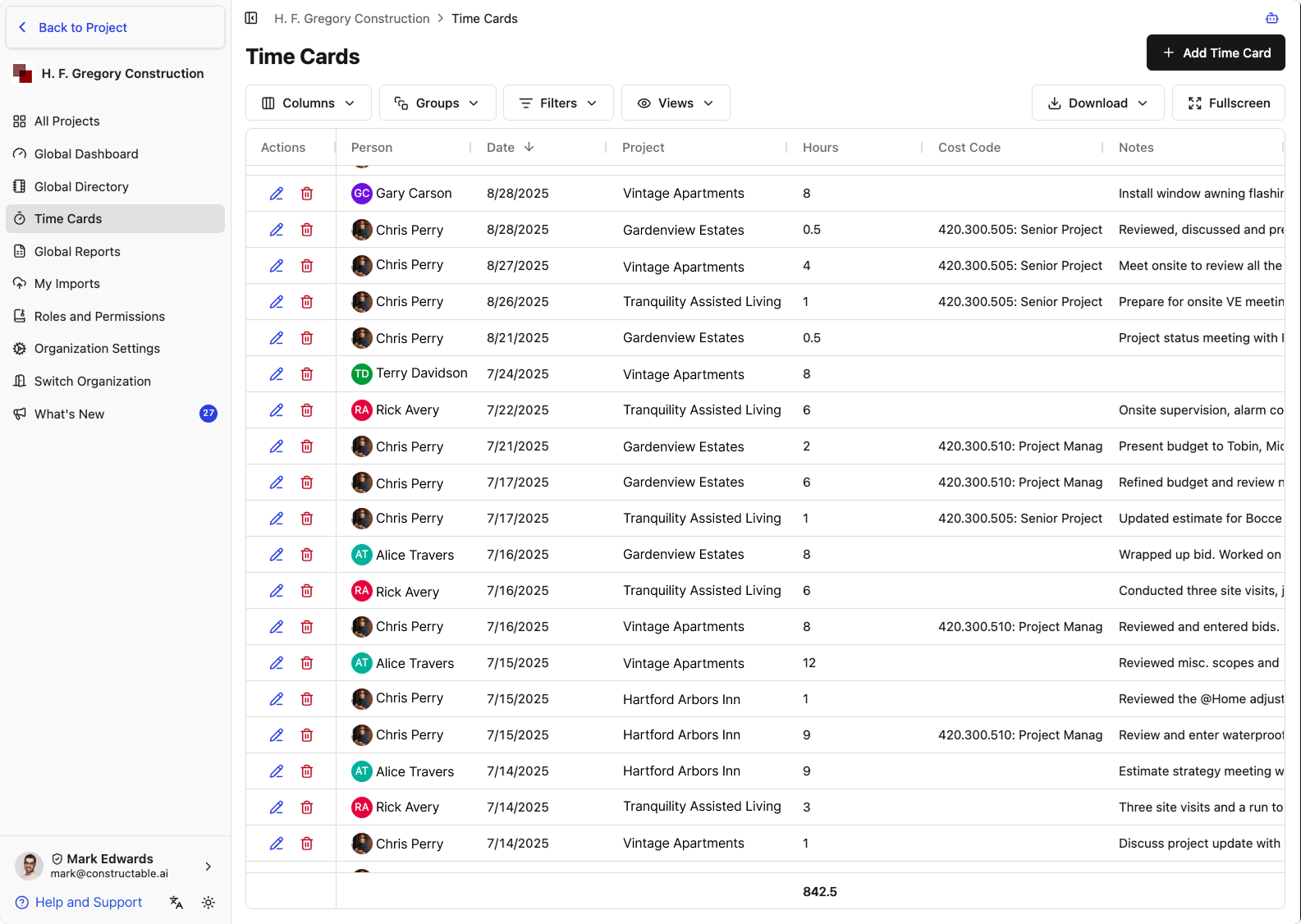
Constructable keeps records up to date as work progresses, so there's nothing to reconstruct at invoice time. Project-level and Organization-level reports show you the full breakdown of all hours worked:
FAQ
Time and materials contract vs fixed price: which should I use?
Use fixed price when scope is locked and fully defined before work starts. Choose T&M when scope is unclear, involves hidden conditions, or needs to start before design is complete; it protects both sides when real uncertainty exists upfront.
Can I use a time and materials agreement without a not-to-exceed clause?
You can, but you shouldn't. Without an NTE ceiling, owners face unlimited cost exposure and contractors face billing disputes - no matter how clean the work is. The NTE protects both sides by setting a hard stop before costs spiral out of control.
What's the biggest mistake contractors make on T&M projects?
Logging hours at the end of the week instead of daily. Memory doesn't hold up when an invoice gets questioned, and unbillable hours disappear fast. Daily time sheets signed by each worker are the only defensible record.
Time and materials vs cost-plus: what's the actual difference?
T&M bakes overhead into hourly rates upfront—owners see a rate and receipts. Cost-plus itemizes every indirect cost separately, so owners see every line of overhead. Cost-plus works for longer projects where detailed tracking is worth the paperwork; T&M works better for shorter scopes where clean hourly billing beats the admin burden.
How do I avoid billing disputes on time and materials contracts?
Four habits stop disputes before they start: log hours daily, keep material receipts organized as work happens, get written sign-off before scope expands, and tell the owner when costs trend toward the NTE ceiling before it shows up on an invoice.